
Lightstone Value Plus REIT IV: Managing Leverage in a Development-Focused Unlisted Portfolio
Lightstone Value Plus REIT IV, Inc. blends development-oriented real estate investments with a concentrated New York City asset base, external management, and high leverage—while remaining unlisted and reporting persistent net losses.
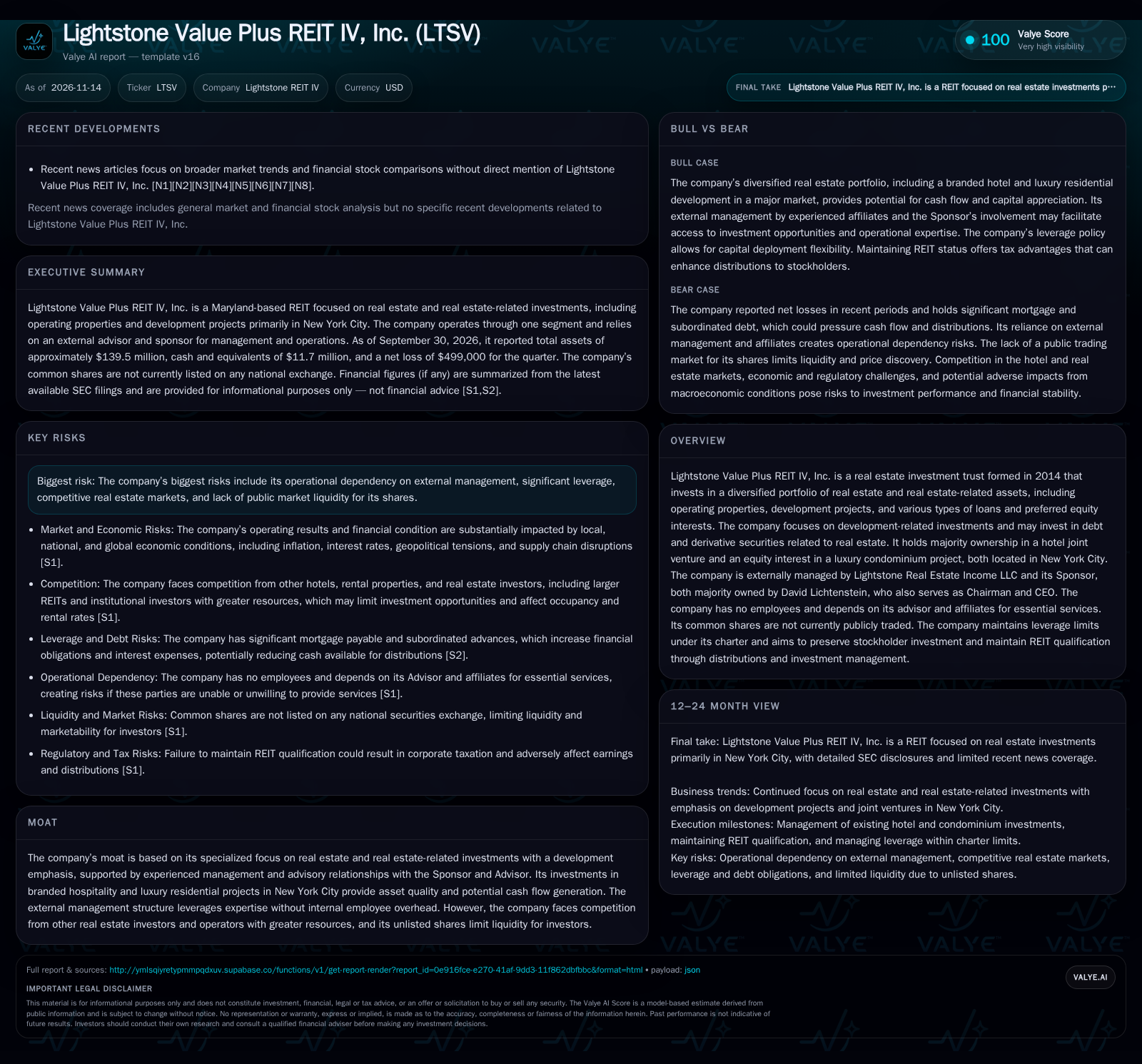
Lightstone Value Plus REIT IV, Inc. owns a Marriott-branded Brooklyn hotel and a minority stake in a Manhattan luxury condo project, with a focus on development-related real estate investments. As of September 2026, it reported $139.5 million in assets, $11.7 million in cash, and ongoing net losses, while operating under significant debt and an unlisted share structure. The company's future hinges on asset performance, debt management, and its ability to sustain distributions amid a lack of public liquidity and external management reliance [S1] [S2].
Lightstone Value Plus REIT IV, Inc. represents a development-focused, externally managed real estate investment trust with concentrated exposure to New York City hospitality and residential markets. As of September 2026, it holds a majority stake in a Marriott-branded Brooklyn hotel and a minority interest in a Manhattan luxury condominium project, while reporting reported cash balance and continued net losses. [S1] [S2]
Recent Developments Shaping Asset Profile, Losses, and Leverage Outlook
As of September 30, 2026, Lightstone Value Plus REIT IV, Inc. reported total assets of $139.5 million and cash and equivalents of $11.7 million [S2]. The company’s portfolio is anchored by a majority-owned 216-room Marriott-branded hotel in Brooklyn, opened in 2023, and an unconsolidated 33.3% stake in a Manhattan luxury condominium project, with most units sold as of the end of 2025 [S1]. Despite these investments, the REIT posted a net loss of $499,000 for the third quarter and $3.1 million for the first nine months of 2026, with negative earnings per share [S2]. The company operates with $94.4 million in mortgage debt and an additional $14.5 million in subordinated advances from related parties, reflecting a highly leveraged capital structure [S2]. Shares remain unlisted, and there is no public trading market [S1]. The company reported cash and liquidity metrics for the period; these figures do not by themselves establish operating runway, investment capacity, financial flexibility, or financing capacity.
Impact of Development-Heavy Investments on Cash Flow and Capital Requirements
Lightstone REIT IV’s economics are fundamentally shaped by the capital intensity and timing uncertainty of development-focused real estate investments. The Brooklyn Marriott hotel and the Manhattan luxury condo stake represent assets that typically require substantial upfront capital, long lead times, and may not generate immediate, stable cash flows. The potential for value creation comes from successful development, lease-up, and ultimately, asset sales or strong operational cash flow—but these outcomes are inherently uncertain and can be lumpy.
The REIT’s leverage policy allows borrowing up to 300% of net assets (about 75% of investment cost), and as of September 2026, the balance sheet reflects $94.4 million in mortgage payables and $14.5 million in related-party advances [S2]. High leverage can amplify returns in favorable markets but increases fixed interest obligations and risk of cash flow shortfalls during downturns or underperformance. Operating expenses are largely variable, tied to asset management fees paid to the external Advisor, as the company has no employees and outsources all core functions [S1].
Since shares are unlisted and there is no public market, the company is not subject to the same market-driven capital access as publicly traded REITs. This limits sources of liquidity to asset-level cash flows, refinancings, or asset sales. Maintaining REIT status requires distribution of taxable income, but ongoing net losses may constrain this ability, especially if cash flows from operating assets are insufficient.
Competitive Dynamics of External Management and Concentrated Asset Base
Lightstone REIT IV’s external management by an experienced Sponsor and Advisor provides access to real estate expertise and deal sourcing, but also introduces operational dependency and potential conflicts of interest. The absence of direct employees lowers fixed overhead but means all critical functions rely on the continued engagement and alignment of the Advisor and affiliates [S1].
The firm’s asset concentration in New York City—specifically a single hotel and a minority interest in a luxury condo project—offers the potential for high-quality, high-value real estate exposure. However, this also increases vulnerability to local market cycles, regulatory shifts, and competitive dynamics from larger REITs, institutional investors, and hotel operators with broader, more diversified portfolios and lower cost structures.
Because the shares are unlisted, Lightstone REIT IV does not compete for retail or institutional capital on traditional public markets, which can limit fundraising flexibility and investor appeal. The company’s ability to deliver attractive risk-adjusted returns will depend on outperforming peers in asset selection, development execution, and capital recycling—none of which are guaranteed in the competitive New York City environment.
Value Creation Potential from Asset Sales and Debt Restructuring
A favorable outcome for Lightstone REIT IV would require successful stabilization and strong cash flow generation from the Brooklyn Marriott hotel, coupled with the realization of proceeds from remaining Manhattan condo sales. If the hotel achieves high occupancy and premium rates, it could provide a steady income stream to offset debt service and fund distributions. Additional upside could come from opportunistic refinancings at favorable terms, lowering interest costs and freeing up cash.
Confirmation of this scenario would come from reported operating profits at the hotel, evidence of substantial cash distributions from condo sales, and a material reduction in net debt or interest expense. A return to positive net income and the ability to make consistent, tax-advantaged shareholder distributions would further support the case. Conversely, continued net losses, lack of asset-level cash flow, or inability to refinance debt on reasonable terms would falsify this upside.
Challenges from Asset Maturity and Distribution Limits in a Static Market
The most plausible trajectory for Lightstone REIT IV is a slow, incremental realization of value from its current assets, with modest or no growth in net asset value. The Brooklyn hotel may stabilize at average occupancy and room rates, generating enough cash to meet most, but not all, debt obligations and management fees. Remaining condo sales may provide periodic cash inflows, but not a transformative boost to the balance sheet.
In this scenario, distributions to shareholders may be sporadic or limited, especially if net losses persist and cash flows remain tight. The company would continue to rely on the Advisor for all operations, with little change in asset mix or leverage. Confirmation would be ongoing small net losses, stable asset values, and minimal changes to leverage or distribution policy. Signs of significant asset impairment, sharply rising debt costs, or a need to sell assets at discounts would suggest a worse outcome.
Risks Posed by Debt Levels and Illiquidity to Distribution Stability
The adverse scenario for Lightstone REIT IV is one where asset cash flows fall short of covering debt service and management fees, forcing the company to curtail or suspend distributions and potentially sell assets under pressure. Weak hospitality demand, increased competition, or local economic downturns could depress hotel revenue, while sluggish luxury condo absorption might delay or reduce proceeds from the Manhattan project.
Inability to refinance maturing debt at reasonable rates, or reliance on related-party advances to bridge cash shortfalls, could further stress the balance sheet. The absence of a public market for the shares would exacerbate investor frustration and limit options for capital raising. Evidence of this scenario would include persistent or widening net losses, rising interest expense, halted distributions, distressed asset sales, or negative fair value adjustments to the asset base.
Evaluating Asset Cash Flow, Leverage, and Distribution Sustainability
Quarterly and annual net income or loss trends, with particular attention to transitions from loss to profit or vice versa.
Occupancy rates, average daily rate (ADR), and cash flow from the Brooklyn Marriott hotel, as these directly influence operating performance.
Timing, volume, and proceeds from the sale of remaining Manhattan condo units, which impact liquidity and potential for special distributions.
Changes in total and net debt, including refinancing activity and interest expense trends.
Distributions paid to shareholders, including both regular and special dividends, and the relationship to taxable income and REIT qualification requirements.
Asset valuation adjustments or impairments, particularly in response to market or asset-specific shocks.
Any changes in the external management agreement, fee structure, or Advisor alignment that could affect operational efficiency or costs.
Regulatory or tax changes that might impact REIT status, investment flexibility, or required distributions.
Disclaimer: This is research-only, informational analysis and not investment advice. It may include AI-generated interpretation and general industry context. Always verify important details using primary sources.

Comments