
Lightwave Logic: Commercialization Tipping Point for Electro-Optic Polymers in the AI Data Interconnect Race
Lightwave Logic’s proprietary electro-optic polymers target the bandwidth and power bottlenecks in next-generation data communications.
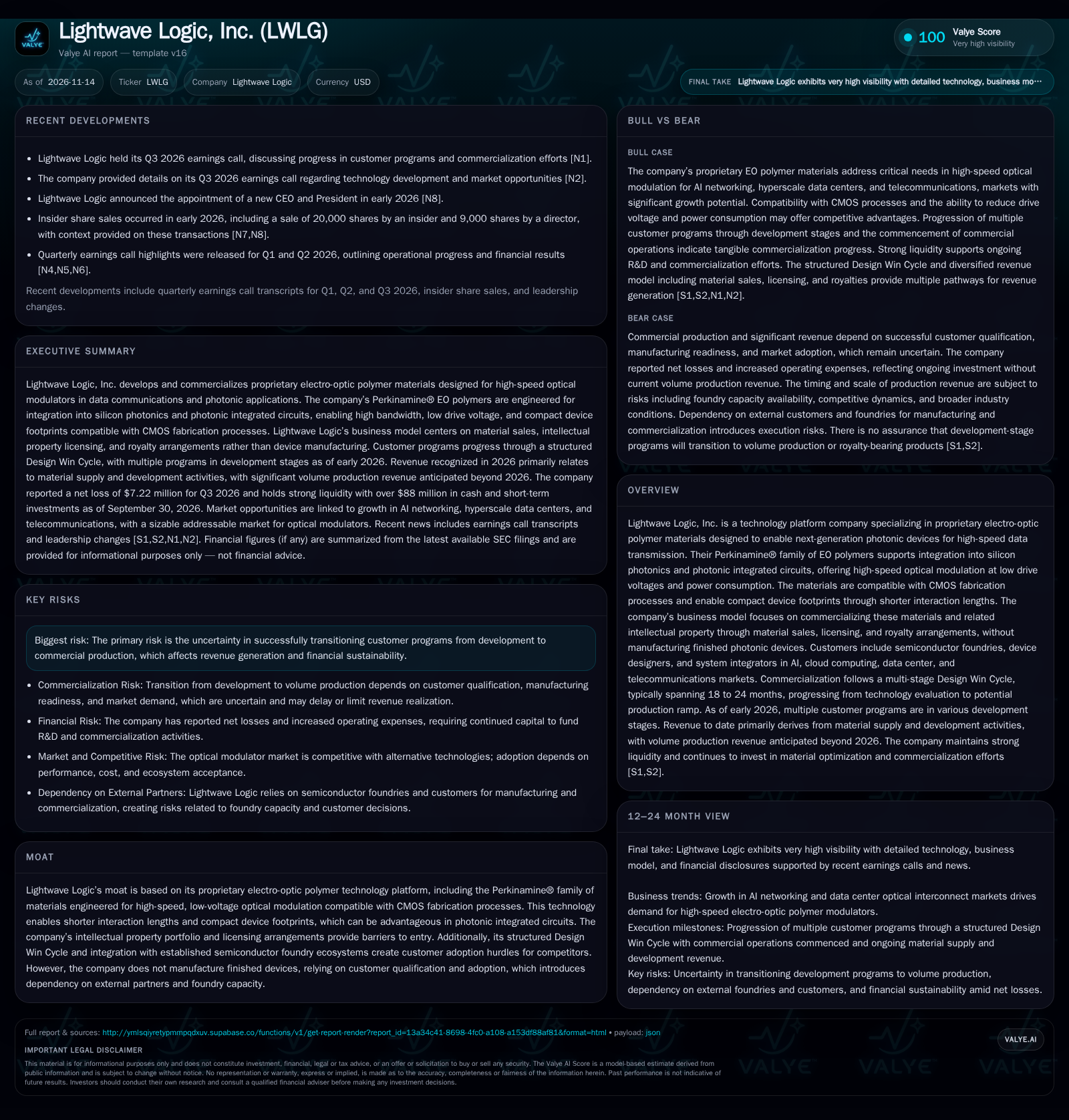
Lightwave Logic is approaching a commercialization inflection, with its EO polymer materials positioned to address high-speed, low-power optical modulation needs for AI, data center, and telecom markets. The company’s revenue model—rooted in material sales, IP licensing, and potential royalties—remains in early development, with volume production revenue anticipated beyond 2026. [S1] [S2]
Lightwave Logic stands at a pivotal juncture in the commercialization of its proprietary electro-optic polymer materials, aiming to solve critical speed and power efficiency challenges in optical modulation for AI-driven data centers and telecom infrastructure. While the company has secured initial licensing and material supply agreements, its financials reflect the reality of a pre-scale technology platform investing heavily in R&D and customer enablement. The central question is whether Lightwave Logic’s technology can cross the chasm from prototype and engineering revenue to sustainable, royalty-bearing production as hyperscale data traffic and AI networking demands intensify in the coming years [S1] [S2].
Recent Progress: Customer Pipeline Advances and Financial Position
[S2] These facts matter because they set the stage for a potential inflection—if customer programs successfully transition to production, the revenue model could shift from sporadic engineering income to more predictable, higher-margin royalty and materials sales. However, this transition is not assured, and the company’s losses underscore the importance of continued execution and customer adoption [S1] [S2].
How the Model Could Scale: Platform Economics and Leverage Potential
Lightwave Logic’s core economics rely on a technology licensing and materials platform, not on manufacturing finished photonic devices. Revenue streams include (a) sales of proprietary Perkinamine® EO polymers, (b) IP licensing fees, and (c) potential royalties or production-based fees tied to customer sales [S1] [S2]. This structure offers high potential operating leverage: once a customer qualifies and integrates the material into a commercial product, incremental revenue from royalties or material sales can scale rapidly with little increase in fixed costs. Because the company does not operate capital-intensive fabs or device lines, capital requirements are focused on R&D, customer enablement, and IP protection rather than manufacturing scale-up. However, the downside is that Lightwave Logic’s top-line growth is directly dependent on customers’ success in commercializing and ramping production of their own photonic devices.
Pricing power is theoretically supported by the differentiation of EO polymers—enabling high-speed, low-voltage modulation and compact device footprints, which are valuable for AI and hyperscale data center applications. However, actual realized pricing and royalty rates will depend on competitive alternatives, customer negotiation leverage, and the pace of ecosystem adoption. The company’s long Design Win Cycle (18–24 months) means that revenue recognition lags technology adoption, but also that customer stickiness may be high if the polymer is deeply integrated into device architectures. The challenge is that, absent volume production, the current revenue mix is weighted toward lower-margin, non-recurring engineering and prototype supply, limiting near-term profitability [S1] [S2].
Technology Edge Versus Ecosystem Inertia: The Battle for Photonic Modulation
Lightwave Logic’s main competitive advantage lies in its proprietary EO polymer chemistry, which enables high bandwidth, low drive voltage, and compatibility with standard CMOS fabrication. This could offer a disruptive alternative to incumbent modulation technologies such as lithium niobate, indium phosphide, and silicon-based modulators. The company’s polymers allow for shorter interaction lengths, supporting higher integration density and potentially lower power consumption—an increasingly critical requirement as AI networking and cloud data traffic surge.
However, the competitive landscape is formidable. Large semiconductor companies and photonics incumbents have entrenched relationships, established device platforms, and proven supply chains. Many customers are risk-averse, with high switching costs and a preference for established materials and process flows. Competing solutions—from advanced silicon photonics to emergent materials—are also targeting the same high-speed, low-power data interconnect market. Lightwave Logic’s dependence on customer and foundry adoption, rather than direct control of device manufacturing or end-market channels, is a double-edged sword: it allows for scalable, asset-light growth if adoption occurs, but also exposes the company to the risk of being bypassed if customers opt for alternative technologies or in-house solutions [S1] [S2].
If Customer Programs Convert: Royalty Flywheel and Platform Licensing
In a favorable scenario, several of Lightwave Logic’s customer programs advance from prototype to full commercial production over the next 12–24 months. As these customers ramp volume, Lightwave Logic begins to recognize not only higher-margin material sales but also recurring royalties and licensing fees tied to the production of photonic devices using its EO polymers. This shift could drive a step-change in revenue and gross margin, as the company’s operating costs are largely fixed and incremental revenue from each qualified customer is highly accretive.
What would confirm this scenario? Clear evidence would include: (a) announcements of multi-year royalty-bearing contracts or confirmed volume orders, (b) customer disclosures of production ramps using Perkinamine® materials, (c) a visible transition in revenue mix from engineering/prototype to commercial sales, and (d) public references to Lightwave Logic-enabled products in end markets. Falsification would be signaled by continued stagnation in revenue, a lack of customer conversions, or customer attrition in late-stage development [S1] [S2].
Incremental Progress: Gradual Customer Qualification and Extended Ramp
The most plausible baseline is that Lightwave Logic continues to advance customer programs through its Design Win Cycle, with some attrition but steady progress toward qualification. Revenue in 2027 begins to reflect initial commercial sales and small-scale royalties, but the transition to large-scale, multi-customer production is drawn out—limited by the pace of customer device launches, foundry readiness, and integration complexity.
Confirmation of this scenario would come via incremental growth in revenue from material sales and licensing, updates on customer milestones, and expanded joint development or PDK enablement partnerships. Falsification would be seen in persistent delays, lack of new customer signings, or evidence that alternative modulation technologies have leapfrogged EO polymers in key target markets [S1] [S2].
Failure to Transition: Stalled Adoption and Erosion of Differentiation
The adverse scenario is that customer programs fail to convert to commercial production, either due to technical integration challenges, foundry bottlenecks, or the adoption of competing solutions by key partners. In this case, Lightwave Logic’s revenue remains limited to modest engineering and development fees, with operating losses persisting as R&D and SG&A expenses outpace income.
Downside confirmation would include: (a) customer program cancellations or publicized setbacks, (b) lack of new development agreements, (c) shrinking pipeline of active customer engagements, and (d) a failure to grow revenue meaningfully beyond prototype and NRE activities. Competitive advances by alternative modulator technologies or a structural shift away from EO polymers in the photonics value chain would further erode the company’s long-term prospects [S1] [S2].
Milestones That Will Validate or Challenge the Commercialization Thesis
The number and stage of customer programs advancing from prototype to confirmed commercial production—updates here would provide leading indicators of revenue inflection.
Mix and magnitude of recognized revenue by category (material sales, licensing, royalties)—a shift toward recurring, production-based revenue would validate the platform model.
Announcements of multi-year, royalty-bearing agreements or volume supply contracts with leading photonics or semiconductor customers.
Evidence of customer device launches or public disclosures referencing Perkinamine®-enabled products in AI, data center, or telecom markets.
Trends in R&D and SG&A spend relative to revenue growth—a narrowing loss or positive operating leverage would indicate scalability.
If disclosed, customer retention, pipeline attrition rates, or feedback on integration challenges—these would help assess adoption risk and technology stickiness.
Competitive activity, especially adoption of alternative modulation materials or architectures by major ecosystem players.
Updates on foundry partnerships, PDK enablement, or ecosystem integration that would lower barriers for new customers.
Disclaimer: This is research-only, informational analysis and not investment advice. It may include AI-generated interpretation and general industry context. Always verify important details using primary sources.

Comments