
Franklin Crypto Trust: Index ETF Structure, Market Flows, and the Mechanics of Diversified Digital Asset Exposure
Franklin Crypto Trust’s EZPZ ETF offers regulated, passive exposure to a basket of major digital assets, with recent inflows spotlighting its role as an institutional gateway. The fund’s structure, operational dependencies, and responsiveness to both crypto market cycles and evolving index composition shape its economic and risk profile.
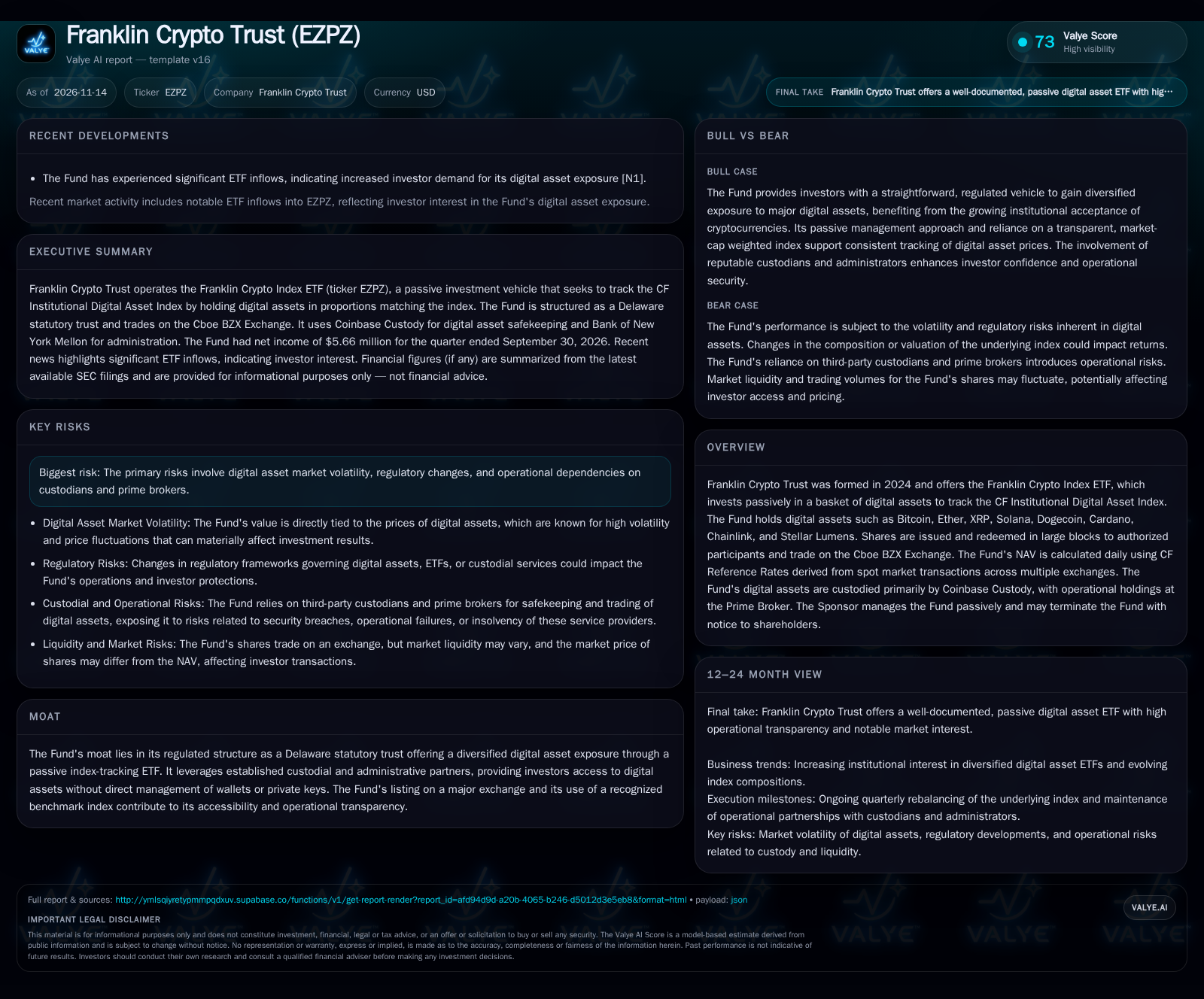
Franklin Crypto Trust’s EZPZ ETF tracks a diversified digital asset index, providing investors with regulated, passive exposure to top cryptocurrencies. The use of established custodians and passive management supports operational transparency, while the ability to maintain inflows and track the index efficiently will be critical to long-term viability. [S1] [S2] [N1]
Franklin Crypto Trust’s EZPZ ETF has emerged as a prominent passive vehicle for diversified digital asset exposure, offering investors a regulated entry point into a basket of leading cryptocurrencies. By tracking the CF Institutional Digital Asset Index, EZPZ captures the performance of assets like Bitcoin, Ether, and Solana without requiring investors to manage wallets or private keys. Recent quarters have seen notable inflows and positive net income, reflecting rising institutional and retail interest. Yet, the fund’s fortunes remain closely tied to crypto market cycles, index rebalancing, and the evolving regulatory landscape.
Recent Inflows and Index Exposure Define EZPZ’s Market Position
Franklin Crypto Trust’s EZPZ ETF passively tracks the CF Institutional Digital Asset Index, investing in assets including Bitcoin, Ether, XRP, Solana, Dogecoin, Cardano, Chainlink, and Stellar Lumens in specified weights [S1]. The ETF reported net income of $5.66 million for the quarter ending September 30, 2026 [S2], a period marked by significant ETF inflows as reported in recent news [N1]. These inflows are material, as they signal growing investor appetite for regulated, diversified digital asset vehicles amidst ongoing crypto market volatility. The fund’s structure as a Delaware statutory trust, with daily NAV calculation using aggregated spot prices, emphasizes operational transparency and index fidelity [S1].
How EZPZ Generates Value: Fee Structure, Index Tracking, and Scale Dynamics
The ETF’s economics are fundamentally tied to two drivers: the net asset value (NAV) of its underlying digital assets and the fee structure charged to shareholders. As a passive fund, EZPZ likely collects a management fee (though the specific rate is not disclosed here), which constitutes its primary revenue source. This fee is typically expressed as a percentage of assets under management (AUM), meaning that rising inflows and asset appreciation both expand the fund’s recurring revenue base. Operating costs include custody (with Coinbase Custody), administration (via Bank of New York Mellon), and index licensing. Most costs are relatively fixed or scale with AUM, suggesting potential operating leverage as the fund grows.
Because EZPZ does not use leverage or derivatives and passively mirrors the index, its revenue and net income are highly sensitive to both net inflows and the performance of digital assets. The ability to track the index closely—minimizing tracking error and slippage—will affect investor confidence and, indirectly, the persistence of inflows. The fund’s capital needs are modest compared to active strategies, but it is exposed to transaction and custody costs associated with index rebalancing, especially if crypto markets are volatile or illiquid.
ETF Landscape, Differentiators, and the Challenge of Asset Substitution
EZPZ competes in a rapidly expanding market of digital asset ETFs, including single-asset funds (e.g., spot Bitcoin or Ether ETFs) and multi-asset or index-based products. Its differentiation lies in offering diversified exposure via a recognized benchmark index, reducing single-asset risk and simplifying access for investors who lack the expertise or risk appetite to manage crypto portfolios directly.
Operational partnerships with established custodians (Coinbase Custody) and administrators (Bank of New York Mellon) provide credibility and mitigate some operational risks. However, the ETF’s reliance on third-party service providers means it is not immune to platform-level risks or security incidents. Substitution risks remain high: investors can choose direct crypto ownership, competing ETFs, or even staking/yield products, depending on their risk preferences and regulatory comfort. The ETF’s value proposition is strongest for institutions and retail investors prioritizing regulatory clarity, daily liquidity, and operational simplicity.
Institutional Adoption and Index Expansion Drive Sustained Growth
A favorable scenario would see continued institutional adoption of digital asset ETFs, with EZPZ benefiting from persistent inflows as investors seek diversified, regulated exposure to the crypto asset class. If the underlying digital assets experience strong price appreciation and/or the index broadens to include additional high-performing tokens, EZPZ’s AUM and fee-derived revenue could grow significantly. Confirmation would come from sustained high net inflows, expansion in daily trading volumes, and narrowing bid-ask spreads, all indicating robust secondary market liquidity.
Further upside could materialize if regulatory clarity improves, reducing perceived risk and attracting more risk-averse investors. If the fund maintains close index tracking and operational continuity with its custodians and administrators, it may become a preferred vehicle for both institutions and sophisticated retail participants. Evidence falsifying this scenario would include sustained outflows, persistent tracking error, or a major operational incident undermining trust in the ETF structure.
EZPZ’s Trajectory Mirrors Crypto Market Cycles and Index Rebalancing
The most plausible outcome is that EZPZ’s performance and fund flows largely track the cyclical trends of the broader digital asset market and the periodic rebalancing of its underlying index. As the ETF is passive, its NAV and revenue will fluctuate with crypto price cycles, while inflows and outflows will be influenced by both market sentiment and the relative attractiveness of competing products.
If the fund reliably tracks its index, maintains cost discipline, and avoids operational disruptions, it should retain a core investor base seeking diversified crypto exposure with regulatory oversight. Confirmation would be stable or modestly growing AUM, consistent quarterly net income, and operational continuity. Disconfirming evidence would include a significant breakdown in index tracking, a material custody incident, or regulatory developments curtailing ETF operations.
Regulatory Shocks or Custody Failures Trigger Asset Flight
A negative scenario for EZPZ would involve a major regulatory intervention—such as new restrictions on digital asset ETFs, changes in index eligibility, or adverse tax treatment—that triggers investor outflows and depresses AUM. Alternatively, a high-profile failure or security breach at a key service provider (e.g., Coinbase Custody or the fund’s administrator) could rapidly undermine confidence, leading to widening discounts to NAV and impaired liquidity.
Other downside risks include an extended downturn in digital asset prices, which would shrink AUM and fee revenue, and the potential for tracking error if illiquidity or operational constraints impede effective index replication. Confirmation would be sharp, sustained outflows, a spike in tracking error, or material operational disclosures. Falsification would be rapid restoration of inflows and operational continuity after a shock.
Thesis-Testing Developments for Franklin Crypto Trust’s ETF Structure
Monthly and quarterly net inflows/outflows: Persistent net inflows would support the upside scenario, while outflows would flag competitive or structural challenges.
Tracking error between the ETF’s NAV and the underlying index: A useful metric would be the fund’s published tracking error, if disclosed, to evaluate operational effectiveness.
Changes in index composition or methodology: Index rebalancing events, additions, or removals of digital assets could materially affect risk, return, and investor perception.
Operational continuity and disclosures from Coinbase Custody and Bank of New York Mellon: Any disruptions or publicized incidents would test the resilience of the fund’s operational model.
Trading volume and bid-ask spreads for EZPZ shares on the Cboe BZX Exchange: High volumes and narrow spreads would confirm market liquidity and investor engagement.
Regulatory developments impacting digital asset ETFs in the U.S.: New SEC guidance, proposed rules, or enforcement actions could rapidly alter the fund’s addressable market.
Quarterly net income and AUM trends: Sustained profitability and AUM growth would support the case for operating leverage and business sustainability.
Public statements or actions by the Sponsor regarding potential fund termination or material changes to the trust structure: Early warning for structural or strategic shifts.
Disclaimer: This is research-only, informational analysis and not investment advice. It may include AI-generated interpretation and general industry context. Always verify important details using primary sources.

Comments