
Franklin Ethereum Trust: Regulated Ether Exposure Meets ETF Simplicity and Market Volatility
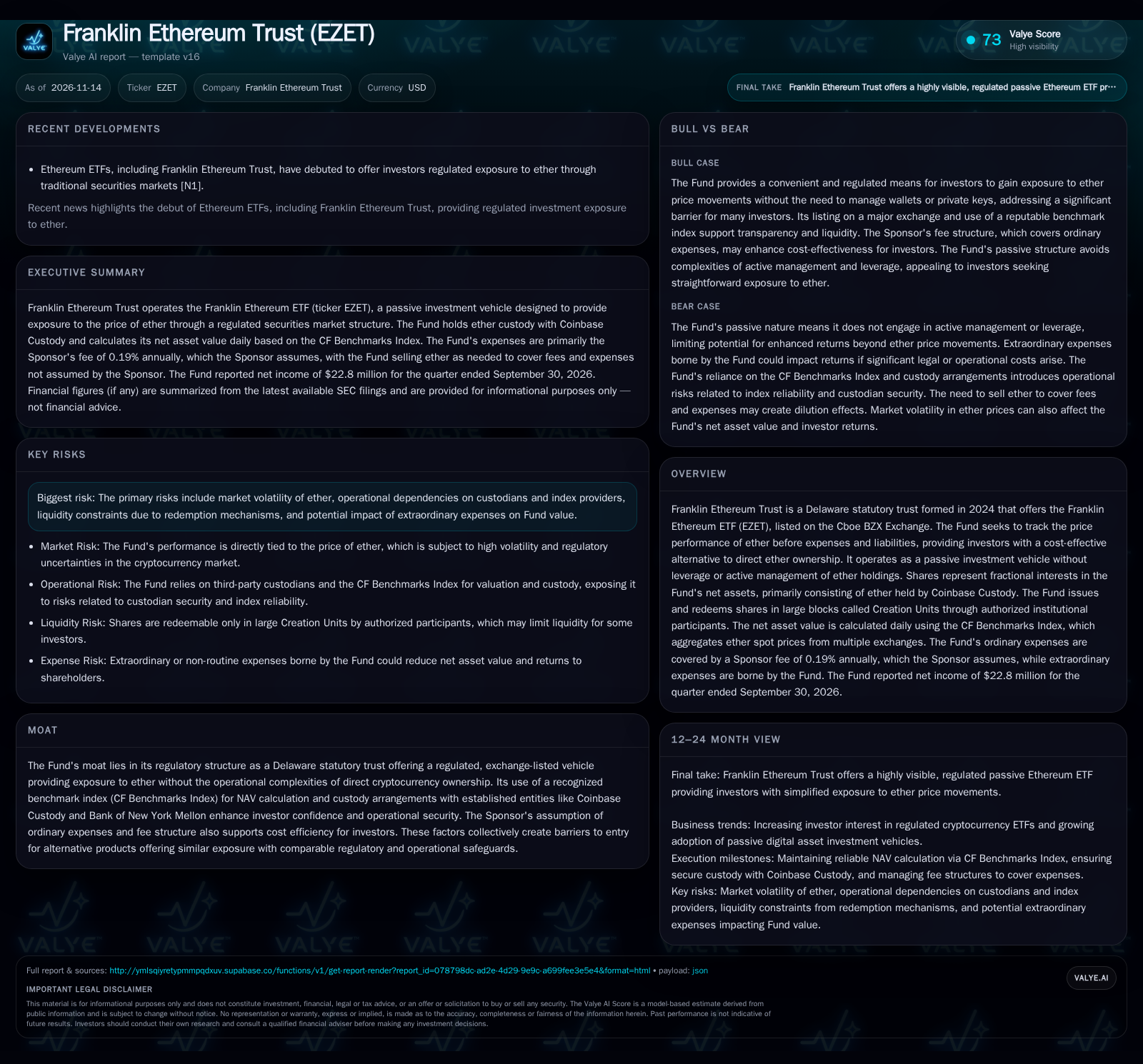
Franklin Ethereum Trust’s Ethereum ETF (EZET) offers investors regulated, cost-efficient access to ether price movements—sidestepping the operational hurdles of direct crypto ownership. With a 0.19% sponsor fee and daily NAV calculation via a multi-exchange benchmark, the fund’s structure is designed for transparency and operational security, but faces direct exposure to ether price swings, operational dependencies, and the evolving competitive ETF landscape.
Franklin Ethereum Trust’s ETF (EZET) delivers passive, regulated exposure to ether, with a low expense ratio and institutional-grade custody. While its simplicity and transparency attract mainstream investors, returns are tightly coupled to ether’s volatility, and the fund’s structure exposes it to operational and index-provider risks.
Franklin Ethereum Trust’s Ethereum ETF (EZET) represents a new breed of regulated, passive digital asset vehicles, aiming to bridge the gap between crypto-native assets and traditional capital markets. By offering exposure to ether through a familiar ETF wrapper—with institutional custody, daily net asset value calculation, and a sponsor fee of just 0.19%—EZET removes many frictions associated with direct ether ownership. Yet, this simplicity comes with a direct tether to ether’s price volatility, the operational robustness of third-party partners, and a competitive ETF landscape that could compress fees and challenge differentiation.
Recent Launch, Passive Structure, and Q3 Results Define the Current Landscape
Franklin Ethereum Trust launched its Ethereum ETF (EZET) following regulatory approval, providing investors with a regulated, exchange-listed vehicle for ether exposure [S1] [N1]. The fund is structured as a passive investment vehicle, holding ether in custody at Coinbase Custody and tracking performance via the CF Benchmarks Index [S1]. Its annual sponsor fee is 0.19%, with the sponsor assuming all ordinary recurring expenses—a cost profile designed to appeal to fee-sensitive investors [S1]. In its first reported quarter, the fund generated $22.8 million in net income, reflecting both ether price appreciation and initial asset inflows [S2]. These developments establish EZET as a credible, cost-competitive, and operationally robust entrant in the rapidly evolving Ethereum ETF landscape.
How EZET’s Economics Work: Fee Structure, Asset Flows, and Expense Dynamics
EZET’s economics are fundamentally tied to two drivers: the market value of its ether holdings and the scale of investor assets under management (AUM). The 0.19% sponsor fee is calculated as a percentage of daily NAV, making overall fee revenue directly proportional to both ether’s price and AUM. As a passive vehicle, the fund does not seek outperformance; instead, it aims to mirror ether’s price, minus expenses. Ordinary operating costs are covered by the sponsor, which supports cost predictability for investors and may serve as a differentiator versus higher-fee or less transparent alternatives.
The fund’s expense structure is unusually lean for a crypto ETF, but extraordinary or non-routine expenses—such as legal settlements or regulatory fines—are borne by the fund itself and paid via ether sales [S1]. This creates a small, ongoing need to liquidate a portion of holdings, though the impact is likely modest unless extraordinary events occur. Redemptions and creations are limited to large institutional blocks, meaning retail investors must transact on the secondary market, where liquidity and spreads could vary depending on market demand.
EZET’s capital needs are minimal after launch, since it does not actively trade, use leverage, or require ongoing capital expenditures. Its main operational leverage comes from scale: as AUM grows, fixed compliance and administration costs become less significant, and fee revenue increases with ether appreciation and inflows. However, the flip side is that a decline in ether prices or investor outflows would reduce both NAV and fee income, with minimal ability to offset via active management.
ETF Structure as Moat—But Fee Compression and Product Substitution Loom
EZET’s competitive position is anchored in its regulatory status, cost efficiency, and operational partnerships. As a Delaware statutory trust with exchange listing, the fund offers investors compliance and transparency not available in purely offshore or unregulated vehicles. Custody partnerships with Coinbase and the use of CF Benchmarks for NAV calculation add institutional credibility and risk management.
However, the competitive landscape is intensifying. Multiple Ethereum ETFs have launched in parallel, often with similar structures and even lower fees. The ETF’s only lever is cost and operational trust—there is no active management, yield enhancement, or proprietary technology to differentiate. Over time, fee compression is likely as scale increases and sponsors compete for AUM. Substitute products—including futures-based ETFs, structured notes, or staking-enabled vehicles—could attract different investor segments or offer higher returns, especially if regulatory clarity emerges around staking or yield generation within ETF wrappers.
Switching frictions are modest: investors can sell ETF shares and move capital to a competitor with little operational friction. The main barriers are trust in custody, NAV calculation, and sponsor reputation. If a competitor demonstrates superior reliability, lower fees, or added features (such as staking rewards), EZET could face AUM outflows.
Mainstream Adoption and Ether Price Appreciation Drive AUM and Fee Revenue
In a favorable scenario, institutional and retail adoption of regulated Ethereum ETFs accelerates, as investors seek diversified crypto exposure without the complexity of wallets or private keys. If ether’s price rises materially and inflows continue, EZET’s AUM and NAV would expand, boosting sponsor fee revenue and increasing secondary market liquidity. The 0.19% fee structure would become even more compelling as scale reduces the effective cost per investor, potentially attracting large allocators.
Confirmation of this scenario would come from rapid AUM growth, increased trading volume on the Cboe BZX Exchange, and positive net inflows relative to competitors. Additional tailwinds could include regulatory approvals for IRA or pension account eligibility, or the introduction of staking rewards (if permitted), which would further enhance returns and differentiation.
Falsification would occur if AUM stagnates, trading volume remains thin, or if new entrants with lower fees or innovative features rapidly gain market share at EZET’s expense.
Fee Compression and Margin Pressure in a Crowded Ethereum ETF Market
The most plausible trajectory is a competitive, low-margin landscape where multiple Ethereum ETFs coexist and compete primarily on fees, liquidity, and operational trust. EZET maintains modest AUM growth and retains a segment of the investor base seeking regulatory clarity and simplicity, but faces ongoing fee compression as rivals undercut on price or add incremental features.
Under this scenario, EZET’s net income remains closely tied to ether’s price and AUM dynamics, with limited levers for differentiation beyond sponsor reputation and operational reliability. Ordinary expenses remain contained, but the risk of extraordinary costs—such as legal or regulatory actions—remains a background concern. Custody and index provider stability are assumed, but a major operational incident could quickly erode trust and trigger outflows.
Evidence supporting this scenario would include steady AUM with moderate inflows/outflows, fee reductions across the peer set, and a lack of product innovation or notable operational failures. Falsification would require either a major operational shock (custody or index event) or a breakthrough innovation (such as ETF-enabled staking) that significantly changes the product landscape.
Custody or Index Disruption, Regulatory Shocks, and Ether Price Collapse
Adverse outcomes could stem from several sources: a major hack or operational failure at Coinbase Custody, a disruption in the CF Benchmarks index methodology, or a sharp regulatory crackdown on crypto ETFs. Any of these could cause the fund to suspend creations/redemptions, misprice NAV, or lose investor confidence, triggering rapid AUM outflows and secondary market discounts to NAV.
A material drop in ether’s price would directly reduce NAV, fee revenue, and potentially trigger retail panic selling—compounding liquidity stress. Extraordinary expenses, such as litigation or regulatory penalties, would force additional ether sales, further diluting investor returns. In the extreme, trust in the ETF wrapper could erode, pushing investors back to direct ownership or alternative vehicles.
Confirmation of this scenario would include a custody or index failure, regulatory actions halting new ETF issuance, or persistent trading at a discount to NAV. Falsification would require continued operational stability, regulatory clarity, and no major market dislocations.
What Will Clarify EZET’s Edge in an Evolving Ethereum ETF Market?
AUM growth rate relative to other Ethereum ETFs, as a proxy for competitive positioning and investor trust—if disclosed.
Daily or weekly trading volumes on the Cboe BZX Exchange, indicating secondary market liquidity and investor engagement—if disclosed.
Tracking error between EZET’s NAV and the CF Benchmarks Index, which would highlight operational robustness or problems in NAV calculation.
Incidence of extraordinary expenses or material ether sales for non-routine costs, as these would erode net asset value and investor returns—if disclosed.
Fee changes by the sponsor or rival ETFs, which could trigger further margin compression or alter EZET’s cost advantage.
Any regulatory developments around staking, yield, or ETF eligibility for tax-advantaged accounts, which could reshape product features and investor demand.
Operational disclosures from Coinbase Custody or CF Benchmarks regarding security, outages, or methodology changes, as these directly affect trust and product reliability.
Disclaimer: This is research-only, informational analysis and not investment advice. It may include AI-generated interpretation and general industry context. Always verify important details using primary sources.

Comments