
VanEck Solana ETF: Passive SOL Exposure Meets Volatility, Regulatory Flux, and Product Competition
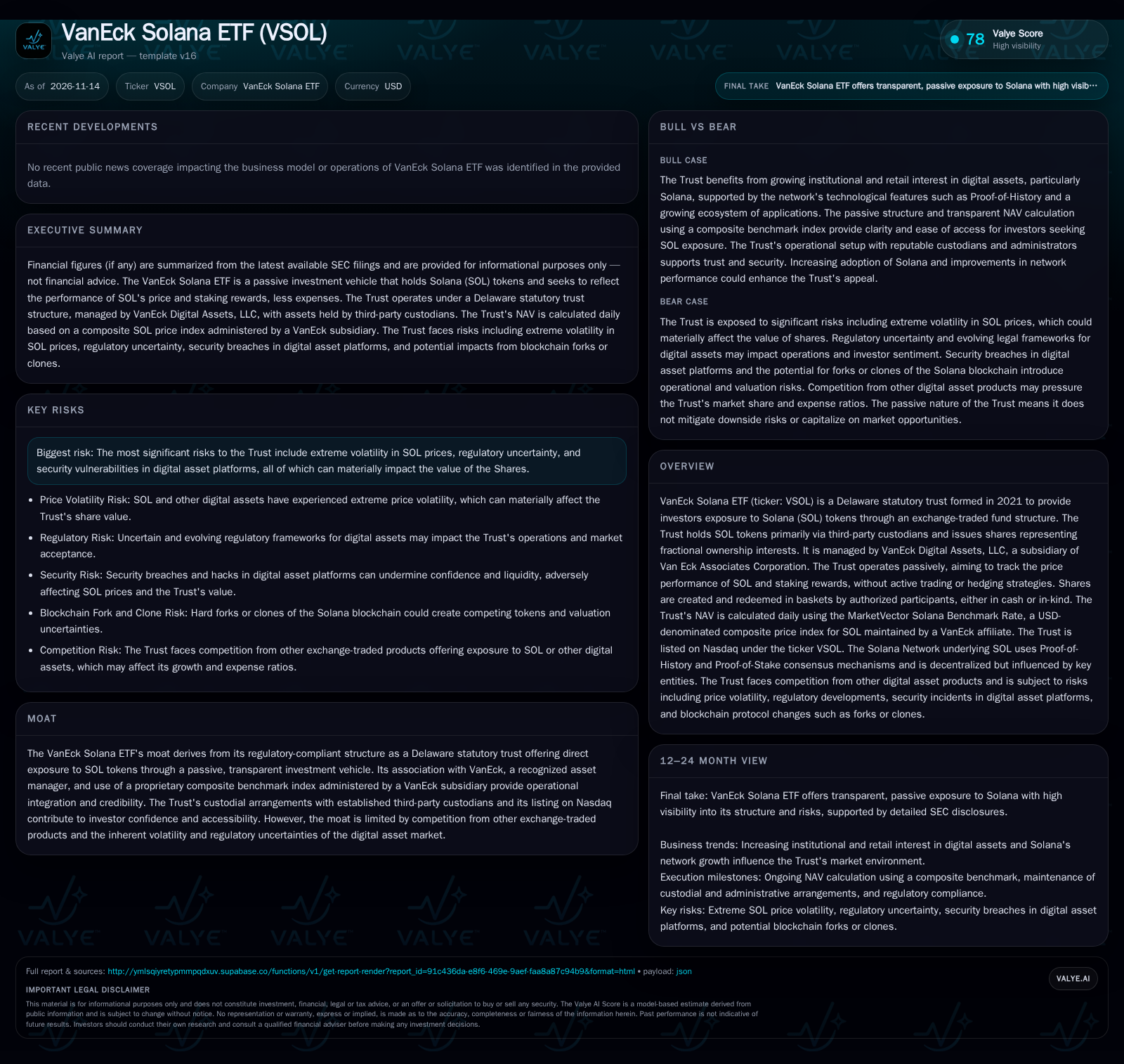
The VanEck Solana ETF (VSOL) provides transparent, passive exposure to Solana (SOL) through a Delaware trust, with NAV tied to a proprietary benchmark and assets held by third-party custodians. While institutional-grade structure and transparent administration underpin investor confidence, the ETF’s economics are ultimately dictated by SOL price, staking rewards, and structural expense drag—leaving it vulnerable to digital asset volatility, regulatory shifts, and the evolving landscape of crypto investment products.
VSOL is a Nasdaq-listed ETF offering direct, passive exposure to Solana (SOL), with assets custodied at Gemini and Coinbase, and NAV based on a VanEck-administered composite index. The Trust’s $23.5 million NAV and $9.36 million quarterly net income highlight its scale and recent profitability, but its value is fundamentally tethered to SOL price performance and staking dynamics. Key risks include extreme volatility, regulatory uncertainty, and product substitution by rival digital-asset ETFs.
The VanEck Solana ETF (VSOL) stands as a specialized, regulated vehicle for investors seeking direct exposure to the price and staking rewards of Solana (SOL) without direct token custody or private key risk. With $23.5 million in NAV and a recent quarter of robust net income, VSOL demonstrates the mechanics and scale of institutional crypto access products. Yet the ETF’s fortunes are inextricably linked to the volatile, evolving world of digital assets—where regulatory changes, product competition, and blockchain-level events can rapidly reshape both demand and risk.
Recent Scale, Profitability, and Operational Structure Define VSOL’s Position
The VanEck Solana ETF reported a NAV of approximately $23.5 million as of December 31, 2025, with 1,450,000 shares outstanding, providing a concrete measure of its asset scale [S1]. For the quarter ended September 30, 2026, the Trust posted net income of $9,360,328, a figure reflecting the combination of SOL price appreciation and staking rewards during a favorable market window [S2]. Assets are held with third-party custodians (Gemini Trust Company and Coinbase Custody Trust Company), and NAV is calculated daily using a proprietary composite index administered by a VanEck subsidiary. These facts underscore VSOL’s role as a transparent, institutional-grade vehicle for SOL exposure, but also highlight its direct dependence on the underlying asset’s performance and the security of off-exchange custodians.
Structural Economics: How Passive SOL Exposure Drives ETF Outcomes
VSOL’s economics are defined by a simple, transparent mechanism: shareholders own fractional interests in a pool of SOL, with share value tracking SOL price and staking rewards, less expenses. Revenue is not generated in the traditional sense; instead, the Trust accrues staking income (when staking is enabled and permitted) and reflects changes in SOL valuation. Operating expenses (including management fees, custody, administration, and insurance) are deducted from the Trust’s assets, producing a structural expense drag. Higher SOL prices and robust staking yields can offset this drag, but in periods of price decline or muted yields, the ETF’s NAV may erode even before expenses.
The Trust’s passive structure means there is no tactical trading, hedging, or use of leverage to mitigate downside or amplify returns. Share creation and redemption occur in large baskets via authorized participants, with arbitrage mechanisms keeping share prices close to NAV. This structure offers operational simplicity and scale benefits, but leaves the Trust’s economics highly sensitive to the price and staking dynamics of SOL itself. Fixed costs (administration, custody) may create modest operating leverage if assets scale, but the ETF does not benefit from variable margin expansion: its value is always a function of net SOL performance and product-level fees.
Product Substitution and the Battle for Crypto ETF Mindshare
VSOL operates in a rapidly growing field of digital asset investment products, competing with other SOL-focused ETFs, broader crypto index funds, and direct token custody solutions. Its core advantages—regulatory compliance, transparent NAV, institutional custodianship, and the VanEck brand—appeal to investors seeking simplicity, security, and market access without operational complexities of private wallets.
However, the ETF’s moat is inherently limited. Competing ETFs with lower fees, different staking policies, or more aggressive marketing could siphon assets. Substitution risk from self-custody, centralized exchanges, and new product formats (such as tokenized funds or actively managed crypto vehicles) remains high. In the broader context, VSOL’s prospects are tethered not just to Solana’s ecosystem growth, but also to the regulatory and competitive dynamics shaping investor preferences for digital asset exposure.
If Solana Adoption Accelerates and Regulatory Clarity Emerges
A favorable scenario for VSOL would see rapid growth in Solana’s ecosystem—driven by applications, transaction throughput, and institutional adoption—leading to sustained SOL price appreciation and higher staking yields. Regulatory developments that legitimize and clarify the status of digital asset ETFs could expand the pool of eligible investors, including RIAs, pensions, and global funds. In this world, VSOL’s assets under management (AUM) would grow, reducing expense ratios via scale and increasing net income through both price and staking reward accretion.
Confirming evidence would include persistent net share creations, rising AUM, narrowing bid-ask spreads, and market share gains versus competing SOL ETFs. Regulatory milestones (such as explicit ETF guidance from the SEC or CFTC) and continued operational security at custodians would further validate the upside trajectory.
ETF Tracks SOL Volatility Amid Regulatory and Product Flux
The most plausible scenario is that VSOL continues to function as a transparent, liquid vehicle for SOL exposure, experiencing significant NAV volatility in line with SOL’s price swings and staking reward variability. The Trust maintains its operational integrity, but faces ongoing fee competition and periodic regulatory uncertainty that limit asset growth. Expense drag persists, and AUM fluctuates as investor sentiment towards Solana and digital assets ebbs and flows.
The base case would be confirmed by stable or slightly growing AUM, moderate net share creations and redemptions, and expense ratios remaining competitive but not industry-leading. Regulatory developments remain ambiguous but non-disruptive, and no major security or operational incidents occur at custodians. VSOL’s market share among SOL-tracking products stays steady, with investor flows tracking overall crypto sentiment.
Adverse Shocks: Regulatory Clampdowns or SOL Ecosystem Disruptions
In a negative scenario, a combination of sharp SOL price declines, a major security breach at a custodian, or adverse regulatory action (such as delisting mandates or restrictive ETF rules) could trigger large-scale redemptions, NAV erosion, and potential operational stress for VSOL. A hard fork, chain halt, or loss of confidence in Solana’s core infrastructure would further exacerbate value destruction, potentially leading to tracking errors, forced asset liquidations, or NAV calculation challenges.
Falsifying this scenario would require ongoing regulatory accommodation, robust security at custodians, and continued Solana network stability. Conversely, evidence such as sudden AUM collapse, NAV discounting, wide share price deviations, or public SEC enforcement actions would support the downside thesis.
How VSOL’s Thesis Could Be Affirmed or Undermined in the Coming Quarters
Net share creations/redemptions: Persistent inflows or outflows by authorized participants would signal changing investor demand and confidence in the ETF structure.
AUM trajectory: Growth or contraction in assets under management would reflect VSOL’s relative competitiveness and market sentiment toward SOL exposure.
Expense ratio trends: Changes in the all-in expense ratio (if disclosed) would indicate pricing pressure and cost discipline versus competing ETFs.
Custodian incident reporting: Any disclosed security events or operational breaches at Gemini or Coinbase Custody would be critical to monitor for risk transmission.
SOL staking yield: If disclosed, actual staking returns achieved by the Trust would help assess economic drag versus direct token holding.
Bid-ask spreads and secondary market liquidity: Persistent deviations from NAV or poor liquidity would undermine the ETF’s value proposition.
Regulatory actions affecting digital asset ETFs: SEC or CFTC statements, rulemakings, or enforcement actions could quickly reshape the competitive and operational landscape.
Solana network incidents: Major forks, outages, or governance disruptions would have direct implications for NAV accuracy and investor confidence.
Disclaimer: This is research-only, informational analysis and not investment advice. It may include AI-generated interpretation and general industry context. Always verify important details using primary sources.

Comments