
Duolingo’s Revenue Growth Accelerates with Rising Subscription Base and AI-Driven Innovation
Strong 2025 financials reflect robust user engagement, expanded product offerings, and intensified R&D investment.
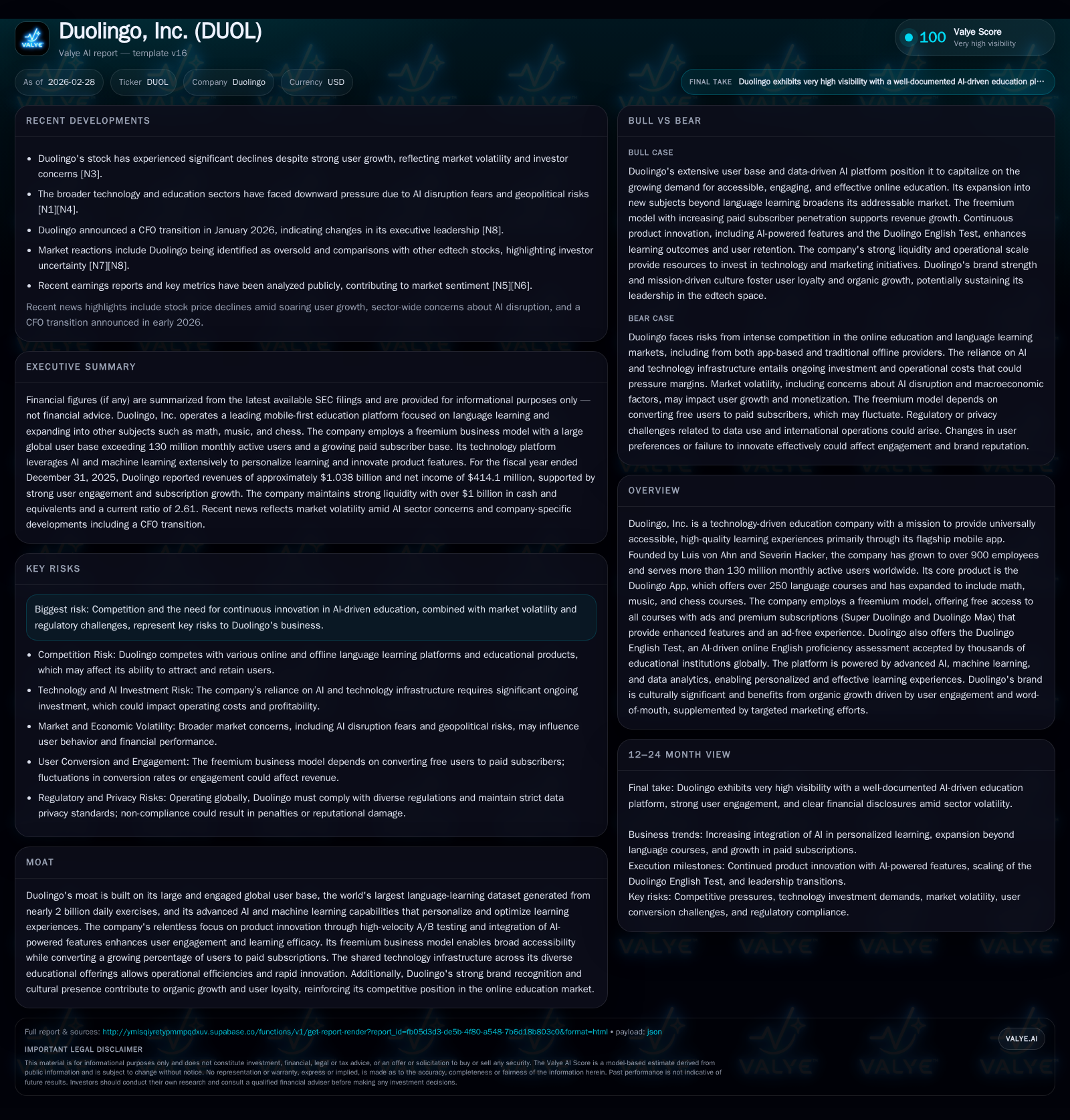
Duolingo, Inc. reported a 39% revenue increase in 2025 driven mainly by a 44% growth in subscription revenue amid an expanding paid subscriber base. The company’s freemium model continues to fuel user expansion, now at over 130 million monthly active users globally, supported by product innovation including AI-powered features and new educational offerings beyond language learning. Operating income more than doubled year over year while net income surged, helped by a one-time tax benefit. Increased investment in research and development reflects Duolingo's commitment to refining its platform and sustaining competitive advantages in the dynamic edtech market. The company maintains strong liquidity with over $1 billion in cash and equivalents and a solid current ratio of 2.61.
Historical Performance and Revenue Drivers
Duolingo demonstrated strong growth momentum through fiscal year 2025, as reflected in its latest annual results. Total revenues increased by $289.6 million or 39% year-over-year to $1.04 billion [F1]. This growth was primarily fueled by subscription revenues which climbed 44% to $873.4 million due to an increased average number of paid subscribers during the period [S4][S12]. Other revenues—including advertising sales, Duolingo English Test fees, and in-app purchases—increased by 17% to $164.1 million.
The company employs a freemium business model where free users generate engagement and data that feed personalized learning algorithms, while a growing percentage convert to paid subscriptions offering enhanced features such as Super Duolingo and Duolingo Max [S1]. As of December 31, 2025, paid subscribers accounted for approximately 9.2% of average monthly active users (MAUs), up from 8.8% in the prior year [S1]. This conversion rate is critical for sustainable revenue growth.
Operating income more than doubled year-over-year from approximately $62.6 million in 2024 to $135.6 million in 2025 (+117%) owing to revenue expansion despite rising operating expenses [F1]. Net income surged markedly to $414.1 million compared to nearly $88.6 million in 2024; however, this included a one-time tax benefit of about $257 million [F1][S16]. Excluding this tax effect still indicates meaningful underlying profit improvement. Gross margin decreased slightly from 72.8% to 72.2%, reflecting increased costs associated with advanced AI features within subscription offerings and a relative increase in lower-margin advertising revenue [S12].
Historical performance (annual)
| FY | Net ($mm) | CFO ($mm) | OpInc ($mm) | Capex ($mm) | Net YoY |
|---|---|---|---|---|---|
| 2025 | 414 | 388 | 136 | 18 | +367.5% |
| 2024 | 89 | 286 | 63 | 12 | +451.3% |
| 2023 | 16 | 154 | -13 | 3 | +127.0% |
| 2022 | -60 | 54 | -65 | 6 |
Source: SEC companyfacts cache [F1].
Capital returns and efficiency (annual)
| FY | Buybacks | FCF ($mm) | ROE% |
|---|---|---|---|
| 2025 | 370 | 30.7 | |
| 2024 | 273 | 10.7 | |
| 2023 | 0 | 150 | 2.5 |
| 2022 | 0 | 48 | -11.0 |
Source: SEC companyfacts cache [F1].
Note: No dividends were paid; no share repurchases have been recorded since at least fiscal year ended December 31, 2023.
Future Growth Prospects
Duolingo’s growth prospects are anchored in several key areas aligned with its mission and market trends [S1][S9]:
Expanding User Base: With an estimated global pool of approximately two billion potential language learners (HolonIQ), Duolingo has significant room for organic expansion leveraging mobile-first design and strong brand recognition.
Product Innovation: Investments into AI-powered functionality such as Duolingo Max's interactive Video Call lessons represent differentiation that enhances engagement and monetization potential [S8]. The company is also diversifying beyond language learning into subjects like math, music, and chess.
Monetization Levers: The freemium strategy converts free users into paying subscribers over extended periods; future pricing enhancements or feature tiers could further increase subscriber value.
Duolingo English Test: Increasing acceptance among over 6,100 education programs worldwide provides a complementary validated revenue stream [S1].
Challenges include intensifying competition from both established platforms and emerging entrants using generative AI or alternative models [S9][S14]. Regulatory uncertainties around AI content disclosure may impose compliance costs or operational constraints [S21][S22]. Intellectual property litigation risks persist that could divert resources or limit product capabilities [S6][S13]. Additionally, shifts in user engagement patterns require ongoing product adaptation.
Milestones & What to Watch
While no explicit forward guidance is provided in filings or news sources, key indicators for monitoring include:
- Growth trajectory of paid subscriber counts relative to total MAUs.
- Changes in revenue mix between subscriptions and ad-supported streams.
- Adoption rates for new educational verticals beyond language learning.
- Regulatory developments affecting AI content policies.
- Competitive advances leveraging next-generation AI learning tools.
- Outcomes of intellectual property disputes impacting technology use or branding.
Returns & Capital Allocation Analysis
Based on available data, Duolingo shows solid capital efficiency metrics [F1]:
- Approximate Return on Equity (ROE) for fiscal year 2025 stands near 30.7%, indicating effective shareholder capital utilization amid rising profitability.
- Operating cash flow nearly reached $388 million with capital expenditures increasing modestly to about $18 million reflecting continued platform investment [F1][S4].
- Free cash flow remains strong at roughly $370 million (operating cash flow minus capital expenditures), providing liquidity for reinvestment.
- Cash & equivalents exceeded $1 billion at end-2025 underscoring financial flexibility [F1].
- No dividends were issued; management has not repurchased shares since before FY2023 signaling focus on growth investments rather than capital returns.
R&D expense increased by about $71 million or +30% year-over-year highlighting intensified focus on product development and technology upgrades essential for maintaining competitive advantage [F1][S8][S16]. Sales & marketing expenses also rose substantially as Duolingo supplements organic growth with targeted paid campaigns internationally [F1][S9][S20].
Competitive Moat: Technology & Data Advantage
Duolingo’s moat is built on its extensive user base exceeding 130 million monthly active learners who complete nearly two billion exercises daily—the largest dataset globally for language learning—which fuels proprietary machine learning algorithms for personalized education pathways [S1][S9]. High-frequency A/B testing enables rapid feature iteration improving both efficacy and engagement.
The breadth of languages offered (over 250 courses), combined with expansion into adjacent educational fields like math and music using shared AI infrastructure promotes operating leverage and fast innovation cycles [S14][S18]. Brand recognition symbolized by the Duo mascot supports viral marketing reducing acquisition costs relative to peers.
Risks Summary
Key risk factors include:
- Sustaining user acquisition while preventing attrition remains critical given dependence on scale and engagement ratios; failure would materially affect revenues [S5][S10][S24].
- Intense competition characterized by low switching costs requires constant innovation especially integrating AI capabilities [S9][S14][S18].
- Regulatory frameworks targeting AI-generated content disclosure could impose costly compliance burdens slowing feature rollout or altering monetization strategies [S21].
- Intellectual property litigation risks require ongoing protection of proprietary algorithms and trademarks; adverse outcomes could disrupt operations or increase costs significantly [S13][S17][S23].
- Taxation complexities across multiple jurisdictions may cause volatility in effective tax rates impacting reported earnings unpredictably [S19].
Conclusion & Outlook Notes (Analysis)
Duolingo has solidified its leadership position in mobile-first digital language learning through robust subscriber growth supported by innovative AI features and integrated expansions into non-language educational verticals. Its freemium model effectively monetizes a vast global learner community while generating valuable usage data that strengthens its technological moat.
Financially, the company demonstrates growing operating leverage combined with disciplined capital expenditure resulting in healthy free cash flow generation alongside significant retained liquidity following strong profitability gains including a favorable one-time tax event.
Future performance will depend on navigating competitive pressures intensified by emerging AI-powered educational technologies alongside managing regulatory compliance complexities related to generative AI usage disclosures globally. Investors should closely watch subscriber conversion trends along with penetration metrics for new product lines such as Duolingo Max’s advanced features alongside sustained global uptake of the Duolingo English Test credentialing service.
This analysis presents factual discussion derived solely from disclosed public filings, regulatory documents, and recent news coverage without expressing investment advice or recommendations.
Disclaimer: This is research-only, informational analysis and not investment advice. It may include AI-generated interpretation and general industry context. Always verify important details using primary sources.

Comments