
Brinker International Q3 2026: Operating Momentum Supported by Value Platform Amid Liquidity Pressure
Brinker International’s Q3 fiscal 2026 results highlight same-store sales growth driven by value offerings and pricing, alongside liquidity constraints reflected in a low current ratio and an expanded share repurchase program.
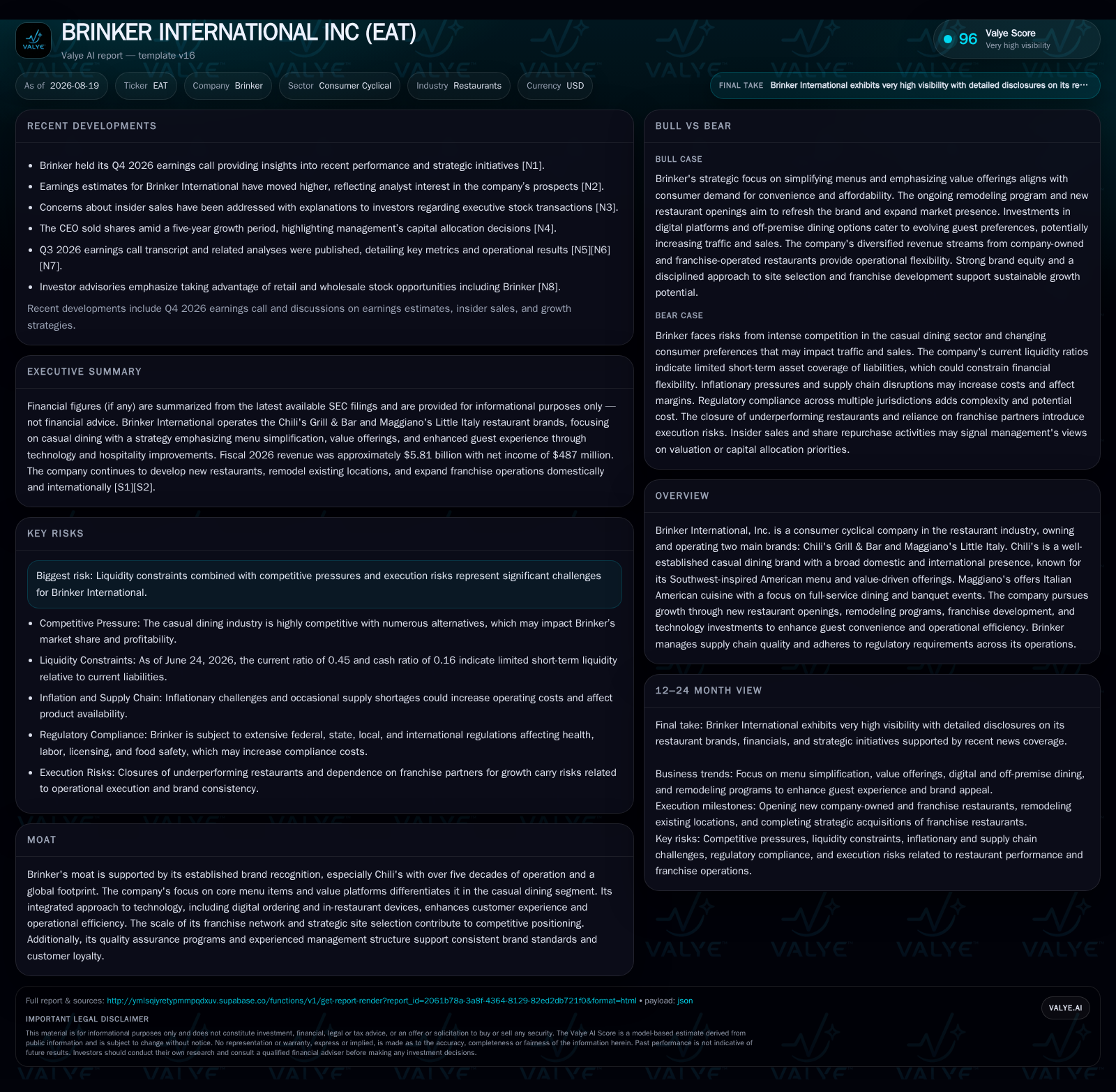
Brinker International reported positive same-store sales growth in Q3 fiscal 2026, supported by its '3 for Me' value platform and strategic menu pricing adjustments to manage inflationary pressures. Despite this operating momentum, the company faces liquidity constraints as indicated by a current ratio of 0.45 as of June 24, 2026, where current liabilities significantly exceed current assets. In response, Brinker’s Board authorized an increase of $718 million to the share repurchase program, raising total repurchase authority to $750 million, signaling continued capital return priorities amid working capital pressures.
The "3 for Me" offering allows guests to enjoy a non-alcoholic drink, an appetizer, and certain entrées starting at $10.99, which has been a key traffic driver during the current economic environment [S2][S1]. Alongside this value platform, Brinker has increased menu prices in other areas to help offset inflationary cost pressures, while also enhancing menu offerings to encourage purchases of higher-priced items [S1]. These initiatives contributed to revenue growth through improved same-store sales and average revenue per guest.
In the casual dining industry, same-store sales growth is a critical indicator of brand strength and consumer demand, reflecting both guest traffic and average check size [S1]. Brinker’s ability to leverage its established Chili’s Grill & Bar and Maggiano’s Little Italy brands, combined with menu engineering and pricing strategies, supports its operating momentum despite inflationary headwinds. The company reported current assets of $307.7 million against current liabilities of $676.7 million, resulting in a current ratio of 0.45 [F1].
Cash and equivalents stood at $110 million as of June 24, 2026, providing some liquidity buffer but limited relative to the level of current liabilities [F1]
In August 2026, Brinker’s Board authorized an increase of $718 million to the share repurchase program, raising the total available repurchase authority to $750 million [S3][S7]. This expanded authorization signals that the company continues to prioritize returning capital to shareholders despite the liquidity constraints. The repurchase program has an open-ended term and may be modified or suspended at any time, reflecting flexibility in capital allocation.
One possible interpretation is that the liquidity pressure is driven by working capital dynamics such as payables and inventory timing, which may normalize in subsequent quarters. The ongoing share repurchase activity, supported by cash on hand and operating cash flow, suggests management views liquidity as manageable in the near term.
Business Model and Competitive Positioning
Brinker International operates primarily through its two well-known casual dining brands: Chili’s Grill & Bar and Maggiano’s Little Italy. Revenue is generated mainly from food and beverage sales at company-owned restaurants and franchise fees from franchised locations [S1]
The company’s business model relies on balancing menu pricing, guest traffic, and cost control across food, labor, and overhead expenses to drive operating margins and cash flow. The "3 for Me" value platform exemplifies Brinker’s strategy to attract price-sensitive consumers while maintaining margin through menu mix and pricing adjustments [S1]. Brand equity, operational scale, and technology-enabled guest experiences contribute to competitive positioning within the casual dining sector.
Scenario Analysis and Forward-Looking Considerations
Looking ahead, one possible bullish scenario is that Brinker successfully sustains same-store sales growth and margin improvement by continuing to leverage its value platform and menu innovation. This would support stronger operating cash flows, which could alleviate liquidity pressures and enable ongoing share repurchases [S2][S3][F1]. Key conditions for this scenario include sustained consumer demand for value offerings, effective cost control amid inflation, and absence of major supply chain disruptions.
Conversely, a bearish scenario would involve intensifying inflationary pressures or shifts in consumer preferences away from casual dining value platforms. This could compress margins and weaken sales, exacerbating liquidity constraints and potentially forcing a reduction in capital returns [S2][F1]. Indicators confirming this downside would include declining same-store sales, worsening liquidity ratios, and suspension of share repurchase programs.
Watchpoints
Investors and analysts should monitor Brinker’s same-store sales trends in upcoming quarters to assess the durability of its value platform and pricing strategy. Operating margin trajectory amid ongoing inflationary pressures will be critical to understanding cash flow generation. Finally, tracking share repurchase activity and any updates to authorization levels will reveal capital allocation priorities under liquidity constraints.
Disclaimer: This is research-only, informational analysis and not investment advice. It may include AI-generated interpretation and general industry context. Always verify important details using primary sources.

Comments