
8X8’s AI-Driven Platform and Global Partnerships Power Q3 2026 Upside Amid Mid-Market Pivot
8X8 Inc. leverages its unified AI-powered communications platform and diversified channel ecosystem to surpass Q3 earnings expectations despite macroeconomic headwinds.
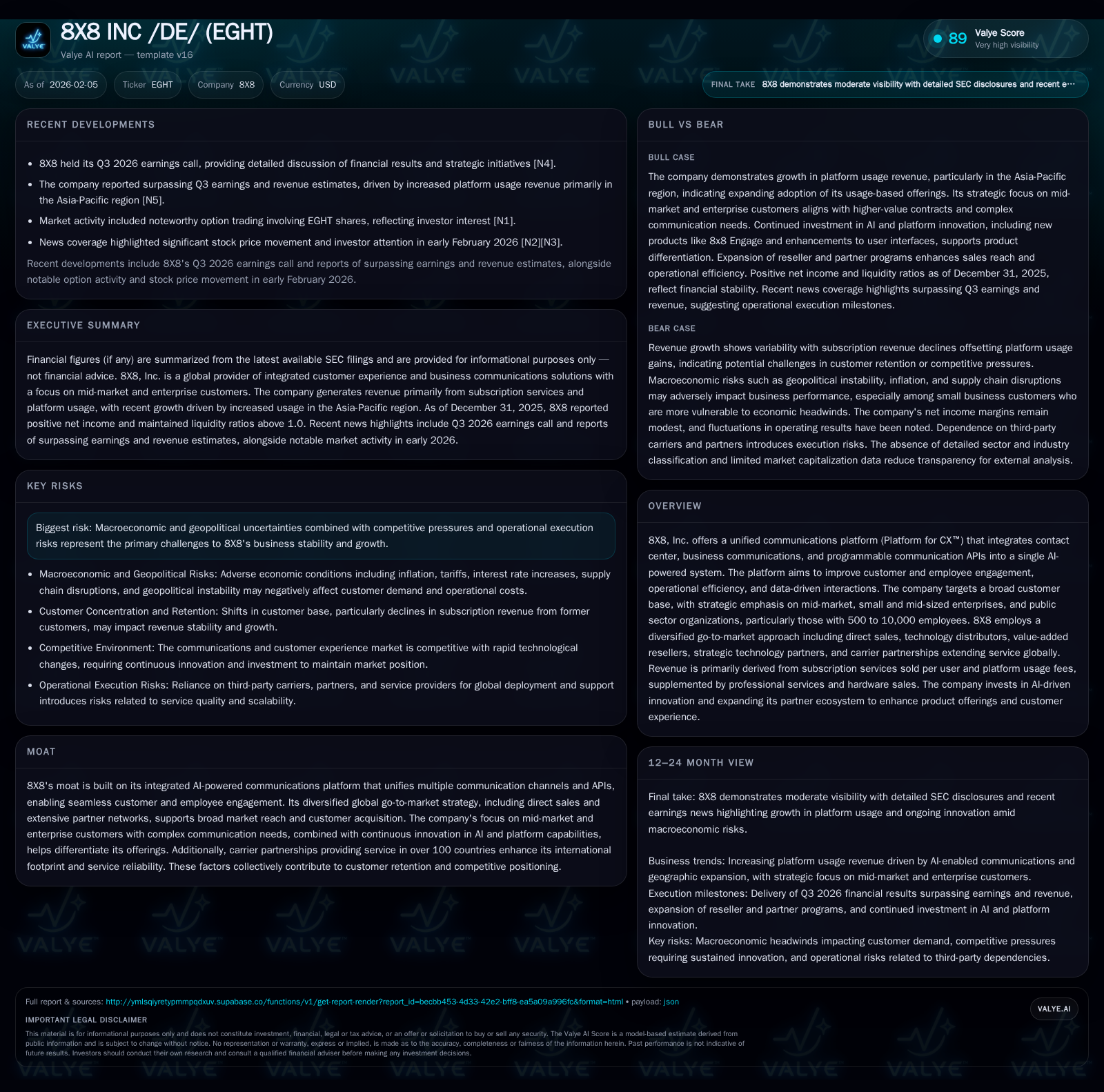
In Q3 2026, 8X8 delivered an earnings beat that contrasted sharply with the broader challenging economic environment. The company’s Platform for CX™—an AI-integrated system unifying contact center services, business communications, and programmable APIs—remains the core engine driving customer engagement and operational efficiencies. A strategic pivot toward mid-market enterprises and SMBs, supported by a layered global go-to-market strategy involving distributors, resellers, partners, and carriers across 100+ countries, has broadened its footprint amid competitive pressures. However, macroeconomic uncertainties, geopolitical risks, and execution challenges temper the outlook as 8X8 balances growth ambitions with operational discipline.
Q3 2026: Earnings Beat Signals Momentum
Emerging from a climate marked by broad economic volatility and cautious corporate spending, 8X8’s Q3 2026 earnings report provided a rare beacon of optimism. The company exceeded both revenue and earnings consensus estimates [N2], triggering a notable surge in its share price shortly after the announcement [N6][N7]. Management attributed this upside not merely to favorable market conditions but to deliberate strategic shifts and product enhancements that resonated with their expanding customer base [N1]. This quarter’s performance reflects momentum accruing from years of refining an AI-embedded communication platform aligned with evolving enterprise demands.
Platform for CX™: AI Integration Driving Differentiation
At the heart of 8X8’s value proposition lies its Platform for CX™, a unified communications ecosystem that fuses contact center capabilities with business communications and programmable APIs into one seamless entity [S2]. This integration is no superficial bundling; rather it harnesses artificial intelligence to transform raw interaction data into actionable intelligence. The platform scales fluidly to accommodate complex workflows typical in mid-market organizations.
Crucially, the AI engine offers predictive analytics and sentiment analysis—tools that help businesses preempt customer needs or optimize employee collaboration without toggling between disparate systems. This technology moat fortifies customer retention by simplifying communication silos into one cohesive interface where every conversation—voice, text, chatbots—feeds an intelligent feedback loop. Such depth of integration is challenging for other vendors offering piecemeal services or less adaptive platforms.
Shifting Focus: Embracing the Mid-Market & SMB Segments
While 8X8's footprint spans from small businesses to large enterprises worldwide [S2], recent years have seen an intentional pivot toward mid-market firms employing between 500 and 10,000 staff along with select public sector clients [S2]. These segments typically harbor more sophisticated customer service requirements coupled with intent to invest across multiple communication channels simultaneously.
This shift reflects a nuanced recognition: mid-market customers demand not just affordable tools but scalable platforms capable of handling omnichannel engagement intricacies. Consequently, 8X8 has recalibrated its sales strategies—embedding more consultative selling approaches tailored for longer decision cycles—and refined onboarding processes supported by dedicated customer care specialists who function as single points of contact [S2]. These investments aim to reduce churn while unlocking higher-value contracts through bundled subscriptions.
Global Reach Amplified by Layered Channel Strategy
Another pillar underpinning 8X8’s recent success is its diversified global go-to-market framework. Beyond direct sales forces targeting key accounts, the company leverages multiple indirect sales channels including technology solutions distributors (TSDs), value-added resellers (VARs), strategic technology partners with deep integrations or OEM relationships, as well as carrier alliances that deliver connectivity in over 100 countries and territories [S2].
This multi-tiered approach allows scalable market penetration without sole dependence on any single channel type. For example, TSDs fuel pipeline growth through broad-based referrals; VARs carry responsibility for marketing plus implementation support; meanwhile partner agreements streamline lead flows creating predictable demand funnels [S2]. Carrier partnerships uniquely extend reach into geographies where local infrastructure or regulatory hurdles might otherwise inhibit direct service delivery.
Collectively these layers create resilience—if one segment softens due to regional factors or competitive encroachments, others can compensate—while also reducing capital intensity by outsourcing some deployment complexities.
Subscription & Usage Revenue: The Financial Backbone
Financially speaking, the company generates most of its revenue via subscription-based models sold per user on the Platform for CX™ [S2][F1]. These plans are tiered based on functionality levels aligned with the communication complexity each user requires—from basic telephony to advanced contact center features integrated with AI analytics.
Complementing subscriptions are usage-based fees tied to telephony minutes consumption, SMS messaging volumes, communications APIs utilization, and interactions through digital voice/chatbot mechanisms [S2]. This hybrid revenue design blends predictable recurring streams with variable usage-linked income providing both stability and upside potential when client engagement intensifies.
Additional revenue surfaces from professional services rendered during platform deployments plus hardware equipment sales notably office phones [S2]. This mix underscores a mature business model anchored in SaaS principles yet flexible enough to address diverse enterprise needs.
Macroeconomic & Operational Risks in Focus
Despite promising growth signals, 8X8 operates against a backdrop of ongoing macroeconomic uncertainty. Rising inflationary costs combined with geopolitical volatility continue to cloud forecasting [S2]. Supply chain challenges occasionally constrain hardware availability impacting peripheral lines of revenue. Moreover, the firm faces intense competitive pressure within unified communications—a sector witnessing rapid technological shifts requiring sustained innovation investments.
Operationally, as the company pursues expansion within more complex mid-market segments internationally, execution risks arise around scaling sales teams effectively while maintaining high service standards demanded by sophisticated clients [S2]. Balancing growth initiatives without diluting margins or customer experience remains a critical challenge.
Capital Position and Financial Health Snapshot
A review of liquidity indicators reveals solid financial footing entering 2026’s first quarter. As of December 31, 2025, cash and equivalents stood at approximately $86.9 million complemented by current assets totaling $203.9 million against current liabilities near $179.9 million yielding a current ratio around 1.13—indicative of adequate short-term liquidity cushions [F1].
Net income posted was $5.1 million reflecting modest profitability progression underpinned by operational efficiencies [F1]. This metric suggests management’s capacity to convert platform scale into positive bottom-line outcomes despite external headwinds.
Such capital adequacy provides breathing room for continued R&D investments into AI capabilities as well as strategic acquisitions or partnerships aimed at accelerating ecosystem expansion.
Looking Ahead: Strategic Growth Drivers and Challenges
Looking forward, several themes crystallize as determinants shaping 8X8's trajectory. Innovation centered around enhancing AI layers within the Platform for CX™ remains paramount—with management emphasizing continuous capability augmentations designed to differentiate against commoditized competitors [N1][S2].
Simultaneously geographic expansion supported by partner network densification will remain critical in capturing untapped mid-market pockets globally especially within emerging markets where cloud communications adoption is ascending.
Customer retention strategies focusing on nuanced onboarding and account management seek to deepen wallet share among existing clients while sustaining robust acquisition pipelines via diversified channels [N1][S2].
Yet these opportunities coexist alongside significant headwinds related to macroeconomic unpredictability plus ongoing integration risks associated with scaling in heterogeneous international contexts.
In balancing this complex equation between ambition and prudence lies the core challenge facing leadership today—as they stride toward transforming how enterprises engage digitally across multifaceted communication environments.
This analysis synthesizes publicly available data drawn primarily from company disclosures and recent earnings reports. While efforts were made to ensure accuracy and nuance without extrapolating unverified specifics, readers should consider inherent uncertainties associated with technology markets and external economic factors when evaluating corporate narratives.
Disclaimer: This is research-only, informational analysis and not investment advice. It may include AI-generated interpretation and general industry context. Always verify important details using primary sources.

Comments