Hubbell Inc.: Strategically Blending Organic Growth and Acquirement Amid Inflation and Supply Challenges
Hubbell’s 2025 marked a pivotal transformation fueled by three acquisitions and operational strides under challenging industry conditions.
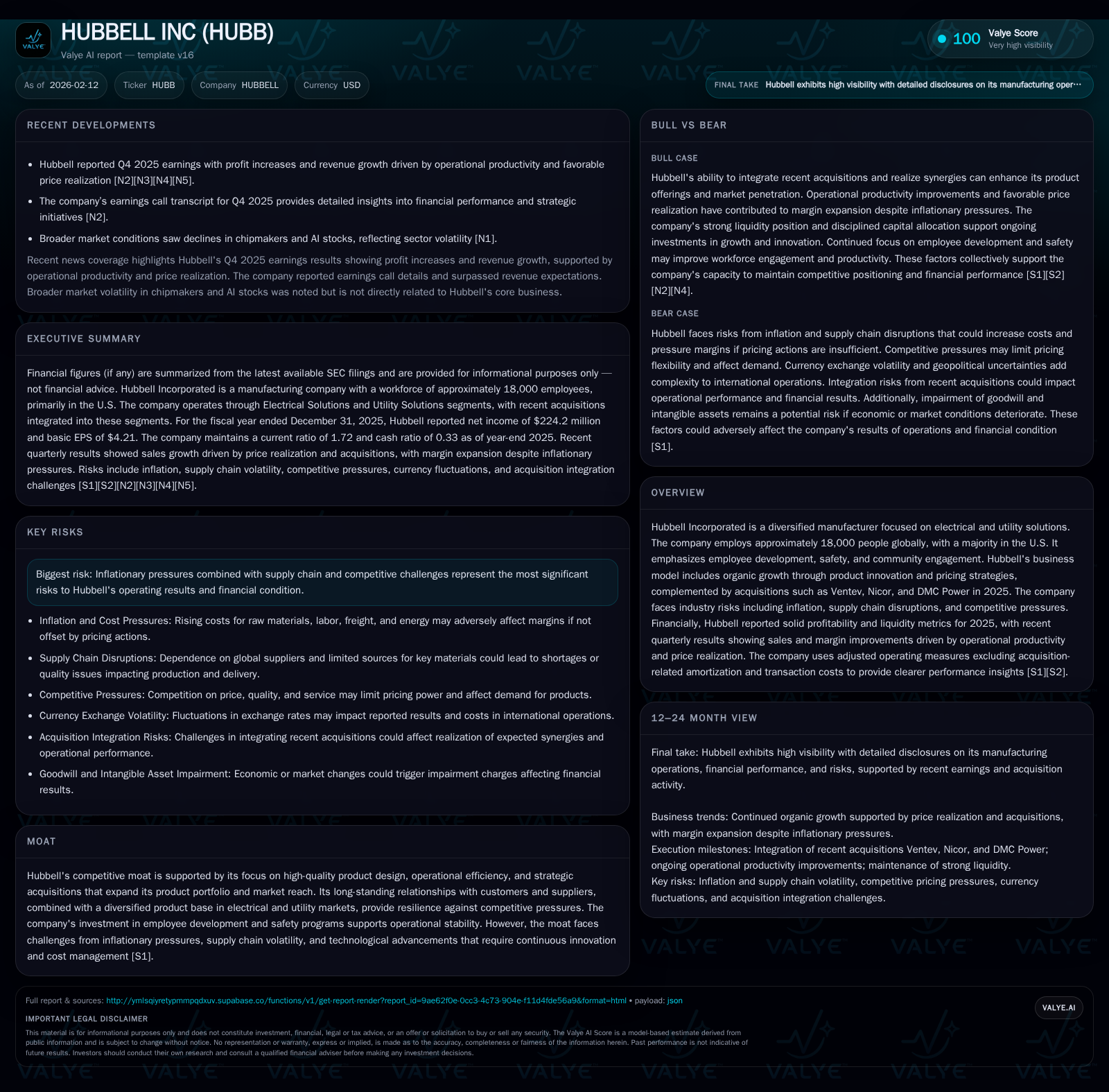
In 2025, Hubbell Inc. accelerated its electrical and utility solutions presence through the acquisitions of Ventev, Nicor, and DMC Power, complementing organic growth via pricing and productivity gains. The company demonstrated resilience with solid profitability metrics and liquidity, highlighted by a net income of $224.2 million and a healthy current ratio of 1.72. A culture emphasizing employee development, safety, and community engagement further fortifies Hubbell’s moat against inflationary and supply chain headwinds. While market risks persist, leadership continuity under CEO Gerben Bakker and focused innovation poise the company for sustained expansion.
Forging Growth: The Impact of 2025 Acquisitions on Hubbell’s Portfolio
The year 2025 was transformative for Hubbell Inc., punctuated by three major acquisitions that reshaped its footprint in electrical and utility solutions. Early in Q1, Hubbell acquired Ventev, a manufacturer providing comprehensive solutions to support wireless networks’ power and connectivity needs, which integrated into the Electrical Solutions segment [S2]. This acquisition bolstered Hubbell’s positioning in rapidly evolving datacenter and industrial markets, aligning with organic growth trends evidenced by an 8.3% segment sales increase in the third quarter that year [S2].
Midyear saw the Nicor acquisition, valued at approximately $56 million net of cash acquired, added to the Utility Solutions segment. Nicor specializes in water metering endpoint solutions critical to advanced metering infrastructure (AMI) networks—an area that diversifies Hubbell’s exposure within the utility sector [S2]. Finally, October’s sizeable $825 million purchase of DMC Power further enhanced Hubbell's utility offering with connectors and tooling geared towards substation and transmission markets [S2]. Together, these acquisitions not only broadened the product portfolio but strategically aligned with Hubbell’s long-term vision to serve adjacent high-growth electrical infrastructure markets.
Financial disclosure emphasizes that acquisition-related amortization and transaction costs were excluded from adjusted operating metrics to clarify underlying performance trends [S2]. This approach aids stakeholders in distinguishing core business operations from transient acquisition expenses.
Financial Health Check: Profitability and Liquidity in Focus
Hubbell closed out 2025 with solid financial fundamentals showcasing operational resilience amid macroeconomic uncertainty. The reported annual net income reached $224.2 million, reflecting profitability improvements supported by both organic initiatives and acquisition contributions [F1][N1]. The company preserved substantial liquidity with cash and equivalents tallying $482.5 million at year-end alongside a current ratio of 1.72—both indicators pointing to strong short-term financial flexibility [F1].
The Q4 earnings call highlighted that revenues beat consensus expectations driven by increased volume and margin expansion [N1][N3]. Operational leverage was evident as adjusted operating margins rose modestly despite known inflationary pressures impacting input costs. Such results underscore Hubbell's adeptness at capitalizing on pricing power while managing expenses effectively.
Operational Levers: Productivity and Pricing Driving Margins
Behind Hubbell’s margin improvement lies an interplay between enhanced productivity measures and strategic pricing tactics that offset raw material cost inflation pervasive in 2025 [S2][N13]. Organic sales volumes climbed by over 3%, driven primarily by favorable price realization across Electrical Solutions markets hungry for robust components in data centers and industrial automation [S2][N1].
Adjusted operating margin (excluding intangible amortization from acquisitions) edged higher—evidence of successful operational discipline embedded within manufacturing efficiencies, streamlined logistics, and overhead control [S2]. Management commentary from earnings transcripts also emphasized continuous lean process improvements underpinning these margin trends.
Human Capital as a Competitive Edge: Culture, Safety, and Development
Hubbell consistently prioritizes its workforce as a cornerstone of competitive advantage. At year-end 2025, approximately 18,000 employees globally formed the company’s backbone—with about 61% based in the U.S., including around 2,425 union-represented workers spanning eight unions [S1]. Despite union presence, labor relations remain satisfactory with proactive engagements helping maintain stable industrial peace.
Employee investment permeates Hubbell’s strategic culture through its expanded "Hubbell University" learning platform offering diverse training modules alongside leadership programs aimed at career progression across all levels [S1]. The company also focuses intently on workplace safety through its “Think Safe, Work Safe, Go Home Safe” ethos monitored via enterprise-wide data systems ensuring incident transparency.
Community engagement receives formal support via Volunteer Paid Time Off policies enabling U.S.-based employees up to eight hours annually to contribute to nonprofit causes of their choice—underscoring social responsibility alongside corporate governance [S1]. The fourth concurrent Elevate Employee Experience Survey conducted in 2025 attracted strong participation exceeding 87% worldwide; feedback from this initiative actively informs localized improvement plans reinforcing workforce morale [S1].
Sustaining the Moat Amid Industry Pressures
Hubbell’s moated business is anchored in a combination of premium product design philosophy, operational excellence, broad geographic reach, and strategic M&A activity that continuously refreshes its offerings [S1]. These factors have cultivated durable customer relationships that help hedge against competitive erosion.
Nonetheless, inflationary cost escalation poses ongoing margin pressure requiring vigilant cost management alongside perpetual innovation cycles triggered by technological shifts like smart grid integration or evolving wireless standards [S1]. The firm also benefits from its supply chain partnerships established over years but remains wary of potential disruptions exacerbated by global geopolitical tensions or raw material shortages.
Employee-centric policies further stabilize operations by reducing turnover risk—a nontrivial moat element for manufacturing firms competing on quality consistency rather than commoditized inputs alone.
Risks on the Horizon: Inflation, Supply Chain, and Competitive Dynamics
Operating within cyclical industries dependent on construction activity exposes Hubbell to macroeconomic shocks manifesting as input inflation or project deferrals linked to capital spending variations across utilities or data center operators [S1][S2]. Supply chains remain fragile given lingering post-pandemic bottlenecks combined with geopolitical freight uncertainties impacting timely delivery.
Competitive forces emanate from global manufacturers targeting similar electrical components markets often leveraging lower-cost geographies. Moreover, advancing technological requirements necessitate constant R&D investments without guaranteed commercial success.
Labor relations are generally stable though approximately 14% of U.S.-based employees operate under union contracts—a factor potentially elevating negotiation complexities or costs during adverse economic conditions [S1]. Such multifaceted risks require sustained mitigation vigilance to preserve financial health.
Future Outlook: Innovation, Integration, and Market Expansion Strategies
Looking ahead, Hubbell charts a course balancing organic innovation with acquisitive growth under CEO Gerben Bakker who has led since late 2020/early 2021 providing leadership continuity vital for seamless integration of acquired entities [S1][N10]. Market expectations position earnings growth positively reflective of confidence in both internal initiatives such as expanding advanced metering products plus synergies harvested from recently acquired Ventev’s wireless ecosystem capabilities and DMC Power’s substation expertise.
The company aims to capitalize on growing demand for infrastructure modernization particularly around electrification trends globally complemented by continual process optimization.[N10]
Successful navigation will depend on harnessing installed talent development mechanisms while scaling newly integrated businesses efficiently without sacrificing operational rigor. Pricing discipline remains a tool alongside measured capital deployment underpinning balanced returns.
This document is prepared solely for informational purposes based on publicly available filings and reputable news sources. It reflects analysis without offering any buy/sell/hold recommendations or price forecasts concerning securities mentioned herein.
Disclaimer: This is research-only, informational analysis and not investment advice. It may include AI-generated interpretation and general industry context. Always verify important details using primary sources.

Comments