
Edgewell Personal Care: Strategic Divestiture and Governance Amidst Operational Challenges
Edgewell Personal Care navigates significant financial setbacks and portfolio changes while leveraging governance strengths to maintain resilience.
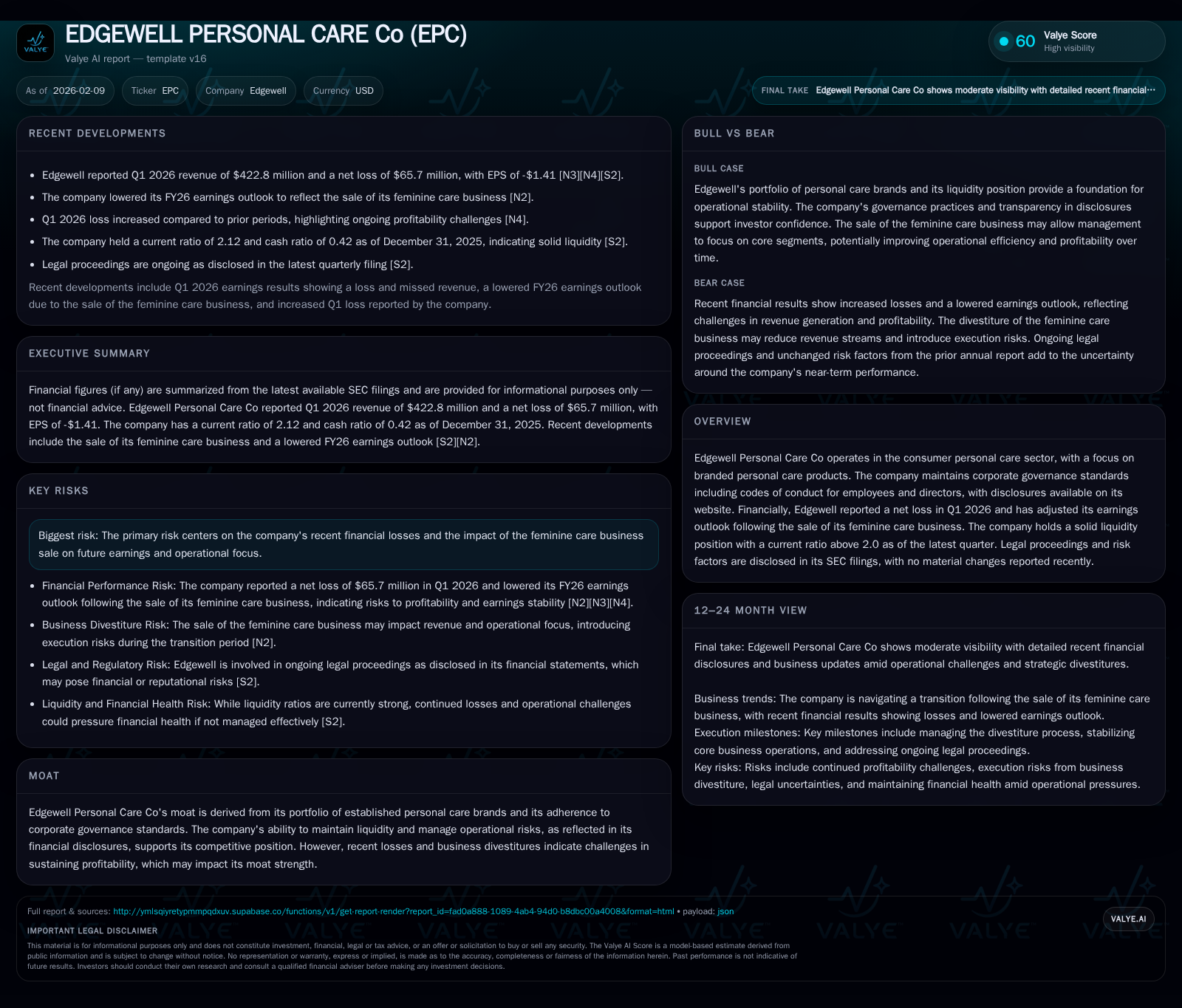
Edgewell Personal Care Co reported a widening net loss in Q1 2026, coinciding with its strategic divestiture of the feminine care business, which has led management to adjust earnings forecasts downward. Amid these operational headwinds, the company relies on its strong liquidity, with a current ratio exceeding 2.0, and robust corporate governance standards to uphold investor confidence. External pressures such as currency fluctuations and ongoing legal proceedings add to the complexity of Edgewell’s recovery path. The company’s future moat depends heavily on its ability to reinvigorate its brand portfolio and navigate market dynamics amidst these challenges.
From Setbacks to Strategy: Navigating EPC's Recent Losses
Edgewell’s fiscal Q1 2026 results unfolded as a challenging episode for the personal care specialist. The company reported a net loss that expanded compared to prior periods, underscoring operational pressures that weighed heavily on earnings [N1][N3][N4]. Revenue figures also fell short of expectations, complicating the narrative for investors already wary about growth trajectories. These financial outcomes prompted management to revise downward their EPS guidance for the full fiscal year, signaling cautious forward visibility.
This sequence of losses is more than an isolated quarter anomaly—it reflects persistent headwinds in Edgewell’s core markets and underscores volatility stemming from evolving consumer demand patterns. Investor sentiment felt the strain as market participants grappled with uncertainty surrounding topline momentum and margin sustainability.
Shedding the Feminine Care Business: Why and What's Next
The divestiture of Edgewell’s feminine care business stands out as a deliberate strategic inflection point rather than a mere asset sale [N2][S1][S2]. Management articulated this move as a refocusing exercise intended to streamline the portfolio around stronger, more synergistic product categories. This recalibration aligns with efforts to sharpen operational focus and improve capital allocation efficiency.
While shedding this segment curtails associated revenue streams — prompting immediate earnings adjustments — it potentially reduces complexity and opens capacity for reinvestment in higher-margin personal care lines. Yet, this transition inevitably raises questions regarding how quickly Edgewell can compensate for relinquished sales volume through organic growth or acquisitions elsewhere.
The Liquidity Lifeline: Analyzing Edgewell’s Financial Cushion
Despite earnings volatility, Edgewell’s balance sheet presents a noteworthy degree of resilience [F1][S2]. As of December 2025, the company holds current assets totaling approximately $1.06 billion against current liabilities of $497.5 million—translating into a healthy current ratio of about 2.12.
This strong liquidity buffer offers crucial operational agility amid unsettled markets. Cash and equivalents nearing $210 million as of late 2024 further reinforce this cushion. Such financial flexibility positions Edgewell well to meet ongoing contractual obligations—including debt maturities, lease commitments, and service agreements—without compromising day-to-day operations [S1]. The robustness here tempers near-term risk while providing breathing room for strategic initiatives.
Governance as a Moat: Codes, Conduct, and Corporate Confidence
In an era where corporate accountability increasingly influences investor trust, Edgewell leverages governance not only as compliance but as competitive differentiation [S1]. The company maintains formalized codes of conduct applicable across all organizational levels—from frontline employees up to executive officers and board members. Transparency around these policies is reinforced through publicly accessible disclosures on the company website.
This governance rigor fosters internal discipline that can mitigate risks related to ethical lapses or strategic missteps. For stakeholders monitoring Edgewell through turbulent financial periods, such frameworks contribute reassurance about management’s commitment to sustainable value creation beyond immediate profit swings.
Market Risks and Currency Fluctuations: External Pressures
Geographically diversified operations expose Edgewell to foreign currency volatility that complicates earnings predictability [S1]. A significant portion of international sales and expenses are denominated in local currencies whose fluctuations against the U.S. dollar produce both translation gains/losses and transactional impacts.
Though management employs hedging strategies aiming to smooth some currency effects, these measures do not achieve full insulation—residual risks persist that can magnify quarterly earnings swings. Given that certain intercompany financing arrangements also carry currency risks, fluctuations add layers of uncertainty which investors should weigh when evaluating reported profitability.
Legal Landscape: Ongoing Proceedings and Their Implications
Edgewell acknowledges multiple legal proceedings arising in the ordinary course of business but indicates none currently pose material threats to its financial health [S1][S2]. Many cases remain preliminary or involve complex regulatory landscapes where outcomes are uncertain.
The company exercises prudent disclosure practices aligned with accounting standards: accruals are established only when losses are deemed probable and estimable; otherwise contingent liabilities are monitored without immediate provision. This approach reflects measured acknowledgement rather than downplaying potential exposure. Vigilance remains essential given the protracted nature litigation can entail.
Innovation or Stagnation? EPC’s Position in Personal Care Market Dynamics
Operating within highly competitive consumer staples segments necessitates continuous innovation infused with brand relevance. While specific product development details from Edgewell are limited in recent disclosures, market context underscores mounting pressure from agile incumbents and emerging niche brands alike.
Validea's December 2025 rankings place Edgewell at a moderate standing among consumer staples players based on fundamental criteria such as profitability metrics and asset efficiency [N5]. This suggests that while EPC is neither at the forefront nor lagging excessively behind peers, its current trajectory calls for renewed emphasis on product pipeline vitality and marketing differentiation to sustain growth amidst evolving customer preferences.
Long-Term Outlook: Can Edgewell Rebuild Its Competitive Moat?
Edgewell now faces the challenging task of reconciling governance strengths with pronounced operating setbacks intensified by recent portfolio reshaping [N2][valye_report_excerpt]. The sale of its feminine care unit cuts both complexity and revenues simultaneously injuring near-term topline results but potentially enhancing focus.
Recovery will likely depend on management’s ability to drive organic growth through innovation within remaining segments while exploiting liquidity advantages for selective investments or alliances that reinforce branding power. Monitoring adjusted guidance will be critical for assessing whether expected improvements materialize alongside cost control efforts.
Ultimately, re-establishing competitive moat durability demands both strategic clarity post-divestiture and nimble responsiveness to changing industry dynamics.
Validea’s Take: Where EPC Stands Among Consumer Staples
Empirical quantitative analysis from Validea ranks Edgewell within a middle tier among consumer staples firms when considering metrics like profitability ratios and return on assets [N5]. This positioning offers a balanced perspective amid recent volatility—a reminder that fundamental attributes underpinning investment considerations remain intact yet underscore scope for operational enhancement.
While quantitative scoring alone cannot capture all qualitative nuances—such as governance adherence or strategic shifts—it does lend empirical weight supporting closer examination rather than outright dismissal due to headline losses alone.
Disclaimer: This report is for informational purposes only. It does not constitute investment advice or recommendations. All analyses herein derive strictly from publicly available data referenced above without speculative assumptions.
Disclaimer: This is research-only, informational analysis and not investment advice. It may include AI-generated interpretation and general industry context. Always verify important details using primary sources.

Comments