
Equitable Holdings Faces Profitability Pressure Amid Revenue Decline and Capital Challenges
A diversified financial services company, Equitable Holdings reported lower revenues and a net loss in 2025 despite robust buyback activity.
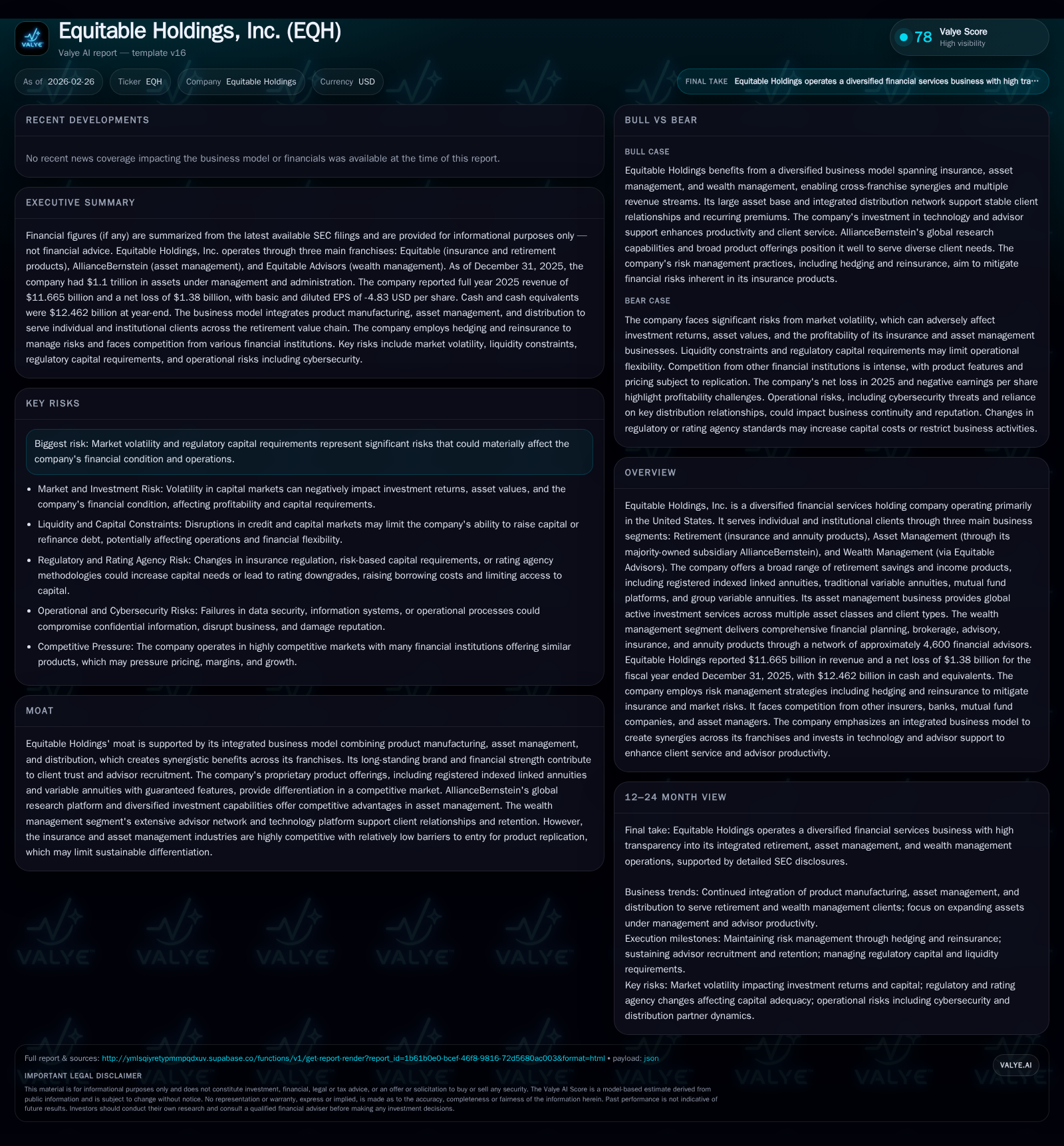
Equitable Holdings, operating across retirement insurance, asset management via AllianceBernstein, and wealth advisory through Equitable Advisors, delivered $11.7 billion in revenue in 2025, down 6.2% year-on-year. Net income swung from a positive $1.3 billion in 2024 to a loss of $1.38 billion in 2025, pressured by market volatility and capital adequacy considerations. While the company maintains an integrated approach linking product manufacturing, asset management, and distribution, unsteady equity markets and regulatory demands have challenged performance and capital structure, resulting in near-zero equity on the balance sheet. Despite these headwinds, Equitable continued significant share repurchases totaling $1.45 billion in 2025, underscoring confidence in long-term value generation.
Company Overview
Founded in 1859, Equitable Holdings is a leading U.S.-based diversified financial services holding company operating through three integrated franchises: Retirement insurance products under "Equitable," global active asset management via its majority-owned subsidiary AllianceBernstein (approximately 68% economic interest), and retail wealth management through Equitable Advisors. This integrated model spans product manufacturing, asset management, and distribution aiming to create synergies that convert investment returns into higher client sales. As of December 31, 2025, the company managed assets under administration totaling approximately $1.1 trillion across these segments.[S1][S8]
Historical Performance
The firm's revenue trajectory shows variability linked closely to market conditions impacting assets under management and account values of annuities:
Historical performance (annual)
| FY | Rev ($bn) | Net ($mm) | CFO ($bn) | Rev YoY | Net YoY |
|---|---|---|---|---|---|
| 2025 | 11.7 | -1380 | 0.7 | -6.2% | -205.6% |
| 2024 | 12.4 | 1307 | 2.0 | +18.1% | +0.4% |
| 2023 | 10.5 | 1302 | -0.2 | -24.9% | -27.1% |
| 2022 | 14.0 | 1785 | -0.9 |
Source: SEC companyfacts cache [F1].
Capital returns and efficiency (annual)
| FY | Buybacks ($mm) | ROE% |
|---|---|---|
| 2025 | 1450 | 1864.9 |
| 2024 | 1014 | 82.5 |
| 2023 | 919 | 49.2 |
| 2022 | 849 | 107.7 |
Source: SEC companyfacts cache [F1].
Key observations:
- Revenue peaked at $14 billion in FY22 before retreating to $11.7 billion in FY25.
- The company generated positive net income from FY22 through FY24 but swung to a sizeable net loss of $1.38 billion in FY25.
- Operating cash flows were negative several years ago but turned positive as recently as FY24 before tumbling by over half in FY25.
- Shareholder equity decreased markedly from $2.65 billion (FY23) to nearly zero by FY25 indicating leverage or accumulated losses pressure.[F1]
- The company increased share repurchases annually from $849 million (FY22) to $1.45 billion (FY25).[F1]
Drivers behind these fluctuations include sensitivity to equity market declines which negatively affect annuity account values and fees; increased hedging costs particularly for variable annuities with guaranteed minimum benefits; shifts in policyholder behavior such as withdrawals; and evolving regulatory capital requirements.[S1][S19][S21]
Business Segments
Retirement Segment
Equitable's retirement franchise offers individual annuities including registered indexed-linked annuities with guarantees designed for retirement income needs alongside institutional savings products.[S8] Revenues mainly arise from insurance premiums investment income and fee revenue.[S8][S28] Pricing incorporates mortality/longevity assumptions plus hedging cost related to embedded guarantees.[S28][S19]
Asset Management Segment (AllianceBernstein)
AllianceBernstein is a global active asset manager with $867 billion AUM at end-2025 split across equities (41%), fixed income (36%), multi-asset solutions and alternatives (23%). It distributes primarily through institutional investors (41%), retail clients and private wealth.[S27][S17] AB operates globally with presence across US, EMEA and Asia.[S27] The segment reflects AB's consolidated results with Equitable holding a controlling interest.[S8]
Wealth Management Segment
Equitable Advisors operates around 4600 financial advisors offering comprehensive financial planning, brokerage services, proprietary life insurance and annuity products distributed nationally via more than eighty branches supported by advanced technology platforms.[S11][S13] Advisory revenues are driven by AUA which totaled around $122 billion at end-2025 ranged across brokerage trade commissions, advisory fees, insurance commissions etc.[S13]
Future Growth Prospects
Growth drivers include:
- Market recovery that boosts asset valuations underpinning fees across annuities and asset management.
- Expansion of proprietary product offerings including indexed-linked annuities which differentiate amidst competitive commoditization.[N9][S8]
- Increasing advisor productivity and net flows within wealth management supported by digital initiatives.
- Continued innovation around risk-managed products providing downside protection features attractive amid volatile markets.
Limitations include:
- Competitive pressures from banks, other insurers and boutique managers posing challenges for pricing power.[S12]
- Regulatory headwinds raising compliance costs notably regarding AI use in underwriting/repricing,[S20] fiduciary standards,[S9], ESG policies,[S15] capital requirements,[S21] and cybersecurity regulations.[S24]
- Market volatility impacting variable annuity hedging effectiveness possibly widening losses.[S19]
- Potential legal/regulatory actions could divert resources or impose fines affecting results.[S4][S6]
Forecasts / Milestones / Expectations
There is no explicit forward guidance disclosed publicly; however analysts surveyed expect earnings growth relative to recent quarters reflecting modest improvements or stabilization post-Q4 losses.[N3][N9] Key upcoming milestones include monitoring AB's ability to retain institutional mandates amid potential consultant-driven shifts,[S15] managing persistency assumptions for retirement products,[S28] success of buyback programs,[N4], and navigating evolving regulatory frameworks impacting product design or disclosures.[S20][S24]
Returns / Capital Allocation
Trailing twelve months ROE is distorted due to near-zero equity; however notable is the deterioration from positive equity balances indicating losses absorbed on retained earnings.[F1] Operating cash flow swings suggest business cyclicality tied to market conditions.
Capital allocation priorities feature consistently high levels of share repurchases: reaching $1.45 billion in FY25 vs dividends which are materially lower ($285 million last disclosed FY19).[F1] This aggressive buyback strategy demonstrates confidence in intrinsic value despite adverse earnings trends but raises questions about balance sheet resilience amid declining equity levels. Dividends appear modest relative to buybacks.
Risk Factors Summary
Key risks distilled from regulatory filing include:
- Market volatility affecting asset values underpinning fees and liabilities from guaranteed features on variable annuities.
- Regulatory changes elevating compliance cost burdens or undermining product economics especially ESG-related regulations or fiduciary standards.
- Legal/regulatory proceedings with potential material financial impact.
- Interest rate fluctuations influencing hedge effectiveness.
- Counterparty credit risks related to reinsurance assumed.
- Competition from diverse financial institutions threatening sales volumes or margins.
- Cybersecurity threats risking operational disruption or reputational damage.
Strategic Reflection
Equitable Holdings' integration of manufacturing, managing assets globally through AllianceBernstein, and domestic wealth distribution creates synergistic advantages difficult for standalone players replicate fully over time despite intensive external competition. Yet these synergies presently meet headwinds from stagnant markets impacting fee-based revenues alongside stretched solvency metrics precipitating losses on equity while sustaining aggressive capital returns via buybacks. Maintaining balanced capital adequacy while investing thoughtfully in technology-enabled advisor networks will be critical going forward given intensifying regulation coupled with premium competition among financial advice channels.
Conclusion
Equitable Holdings presents a complex picture combining deep legacy strength with acute challenges shaped chiefly by market dynamics beyond immediate control alongside fine balancing acts between risk management provisioning requirements versus shareholder return commitments evident from robust buybacks against deteriorating profitability metrics. Monitoring how effectively the integrated business model leverages product innovation combined with sustained advisor recruitment amid evolving regulation will be pivotal drivers shaping medium-term trajectory for operational results and capital structure normalization.
This report synthesizes information from the latest SEC filings including the annual Form 10-K dated February 25, 2026 [S1], quarterly updates [S2], recent earnings-related news [N1–N9], along with XBRL-calculated historical financial performance [F1]. It aims solely to provide an informed view grounded explicitly on documented evidence without expressing investment recommendations or price forecasts.
Disclaimer: This is research-only, informational analysis and not investment advice. It may include AI-generated interpretation and general industry context. Always verify important details using primary sources.

Comments