
Flowers Foods Q2 2026 Results: Snack Expansion Supports Sales, Liquidity Below One
Flowers Foods reported Q2 2026 revenue growth driven by branded retail and snack products, while net income declined amid liquidity pressures.
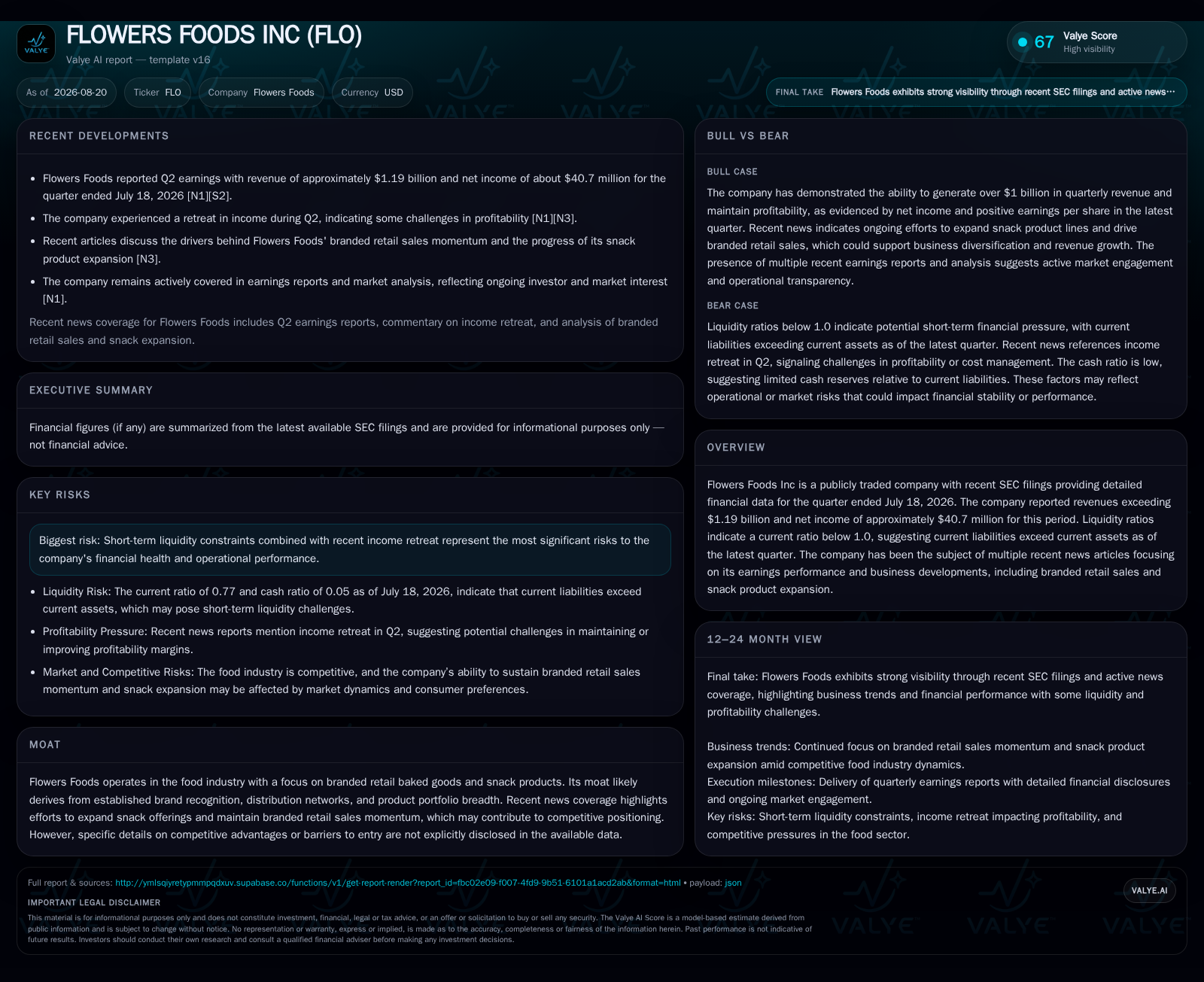
In the 12 weeks ended July 18, 2026, Flowers Foods Inc generated revenues exceeding $1.19 billion, supported by branded retail sales momentum and expansion of snack products. Despite top-line growth, net income declined to approximately $40.7 million, reflecting margin compression likely caused by cost inflation and operational inefficiencies. The company’s liquidity remains constrained, with a current ratio of 0.77 at quarter-end, indicating current liabilities exceed current assets. High leverage with total debt of $1.7 billion and net debt near $1.65 billion further underscores balance sheet pressures. These dynamics highlight operational and financial challenges that could affect near-term flexibility.
Q2 2026 Operating and Financial Results
Flowers Foods Inc reported revenues exceeding $1.19 billion for the 12 weeks ended July 18, 2026, marking continued top-line growth supported by branded retail sales momentum and expansion in snack product offerings [S2][N11]. This revenue increase reflects the company's ability to leverage its product portfolio breadth and distribution network to capture consumer demand in the branded bakery and snack segments.
However, net income for the quarter declined to approximately $40.7 million, a decrease from prior periods despite higher revenues [S2]. This divergence suggests margin compression, which may stem from rising commodity input costs such as wheat, soybean oil, corn, and natural gas, as well as operational inefficiencies impacting production efficiency and fixed cost absorption. The company's use of commodity derivatives to hedge price risk aims to stabilize production costs, but inflationary pressures appear to have weighed on profitability in this period [S1].
Balance Sheet and Liquidity Analysis
The company's liquidity position exhibits notable constraints. As of July 18, 2026, Flowers Foods’ current ratio was 0.77, indicating that current liabilities of approximately $1.02 billion exceed current assets of about $786 million [F1]. This working capital deficit implies limited short-term liquidity to cover obligations, which could pressure operational flexibility in managing supply chain and production needs.
Cash and cash equivalents stood at $52.8 million, providing a limited liquidity buffer relative to the sizable current liabilities [F1]. Total debt was $1.7 billion, with net debt approximately $1.65 billion after accounting for cash on hand [F1]. This significant leverage level underscores the company’s reliance on external financing and the importance of managing debt service obligations carefully.
These financial conditions may also increase refinancing risk, especially if operating cash flows remain pressured by margin compression [F1]
Business Model and Competitive Positioning
Flowers Foods operates primarily in the consumer packaged goods sector focused on branded retail baked goods and snack products. Revenue is generated through sales of bread, snack cakes, and other bakery items via retail and distribution channels [S1]. The company’s competitive positioning benefits from established brand recognition and an extensive distribution network, which support branded retail sales momentum.
Margins in this sector are sensitive to commodity input cost volatility and production efficiency. Flowers Foods employs commodity futures and options to hedge price risk on key inputs such as wheat, soybean oil, corn, and natural gas, aiming to stabilize costs and protect earnings [S1]. These hedging strategies are designed to mitigate the impact of commodity price fluctuations on production costs, but they cannot fully insulate the company from inflationary pressures.
Operational efficiency is another critical margin driver. The company’s ability to manage production costs, labor, and supply chain logistics affects fixed cost absorption and overall profitability. The recent margin compression indicates challenges in these areas, possibly due to increased input costs and inefficiencies in production or distribution.
The competitive landscape includes private label and discount brands, which exert pricing pressure and limit Flowers Foods’ ability to pass on cost increases fully to consumers. Nonetheless, the company’s strong brand portfolio and distribution reach provide a platform for maintaining market share and pursuing product innovation, particularly in the snack segment.
Analytical Conclusions and Scenario Outlook
The evidence indicates that Flowers Foods’ revenue growth in Q2 2026 was effectively driven by branded retail sales momentum and snack product expansion, demonstrating successful product portfolio management and market penetration [S2][N11]. This suggests that the company’s strategic focus on branded products and snack diversification is resonating with consumers and contributing to top-line strength.
However, the decline in net income despite higher revenues points to margin compression likely caused by cost inflation and operational inefficiencies, which also contribute to working capital and liquidity constraints [S2][F1]. The current ratio of 0.77 and high leverage as of July 18, 2026, highlight financial pressures that could constrain operational flexibility and increase refinancing risk
One plausible bullish scenario is that Flowers Foods could leverage its branded retail momentum and product breadth to enhance pricing power and operational efficiency, leading to margin stabilization and improved liquidity [S2][F1]. If the company can moderate commodity cost inflation through effective hedging and realize operational improvements, net income margins could recover. This would likely be accompanied by a rising current ratio above 1.0 and stable or reduced net debt levels, signaling improved financial health
Conversely, a bearish scenario involves persistent cost pressures and worsening liquidity constraints that could impair profitability and heighten refinancing risks [S2][F1]. Sustained commodity inflation, ineffective working capital management, and adverse market conditions impacting branded retail sales could exacerbate margin pressures and cash flow challenges. The company earns revenue primarily through sales of branded baked goods and snacks to retail customers and distributors [S1]. Its margins depend heavily on commodity input costs, production efficiency, and pricing power within a competitive retail environment.
Commodity cost volatility is a key risk factor. Despite the use of commodity derivatives to hedge price risk, fluctuations in wheat, soybean oil, corn, and natural gas prices can materially affect production costs and margins. Operational inefficiencies, such as supply chain disruptions or labor cost increases, can further pressure profitability.
The company’s leverage and liquidity position present additional risks [F1]. This could limit the company’s ability to invest in growth or respond to competitive pressures and may elevate refinancing risk
Progress in branded retail sales growth and snack product expansion will also be critical indicators of the company’s ability to sustain revenue momentum and improve financial stability [S2]
In summary, Flowers Foods’ Q2 2026 results reflect a complex interplay of growth opportunities and financial pressures. While branded retail sales and snack product expansion support revenue growth, margin compression and liquidity constraints pose challenges. The company’s near-term performance will depend on its ability to manage cost inflation, operational efficiency, and balance sheet risks effectively.
Disclaimer: This is research-only, informational analysis and not investment advice. It may include AI-generated interpretation and general industry context. Always verify important details using primary sources.

Comments