
Flux Power Q3 2026: Revenue Decline and Near-Break-Even Liquidity Highlight Financial Strains
Flux Power Holdings reported Q3 2026 operating losses and tight liquidity, underscoring challenges in the competitive clean energy battery market.
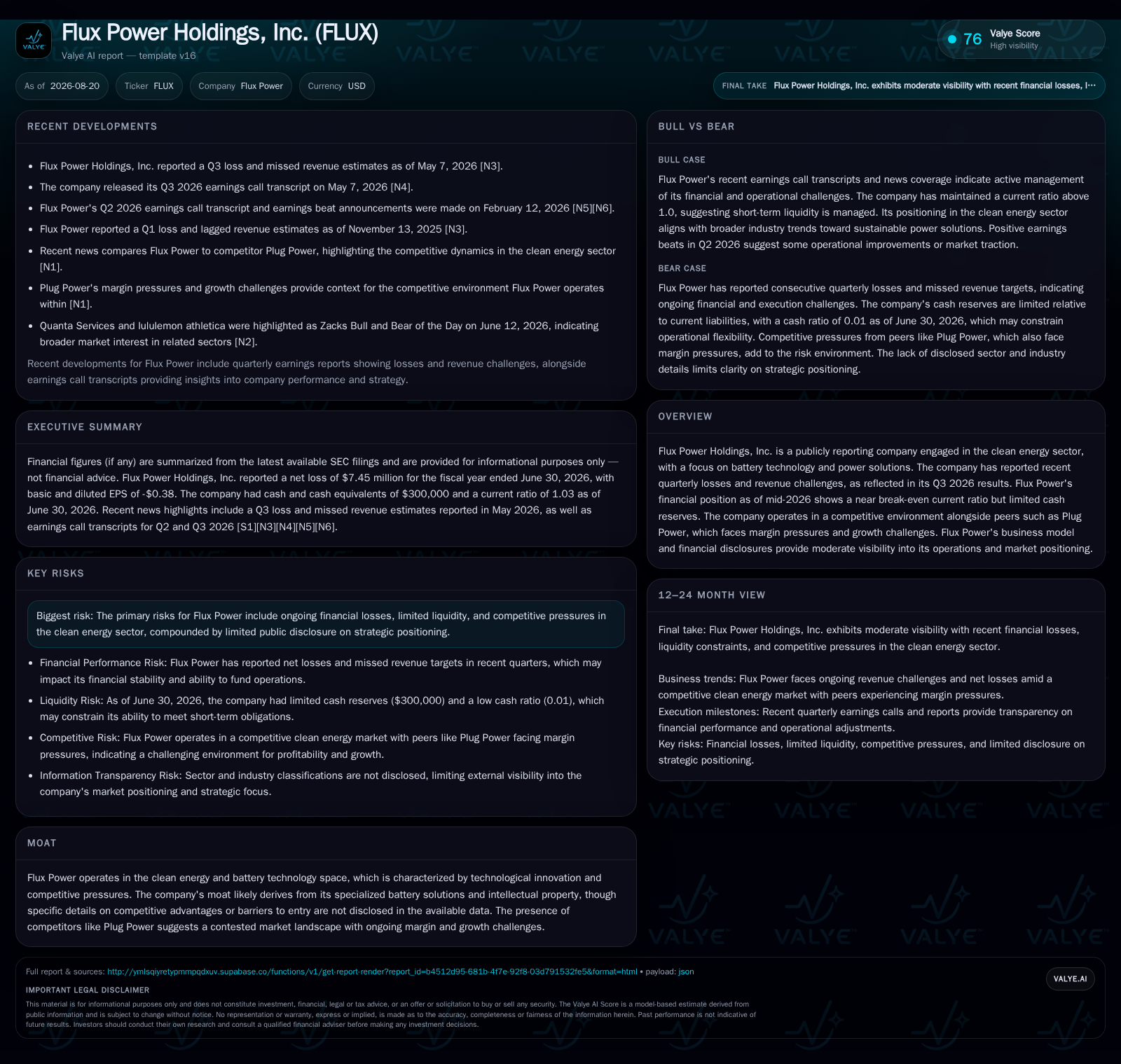
In Q3 2026, Flux Power Holdings experienced a decline in revenue alongside continued operating losses, reflecting persistent sales and margin pressures. The company's liquidity remains constrained, with a current ratio of 1.03 and cash reserves of only $300,000 as of June 30, 2026. These financial conditions indicate limited operational flexibility amid competitive dynamics in the lithium-ion battery sector for industrial motive power applications.
Flux Power Holdings, Inc. reported a decline in revenue and continued operating losses for the third quarter ended June 30, 2026, reflecting ongoing challenges in the competitive clean energy battery market [S3][S2]. The company's liquidity remains constrained, with a current ratio of 1.03 and limited cash reserves, indicating tight working capital and limited cash flow capacity amid cost pressures and competitive dynamics [S3][F1]. These financial conditions suggest that Flux Power may face challenges in sustaining operations without improvements in operational efficiency or market conditions [S1].
Liquidity metrics further underscore financial strains. As of June 30, 2026, Flux Power’s current ratio was 1.03, indicating working capital is just sufficient to cover current liabilities but leaves little room for operational flexibility [F1]. Cash and cash equivalents stood at a constrained $300,000, limiting the company’s capacity to fund ongoing operations or invest in growth without external financing [F1]. The balance sheet showed current assets of $20.7 million against current liabilities of $20.05 million at quarter-end, reinforcing the tight liquidity position [F1].
Business Model and Competitive Environment
Flux Power operates in the industrial battery manufacturing sector, specializing in lithium-ion battery systems and battery management solutions designed primarily for motive power applications such as forklifts and other material handling equipment [S1]. Its customers are industrial and commercial operators seeking to replace traditional lead-acid batteries with higher energy density, longer cycle life lithium-ion alternatives.
Revenue generation relies mainly on product sales of lithium-ion battery packs and integrated battery management systems, with ancillary services like installation and support potentially contributing [S1]. Margins in this sector depend heavily on manufacturing efficiency, scale, and product pricing. Competitive pressures from other battery manufacturers and ongoing technological innovation in battery chemistry and management systems constrain pricing power and market share expansion.
Financial Position and Liquidity Analysis
The near break-even current ratio of 1.03 as of June 30, 2026, reflects a working capital position that is barely positive, restricting Flux Power’s operational flexibility and capacity to absorb unforeseen expenses or invest in growth initiatives [F1]. The limited cash reserves of $300,000 further constrain liquidity, raising concerns about the company’s ability to sustain operations without improved cash flow or successful capital raising [F1].
This tight liquidity environment is particularly challenging given the capital-intensive nature of industrial battery manufacturing, where investments in manufacturing scale, R&D, and inventory management are critical for competitiveness. Without sufficient cash or working capital buffers, the company may face difficulties in managing supply chain demands, supporting sales growth, or responding to competitive pressures.
Analytical Conclusions and Scenarios
Flux Power’s continued operating losses and declining revenue in Q3 2026 highlight ongoing challenges in a contested clean energy battery market characterized by intense competition and limited pricing power [S2][S1]. The company’s near break-even current ratio and minimal cash reserves as of June 30, 2026, indicate constrained liquidity that may limit operational flexibility and the ability to invest in growth or weather market volatility [F1].
One plausible downside scenario is that if Flux Power fails to improve sales or secure additional capital, liquidity constraints could force operational cutbacks or restructuring. This scenario would become more credible if upcoming quarters show further revenue declines, deteriorating liquidity ratios, or disclosures of cost-cutting measures [S2][F1]. Conversely, a base case scenario involves maintaining current operations with modest revenue growth and continued cost control, sustaining the company’s position amid tight liquidity but without significant capital infusion [S2][F1].
Watchpoints
Investors and stakeholders should monitor several key indicators in upcoming quarters: trends in revenue and operating margins will signal whether Flux Power can stabilize or grow sales amid competitive pressures. Changes in cash reserves and the current ratio, which stood at $300,000 and 1.03 respectively as of June 30, 2026, will provide insight into liquidity dynamics and operational sustainability [F1]. Additionally, announcements regarding capital raising efforts or restructuring initiatives will be critical to assess the company’s ability to address its constrained financial position. Competitive developments in the clean energy battery sector, including technological innovation and pricing dynamics, will also influence Flux Power’s prospects.
In summary, Flux Power’s Q3 2026 results reflect ongoing financial and operational challenges in a competitive industrial battery market. The company’s constrained liquidity and revenue pressures underscore the importance of closely watching its financial trends and strategic responses in the near term.
Disclaimer: This is research-only, informational analysis and not investment advice. It may include AI-generated interpretation and general industry context. Always verify important details using primary sources.

Comments