
Farmers & Merchants Bancorp's Regional Focus and Agricultural Lending Shape Growth and Capital Strategy
The Ohio-based bank holding company leverages a century-old local presence and diversified loan portfolio concentrated in agriculture to sustain steady income and manage regulatory capital demands.
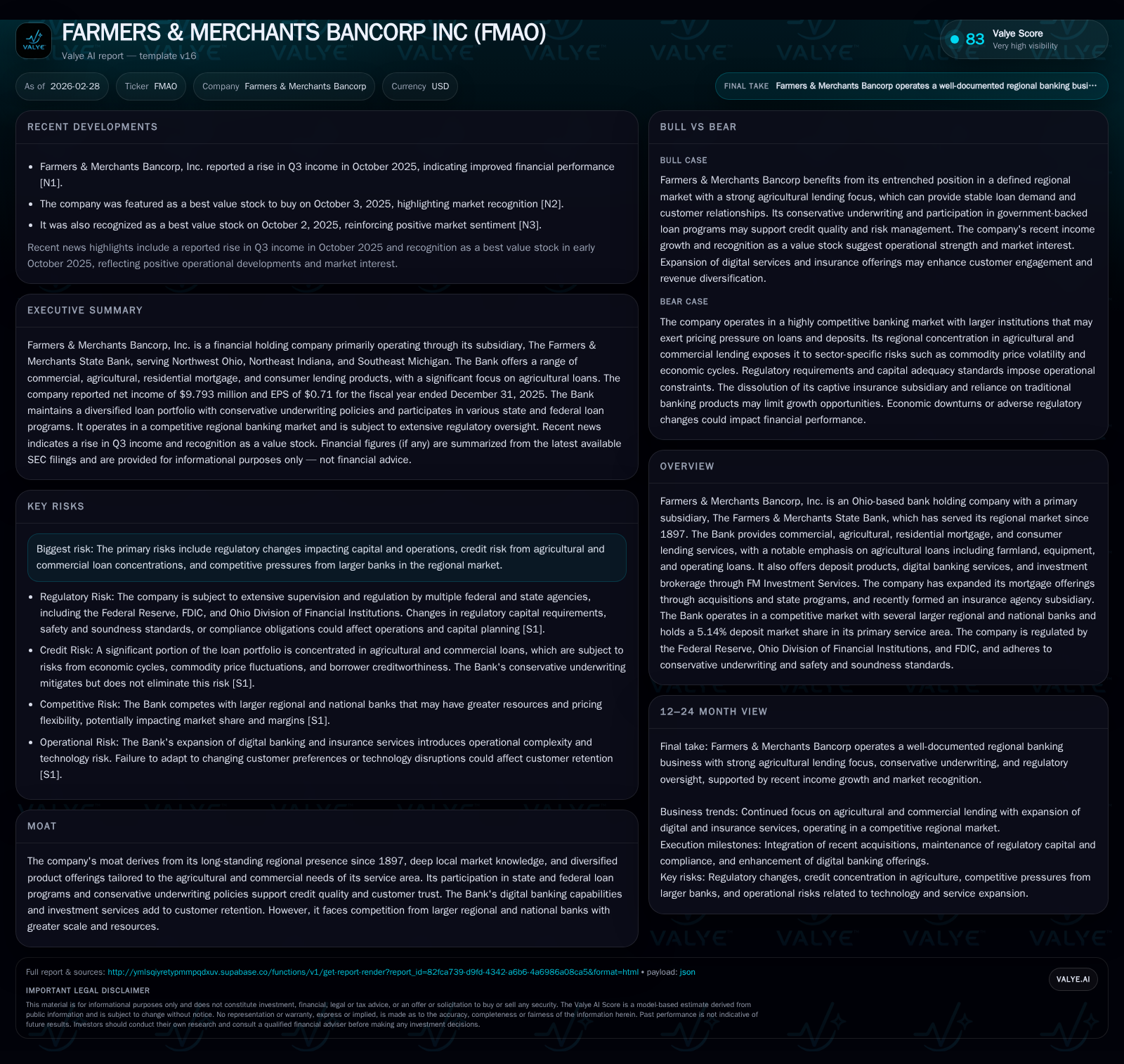
Farmers & Merchants Bancorp, Inc., with its flagship subsidiary The Farmers & Merchants State Bank, operates predominantly in Ohio and neighboring states, emphasizing commercial and agricultural loans. Its historical roots since 1897 underpin a moat enhancing customer loyalty, supported by conservative underwriting and participation in state programs. Earnings grew steadily over recent years driven by loan portfolio expansion and acquisitions, notably in mortgage services. The holding company maintains a well-capitalized balance sheet under Basel III norms and Federal Reserve oversight, balancing dividend payments with modest buybacks amid evolving regulatory scrutiny. Future growth hinges on regional economic conditions, competitive pressures from larger banks, and sustained credit quality within its concentrated agricultural segments.
Company Background and Regional Market
Farmers & Merchants Bancorp, Inc., incorporated in Ohio in 1985 as a bank holding company, commands a legacy through its primary subsidiary The Farmers & Merchants State Bank tracing back to 1897. The Bank’s footprint spans northwest Ohio, northeast Indiana, and southeast Michigan — engaging both rural agricultural communities and commercial centers. This entrenched local presence crafts the company's moat via longstanding customer relationships, specialized market knowledge, and tailored financial solutions that suit both agrarian clients and small-to-medium businesses.
Its market share stands at approximately 5.14% for deposits as of mid-2025 in its core service area [S13]. This places it fourth amid competitors including large national players such as Huntington National Bank, Fifth Third Bank, PNC, Wells Fargo, KeyBank, and JPMorgan Chase — underscoring the challenges inherent in scaling beyond regional roots.
Lending Portfolio Concentration
A distinctive characteristic of Farmers & Merchants Bancorp is its substantial agricultural loan concentration. The loan book includes financing for farmland acquisition, farm equipment purchases, livestock operations, seed/fertilizer inputs, and operating lines for agribusinesses [S1,S17]. Alongside agriculture-focused lending, the Bank has broadened exposure to commercial real estate and industrial loans reflective of recent expansions into newer markets.
The underwriting philosophy prudently imposes collateral-based limits: e.g., loans on crops carry maximum LTVs up to around 75%, livestock up to 80%, new vehicles up to wholesale value caps of 100%, with more conservative percentages for restaurant equipment or heavy trucks [S4,S17]. These measures reflect carefully calibrated risk appetite aligned with supervisory safety norms.
Mortgage offerings have evolved through strategic acquisitions in recent years including Perpetual Federal Savings Bank (2021) and Peoples Federal Savings (2022), augmenting fixed rate slab mortgages for residential customers [S17]. In tandem with these organic efforts, the Bank participates in state-supported programs like Ag-Link and Ohio Homebuyers Plus to offer competitive borrowing advantages particularly benefiting low- to moderate-income segments.
Historical Financial Performance
Over the last four fiscal years ending December 31st 2025, net income demonstrated a resilient upward trend despite sector volatility:
Historical performance (annual)
| FY | Net ($mm) | CFO ($mm) | Capex ($mm) | Net YoY |
|---|---|---|---|---|
| 2025 | 10 | 37 | 2 | +16.8% |
| 2024 | 8 | 32 | 2 | +51.2% |
| 2023 | 6 | 22 | 11 | -22.9% |
| 2022 | 7 | 41 | 3 |
Source: SEC companyfacts cache [F1].
Capital returns and efficiency (annual)
| FY | Div ($mm) | Buybacks ($) | FCF ($mm) |
|---|---|---|---|
| 2025 | 12 | 362000 | 35 |
| 2024 | 12 | 664000 | 31 |
| 2023 | 11 | 218000 | 11 |
| 2022 | 10 | 308000 | 38 |
Source: SEC companyfacts cache [F1].
The net income growth between FY2024 and FY2025 was approximately 16.8% with operating cash flows improving by circa 13%. Notably capex spending decreased markedly after an elevated outlay in FY2023 possibly related to technology or branch infrastructure upgrades that year [F1].
Equity has expanded steadily reflecting retained earnings alongside modest dividend payout increases consistently near $12 million per annum since FY2023 demonstrating a stable shareholder return policy alongside cautious share repurchasing activity.
Capital Allocation and Returns
Capital allocation reflects prudence consistent with regulatory conservatism exhibited by community banks holding significant agricultural credit risk [S5,S6]. Dividend payments occupy an important portion of free cash flow while buybacks remain nominal—partly due to maintaining surplus capital buffers required under Basel III measures overseen by the Federal Reserve Board [S5].
The approximate annual return on equity stood near 2.6% for FY2025—a figure indicative of modest profitability typical within community banking where risk-adjusted parameters prioritize capital preservation over aggressive returns [F1]. Cash flow from operations sufficiently supports capex needs after dividend distributions leaving healthy free cash flow available for opportunistic redeployment if strategic conditions arise.
Regulatory Environment and Risk Factors
The company operates under close regulatory supervision from multiple authorities: the Federal Reserve as a financial holding company regulator; Ohio Division of Financial Institutions; the FDIC; and compliance frameworks addressing consumer lending fairness (CFPB rules), anti-money laundering statutes (BSA/USA PATRIOT), cybersecurity mandates among others .
Farmers & Merchants maintains "well capitalized" status under prompt corrective action rules limiting restrictions on brokered deposits or growth initiatives [S5,S6]. The company also recently formed an insurance agency subsidiary broadening non-lending financial services offerings which could generate fee income while diversifying revenue beyond interest-dependent segments [S1].
Concentration risks remain foremost among credit exposures given the agricultural focus vulnerable to commodity price cycles or weather-related risks; however underwriting policies cap LTV ratios tightly [S1,S4]. Competition poses an inherent threat as larger regional/national banks exhibit scale advantages across technology investments or product breadth.
Future regulatory developments such as revisions to Basel III "endgame" standards or changes in Community Reinvestment Act criteria could materially affect capital planning or expansion capabilities [S25]. The Bank continues monitoring legal developments particularly regarding consumer lending data requirements under ECOA amendments enforced by CFPB yet subject to litigation delay [S21].
Strategic Growth Drivers and Outlook Analysis
While explicit forward guidance is unavailable from filings reviewed [N#], several factors imply potential avenues for continued growth:
- Continued penetration into adjacent geographic markets leveraging existing Loan Production Offices in Ohio and Indiana with focused marketing on commercial-industrial sectors [S1]
- Expanded mortgage product origination supported by state mortgage assistance programs maintaining affordability appeal [S17]
- Incremental diversification into insurance products through F&M Insurance Agency expanding cross-selling opportunities [S1]
- Digital platform enhancements improving customer onboarding/remittance experience enticing younger demographics while preserving traditional client satisfaction [S10]
Conversely growth ceilings may emerge from limited scale versus established banking conglomerates wielding superior technology ecosystems; the cyclical nature of agricultural client income streams; evolving compliance costs demanding resource intensiveness; plus deposit cost pressures exacerbated by interest rate volatility observed sector-wide post-2023 stress events [S8].
Conclusion
Farmers & Merchants Bancorp’s enduring heritage anchored in regional markets has cultivated intimate local knowledge leveraged into targeted lending primarily serving agriculture alongside commercial enterprises spanning multiple Midwestern states. Conservative underwriting frameworks combined with gradual service line diversification reinforce the company’s safe-and-sound stature evident through consistent profitability rising net income trends, robust operational cash flow generation, disciplined capital management delivering steady dividends without excessive share buybacks.
Regulatory vigilance remains high post-pandemic stress scenarios triggering increased scrutiny especially regarding liquidity resilience measures complemented by community reinvestment obligations shaping ongoing strategic choices.
Fresh growth will likely originate through leveraging mortgage platform expansions assisted by public programs coupled with digital banking enhancements nurturing customer franchise enrichment amidst industry consolidation headwinds posed by multi-billion-dollar regional banks competing aggressively across similar footprints.
This report synthesizes publicly available SEC filings dated through February 2026 along with company-provided descriptions without issuing investment recommendations.
Disclaimer: This is research-only, informational analysis and not investment advice. It may include AI-generated interpretation and general industry context. Always verify important details using primary sources.

Comments