
Farmhouse, Inc. 2026 Q2: Digital Asset Strategy Advances Amid Liquidity Constraints
Farmhouse, Inc. reports no revenue and a significant working capital deficit in Q2 2026 while advancing its digital asset treasury subsidiary.
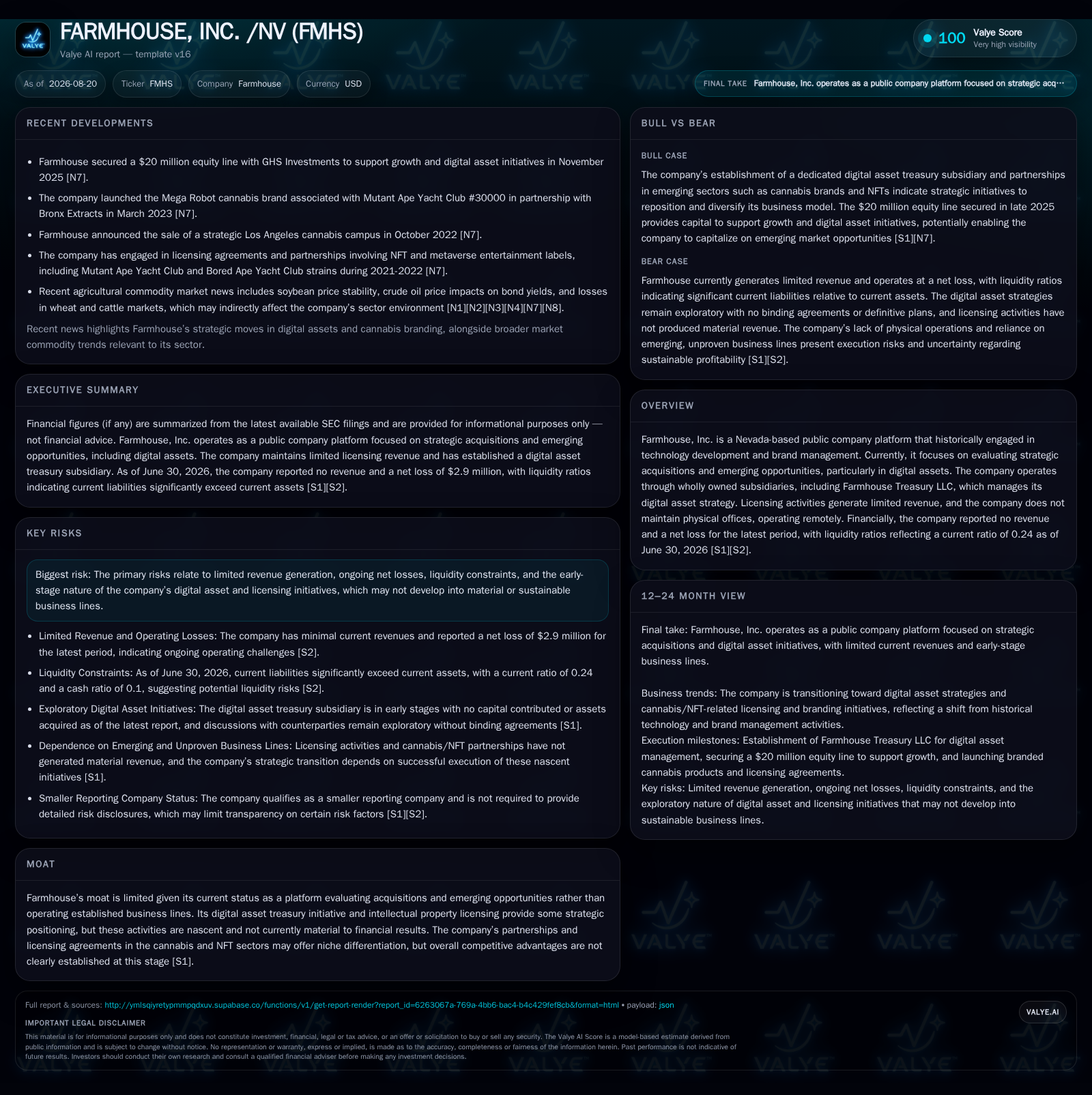
Farmhouse, Inc. remains a public company platform focused on intellectual property licensing and emerging digital asset initiatives as of Q2 2026. The company reported no revenue and a net loss for the quarter, consistent with its limited operating business lines. Its liquidity position is constrained, with current liabilities of approximately $7.0 million far exceeding current assets of $1.7 million, resulting in a current ratio of 0.24. Meanwhile, the wholly owned subsidiary Farmhouse Treasury LLC, formed in late 2025, manages the company’s Anti-Debasement Digital Asset Treasury initiative, which is still in an exploratory phase without capital contributions or digital asset acquisitions.
Q2 2026 Operating and Financial Update
Farmhouse, Inc. reported no revenue and a net loss for the quarter ended June 30, 2026, consistent with its status as a public company platform with limited operating business lines [S2]. The absence of revenue underscores the company’s current reliance on licensing activities that have yet to generate material income. Financially, Farmhouse faces significant liquidity constraints. Its balance sheet as of June 30, 2026, shows current liabilities of approximately $7.0 million far exceeding current assets of $1.7 million, resulting in a current ratio of 0.24 [F1]. Cash and cash equivalents totaled $678,462, indicating limited cash reserves to support ongoing operations [F1]. This working capital deficit highlights a critical liquidity risk that could impair the company’s ability to meet short-term obligations and fund strategic initiatives without external financing.
Business Model and Strategic Initiatives
In September 2025, Farmhouse formed Farmhouse Treasury LLC, a wholly owned subsidiary created to manage its Anti-Debasement Digital Asset Treasury (DAT) initiative [S1]. This initiative targets investments in Bitcoin and tokenized or physical gold assets held under institutional-grade custody with BitGo, a custodian that provides insurance coverage and is pursuing a national trust bank charter [S1]. The establishment of Farmhouse Treasury LLC creates a dedicated entity for exploring digital asset market participation, though no capital contributions or asset acquisitions had occurred as of the latest report.
At formation, Farmhouse Treasury LLC received no capital contributions, and no digital assets have been acquired as of Q2 2026 [S1]. The subsidiary remains in an exploratory phase, engaging in preliminary discussions with cryptocurrency financing and investment platforms but without binding agreements or definitive plans [S1]. With current liabilities of approximately $7.0 million vastly exceeding current assets of $1.7 million, Farmhouse’s current ratio stands at a low 0.24 [F1]. This working capital deficit signals that the company does not have sufficient short-term assets to cover its immediate liabilities, raising questions about its near-term operational flexibility.
Cash and cash equivalents totaled $678,462 as of the quarter-end, which is limited relative to the scale of current liabilities [F1]. The absence of positive operating cash flow and reliance on limited licensing revenue exacerbate these liquidity constraints [S2]. Without improvement in cash reserves or access to external financing, Farmhouse may face challenges in funding ongoing operations, pursuing strategic acquisitions, or advancing its digital asset initiatives.
This liquidity risk is particularly acute given the company’s platform status and lack of material operating business lines. Current liabilities exceed current assets by over $5 million, and cash reserves totaled $678,462 as of June 30, 2026 [F1], indicating liquidity risk that could impact ongoing operations and strategic initiatives. This constraint underscores the importance of securing additional capital or generating revenue to stabilize the balance sheet.
The subsidiary’s institutional custody arrangements and focus on Bitcoin and tokenized gold assets establish a framework that could support future capital deployment; however, the absence of current capital contributions or asset acquisitions indicates that the initiative remains at an exploratory stage.
Looking forward, one possible positive scenario is that Farmhouse successfully deploys capital into appreciating digital assets under its Anti-Debasement framework and develops revenue-generating licensing or operating businesses. Confirmation would come from disclosures of digital asset holdings, revenue growth, and improved liquidity metrics [S2]. Such developments could enable the company to transition from a platform to a scalable operating entity, improving its financial health and strategic positioning.
Additionally, disclosures of capital raises or financing transactions and updates on Farmhouse Treasury LLC’s investment activities and counterparties will be critical indicators of the company’s progress in overcoming liquidity constraints and advancing its strategic initiatives.
Its digital asset treasury subsidiary represents a strategic but nascent initiative that could shape future growth. However, the company’s near-term operational flexibility is materially constrained by its working capital deficit, underscoring the importance of capital deployment success and liquidity improvement for its strategic outlook.
Disclaimer: This is research-only, informational analysis and not investment advice. It may include AI-generated interpretation and general industry context. Always verify important details using primary sources.

Comments