
Greater Cannabis Company Advances Neuropsychiatric Cannabinoid Therapeutics Amid Funding and Regulatory Challenges
GCAN progresses toward Phase II clinical trials for its licensed cannabinoid drug, navigating operational scale constraints and liquidity pressures while strengthening governance.
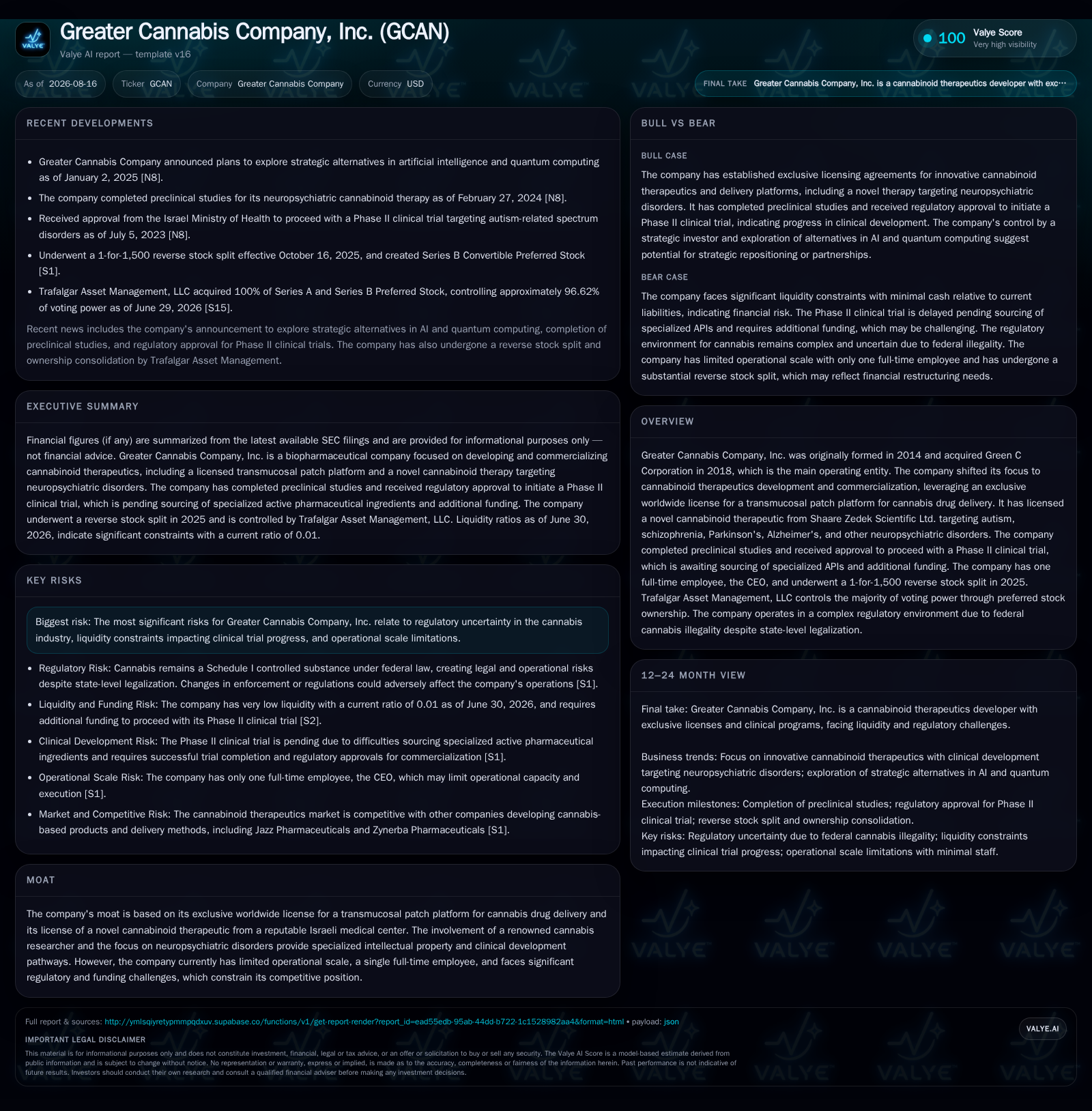
Greater Cannabis Company, Inc. is advancing development of cannabinoid-based therapeutics targeting neuropsychiatric disorders through exclusive licenses of a transmucosal patch delivery platform and a novel cannabinoid formulation from Shaare Zedek Scientific. Following completed preclinical studies and regulatory approval to initiate a Phase II clinical trial in Israel, trial commencement is delayed due to challenges in sourcing specialized active pharmaceutical ingredients (APIs) and the need for additional funding. Recent governance enhancements include appointment of new directors and C-suite executives, alongside Trafalgar Asset Management consolidating control via preferred stock ownership. Despite these steps, GCAN operates with minimal staff and limited liquidity, highlighting execution risks amid a complex regulatory environment.
Recent Operating Update
Greater Cannabis Company, Inc. (GCAN) disclosed in its August 14, 2026 10-Q filing that it remains poised at the threshold of advancing from preclinical research into active clinical development. The company holds exclusive worldwide licenses for a transmucosal patch platform optimized for cannabinoid drug delivery alongside rights to a novel cannabinoid therapeutic licensed from Shaare Zedek Scientific Ltd., targeting neuropsychiatric indications including autism spectrum disorder, schizophrenia, Parkinson's disease, and Alzheimer's disease [S2], [S1]. After completing preclinical studies as announced in February 2024, GCAN secured regulatory approval from the Israeli Ministry of Health in July 2023 to initiate a Phase II clinical trial [S1]. However, the start of this trial has been delayed pending the procurement of specialized active pharmaceutical ingredients (APIs) essential for formulation—a supply chain challenge commonly faced in cannabinoid therapeutics development [S1].
Alongside operational developments, GCAN has strengthened its governance framework. On July 29, 2026, three new directors—Carlos Septián (COO), Michelle Cervantes Vivanco (CFO), and Ernesto Gómez Berjón (Chief Growth Officer)—were appointed to enhance executive leadership during this pivotal transition [S3], [S27]. This governance expansion follows Trafalgar Asset Management’s consolidation of controlling interest through majority ownership of Series A and B preferred shares as of June 29, 2026 [S13], [S16]. This concentrated ownership structure enables Trafalgar to exercise decisive influence over corporate strategy.
Financially strategic moves include GCAN's execution of a one-for-1,500 reverse stock split effective October 2025 aimed at restructuring common equity capitalization ahead of anticipated corporate actions such as an imminent corporate name change [S20], [S10]. Such capital restructuring often precedes fundraising or partnership initiatives vital in early-stage biotech.
Business Model Analysis
GCAN’s business model centers on leveraging licensed intellectual property—specifically an eluting transmucosal patch platform—and proprietary cannabinoid therapeutics developed through collaborations with medical research institutions. Revenue streams are primarily derived from annual licensing fees starting at $5,000 per year with stepwise escalations up to $30,000 over time; milestone payments triggered by key clinical events ($75,000 upon Phase II trial initiation; $200,000 at Phase III start; $300,000 upon first regulatory drug approval); and scaled royalty payments contingent upon net sales thresholds for dietary supplements and drug products [S1]
This milestone-driven licensing approach aligns with typical biotech models where value crystallizes upon successful clinical progression rather than product sales at early stages. The company must secure substantial external capital primarily earmarked for funding its Phase II clinical trial estimated to span 18–24 months post-initiation [S1], [S17].
Historically shifting from direct commercialization efforts focused on cannabis consumer products through mid-2021 towards R&D-centric therapeutic innovation reflects strategic repositioning aimed at higher-margin pharmaceutical opportunities [S1]. The transmucosal patch platform offers clinically relevant advantages by enabling non-invasive delivery through buccal mucosa absorption—potentially improving patient compliance especially within neurological disorder therapies
Operationally GCAN has been lean; prior disclosures indicate only one full-time employee—the CEO—underscoring significant execution risk given the complexity involved in coordinating clinical trials requiring interactions with contract research organizations (CROs), regulators including eventual FDA submissions, specialized API suppliers, and research partners such as Shaare Zedek Medical Center.
Industry Structure and Competitive Position
Operating within the Biotechnology - Cannabinoid Therapeutics sector—a specialized intersection of pharmaceutical R&D rigor and emerging cannabis science—GCAN positions itself as a clinical-stage developer relying on licensed IP assets rather than integrated cultivation or product distribution.
Its competitive set includes firms like Jazz Pharmaceuticals (NASDAQ: JAZZ), which markets specialty pharma products encompassing cannabinoid-based drugs such as Epidiolex; and Zynerba Pharmaceuticals (NASDAQ: ZYNE), which focuses on transdermal cannabinoid therapies for neuropsychiatric conditions. These peers exemplify how proprietary delivery platforms combined with rigorous clinical programs drive valuation inflection points via milestone achievements or approvals. Both rely heavily on milestone-triggered revenues during development phases.
GCAN's unique value proposition lies in its exclusive license rights over an innovative transmucosal patch delivery system coupled with access to novel cannabinoid formulations originating from reputable medical research institutions. While providing differentiation within this niche segment, these assets have yet to translate into commercial-scale revenues.
Growth Drivers
Key growth catalysts for GCAN include advancing its lead therapeutic candidate through Phase II trials yielding positive safety and efficacy data—critical prerequisites for initiating pivotal studies necessary for FDA marketing applications. Successful trial outcomes would unlock milestone payments underpinning near-term revenue recognition.
Broader tailwinds stem from expanding global legalization trends facilitating increased investor interest in pharmaceutical-grade cannabinoid therapies. Improvements in API manufacturing capabilities could mitigate current supply constraints delaying trial initiation.
Strategic partnerships or collaborations with larger pharmaceutical companies may provide essential capital infusion and commercialization expertise enabling downstream royalty capture and global market penetration.
Risks and Watchpoints
Prominent risks include:
- Regulatory uncertainty arising from conflicting federal and state cannabis laws restricts research flexibility and complicates commercial pathways within major markets such as the U.S. [S11], [S17].
- Persistent challenges sourcing specialized APIs delay critical Phase II trial commencement exacerbating cash burn amid limited internal liquidity.
- Minimal operational staffing prior to recent hires elevates managerial bandwidth risks during complex clinical coordination.
- Financial position reflects high leverage relative to cash reserves ($111 cash vs.
$171K debt as of mid-2026) resulting in an extremely low current ratio (0.01), signaling acute liquidity constraints without near-term financing [F1]. - Dependence on binary milestone payments linked directly to uncertain clinical outcomes introduces revenue volatility.
- Market acceptance hurdles exist regarding novel transmucosal delivery methods compared with traditional oral dosage forms.
What To Watch Next
Investors should monitor:
- Successful procurement of required APIs enabling formal Phase II clinical trial launch.
- Impact of expanded leadership team on operational execution post-July 2026 appointments [S27].
- Progress toward FDA Investigational New Drug (IND) application submissions following Phase II data availability.
- Recognition timing of milestone payments associated with clinical phase initiations confirming development progress.
- Corporate actions related to upcoming name change alongside potential partnership or financing announcements enhancing capital resources.
Financial Profile Discussion
As of June 30, 2026, GCAN held approximately $111 in cash equivalents against current liabilities exceeding $12K resulting in severely constrained liquidity reflected by a current ratio near 0.01 [F1]. Total debt was approximately $171K at December 31, 2025 [F1], indicating considerable leverage relative to asset levels amid ongoing net losses driven by R&D expenses without meaningful recurring revenues beyond modest historical product sales [$7K last disclosed] [F1].
Recent acquisition of controlling voting interest by Trafalgar Asset Management through preferred stock purchases combined with debt cancellation agreements suggest institutional backing that may facilitate improved governance oversight though immediate working capital needs remain acute given impending Phase II expenditures [S13], [S16].
Conclusion
Greater Cannabis Company operates within a highly specialized niche focused on developing innovative cannabinoid therapeutics delivered via proprietary transmucosal platforms targeting neuropsychiatric disorders. While exclusive licensing arrangements provide defensible intellectual property advantages relative to peers like Jazz Pharmaceuticals or Zynerba Pharmaceuticals—who have more advanced pipelines or commercial products—GCAN faces significant near-term challenges including API sourcing delays compounded by precarious liquidity despite recent governance enhancements aimed at supporting growth execution. The company's ultimate success hinges on timely commencement and favorable outcomes from its Phase II clinical trial coupled with sustained capital influxes secured through milestone recognitions that underpin longer-term viability amid complex regulatory landscapes. Ongoing monitoring of operational milestones alongside financial health indicators will be critical for assessing progress within volatile biotech development cycles.
This analysis is based solely on publicly available SEC filings dated through August 14, 2026 ([S2],[S3],[S1]) supplemented by financial data ([F1]). It is provided for informational purposes only without investment advice or research views.
Disclaimer: This is research-only, informational analysis and not investment advice. It may include AI-generated interpretation and general industry context. Always verify important details using primary sources.

Comments