
Graphene & Solar Technologies Leverages Patent Assets to Advance Silicon Wafer Manufacturing Amid Financing Challenges
GSTX progresses toward silicon wafer production with a $45M California tax credit and refreshed leadership, balancing innovation with acute liquidity risks.
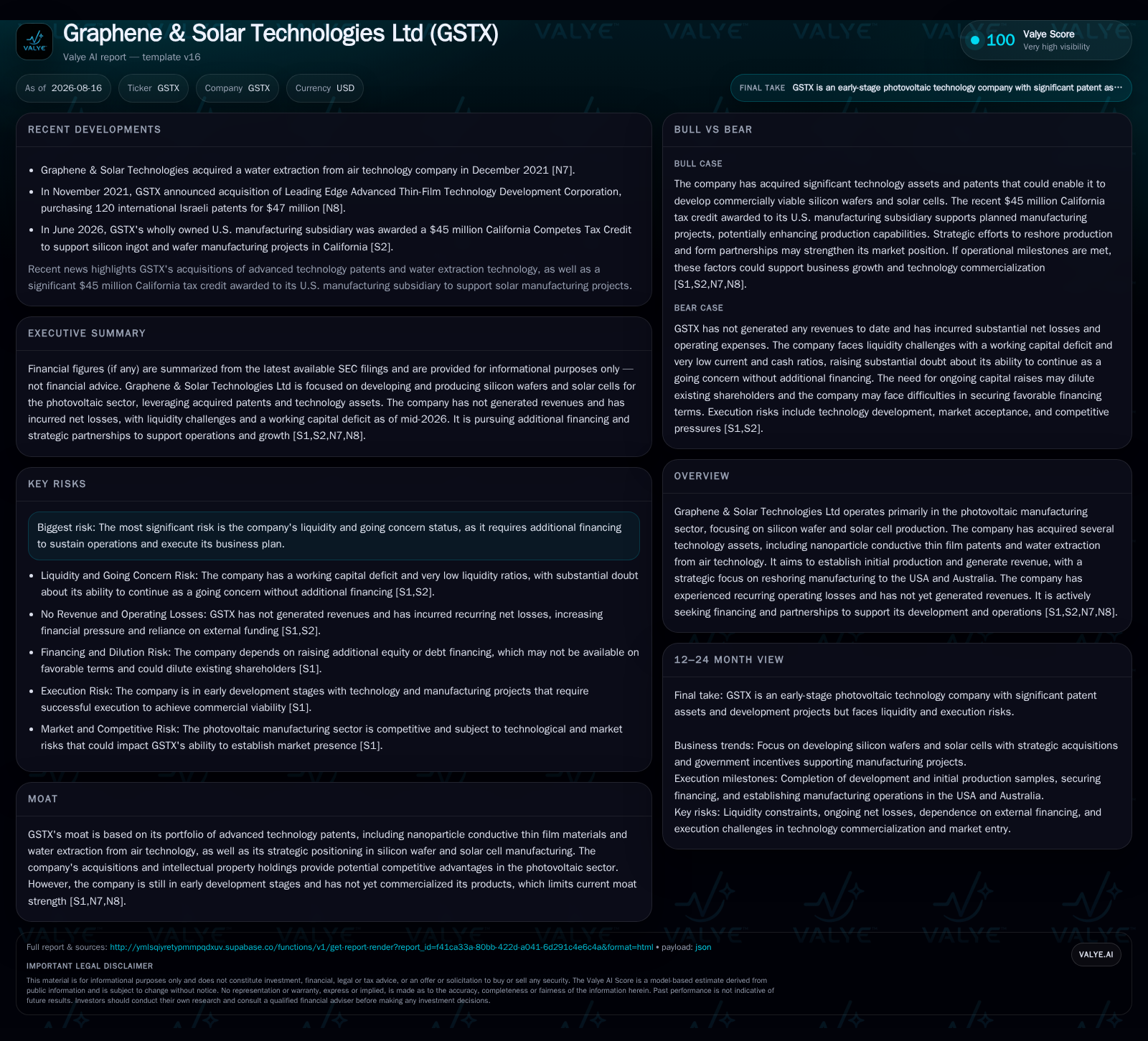
Graphene & Solar Technologies Ltd (GSTX) is advancing development of silicon wafer and solar cell manufacturing anchored by proprietary nanoparticle conductive thin film patents and recent government incentives. The award of a $45 million California Competes Tax Credit provides strategic support for planned US-based manufacturing facilities, aligning with the company’s reshoring and supply chain localization aims. However, GSTX remains in an early-stage development phase without revenue generation, facing significant liquidity constraints and going concern risks driven by high capital requirements and ongoing operating losses.
Latest Quarter Highlights: Tax Credit Win and Leadership Refresh Signal Strategic Momentum
Graphene & Solar Technologies Ltd (GSTX) reported its latest quarterly updates on August 14, 2026 [S2], largely focused on operational developments and risk disclosures consistent with its early-stage development profile. A standout milestone was the June 23 announcement that its wholly owned U.S. subsidiary, The Quartz & Silicon Materials Company Limited (QSM USA), received a $45 million California Competes Tax Credit; this five-year award is explicitly aimed at supporting GSTX's planned silicon ingot and wafer manufacturing projects in California [S9][S10]. This substantial government incentive reduces capital expenditure pressure on the company's reshoring initiative, which seeks to establish domestic upstream photovoltaic component manufacturing during global supply chain uncertainties.
Simultaneously, GSTX refreshed its governance with two new board members appointed on June 26, 2026—Daniel Kennedy and Theresa Jester—both bringing relevant solar industry experience which could be pivotal for strategy execution as GSTX advances from development toward commercial production [S3]. These appointments indicate an organizational strengthening effort aligned with scaling operations.
Technology Portfolio & Manufacturing Focus: Leveraging Nanoparticle Conductive Films for Silicon Wafers
GSTX's core technology foundation is anchored in its acquired intellectual property portfolio, notably from the Specialty Material Group acquisition completed in September 2021. This includes patents related to nanoparticle conductive thin film materials which are applied within advanced photovoltaic manufacturing processes [S1]. The company emphasizes upstream production of silicon wafers and solar cells over downstream assembly into modules, aiming to differentiate through these proprietary conductive films that may enhance photovoltaic efficiency or reduce production costs per watt.
Currently focused on establishing initial sample production of commercially viable wafers and cells targeting fiscal year 2025 for initial revenue generation [S1][S2], GSTX is still navigating typical developmental hurdles for technology commercialization such as ramping production yield rates and conversion efficiency benchmarks. While its patent portfolio provides some competitive insulation against commoditized crystalline silicon manufacturing, actual technology advantages remain unproven at scale.
Competitive Landscape: GSTX Position Versus Tier-One Silicon Wafer Manufacturers
The upstream solar photovoltaic manufacturing space is dominated by large integrated firms like LONGi Green Energy and REC Group that command economies of scale reflected in higher production capacities (measured typically in gigawatts of wafer output), optimized conversion efficiency rates, cost-effective operations, and robust customer qualification pipelines. These incumbents set pricing norms downstream affecting suppliers’ margin potential. GSTX’s strategy of leveraging proprietary nanoparticle conductive films positions it more as a technology innovator than a commodity supplier currently.
While GSTX does not yet compete on capacity or output volumes, its focus on reshoring wafer production—with localized supply chains reducing exposure to global trade disruptions—raises the prospect of incremental pricing power if successful. However, market acceptance depends heavily on proof points such as sample quality consistency, customer certifications, and demonstration of scalable yields versus established peers.
Growth Levers: Reshoring Manufacturing in USA & Australia Amid Industry Localization Trends
In line with broader industry trends catalyzed by geopolitical trade tensions and sustainability initiatives under frameworks like the Inflation Reduction Act (IRA), GSTX aims to reestablish upstream photovoltaic component manufacturing domestically in both the United States and Australia to reduce logistics complexity and tariff exposure [S1]. The recently awarded California Competes Tax Credit materially strengthens funding visibility for these endeavors [S9], signaling governmental alignment with renewable energy sector localization efforts.
This geographic diversification could also align GSTX closely with utility-scale solar project developers prioritizing regional supply resilience. Yet reshoring imposes capital intensity pressures requiring sizeable investments in facilities capable of high-capacity ingot casting, wafer slicing with high utilization rates, reliable production yields, and integration of its nanoparticle conductive film technologies into manufacturing processes.
Risks & Bottlenecks: Capital Intensity, Execution Timelines & Pre-Revenue Status
GSTX's financial position as of June 30, 2026 shows cash and equivalents of approximately $50,000 against current liabilities exceeding $5.3 million, resulting in a current ratio near 0.01—indicative of significant working capital constraints that may require prompt recapitalization to sustain operations [F1]. This highlights existential risks related to ongoing operations continuity without swift additional funding rounds.
Operationally, transitioning from patent portfolio ownership to pilot-scale production involves execution risks including achieving targeted wafer production yields and conversion efficiencies sufficient for industry qualification—milestones necessary but not yet evidenced publicly [S1][S2]. Patent amortization over roughly seven years caps asset valuation duration adding pressure for timely commercialization. External factors like raw material sourcing volatility or accelerated innovation cycles demand agility which early-stage firms often struggle to manage relative to established players [S6][S7][S8].
Should financing gaps widen or technological adoption delays persist, GSTX might face stringent measures such as seeking strategic alliances involving relinquishment of IP rights or even ceasing operations [S18][S20].
What Investors Should Watch Next: Financing Milestones, Pilot Production, Customer Qualification
Key upcoming indicators will be securing additional equity or debt financing rounds required to support operational burn beyond existing minimal liquidity [S2][S1]. Progress towards pilot-scale silicon ingot casting followed by wafer slicing samples qualifying for customer testing will serve as tangible proofs validating product-market fit potential. Monitoring any formal partnerships or collaborations with incumbent manufacturers would also signal confidence in GSTX’s technologies and business model.
Given the upstream value-chain focus at pre-revenue stage, order backlogs or firm customer commitments remain aspirational but are important KPIs once production ramps begin. Observing improvements in capacity utilization rate and yield metrics will inform whether patented thin film materials translate into operational efficiencies competitive against peers such as LONGi Green Energy or REC Group.
Financial Profile Discussion: Cash Burn Dynamics and Liquidity Challenges in Development Phase
GSTX’s financial state at the most recent quarter highlights severe constraints typical of pre-commercial-stage clean energy technology developers. The company’s cash balances were reported at roughly $50,000 at June 30, 2026 juxtaposed against current liabilities exceeding $5.3 million resulting in a working capital shortfall that compromises near-term operational stability unless promptly remedied [F1]
Operating expenses outpaced prior years' levels fueled by increased professional fees related to market development, legal matters, financing activities, and general administration totaling above $2.5 million as of September 2024 [S22]. With no revenues generated historically through September 30, 2024 due to development status [F1], reliance remains on external capital inflows primarily via stock issuances or convertible notes — each posing dilution risks borne by shareholders.
This financial profile demands close attention given the going concern warnings embedded within latest filings where management acknowledges existential dependencies on raising additional funds under favorable terms or pursuing alternative restructuring pathways including asset monetization or strategic mergers [S17][S19][S20]. Sustained cash burn without commensurate revenue traction maintains significant downside operating leverage.
Disclaimer: This analysis is based solely on publicly available documents including SEC filings as cited. It does not constitute investment advice or research views but aims to provide an informed perspective grounded in disclosed facts combined with sector expertise.
Disclaimer: This is research-only, informational analysis and not investment advice. It may include AI-generated interpretation and general industry context. Always verify important details using primary sources.

Comments