
Hyperscale Data Advances AI Hosting Amid Bitcoin Transition and Capital Pressures
Hyperscale Data pivots from Bitcoin mining to AI and HPC colocation while managing significant liquidity challenges and complex subsidiary operations.
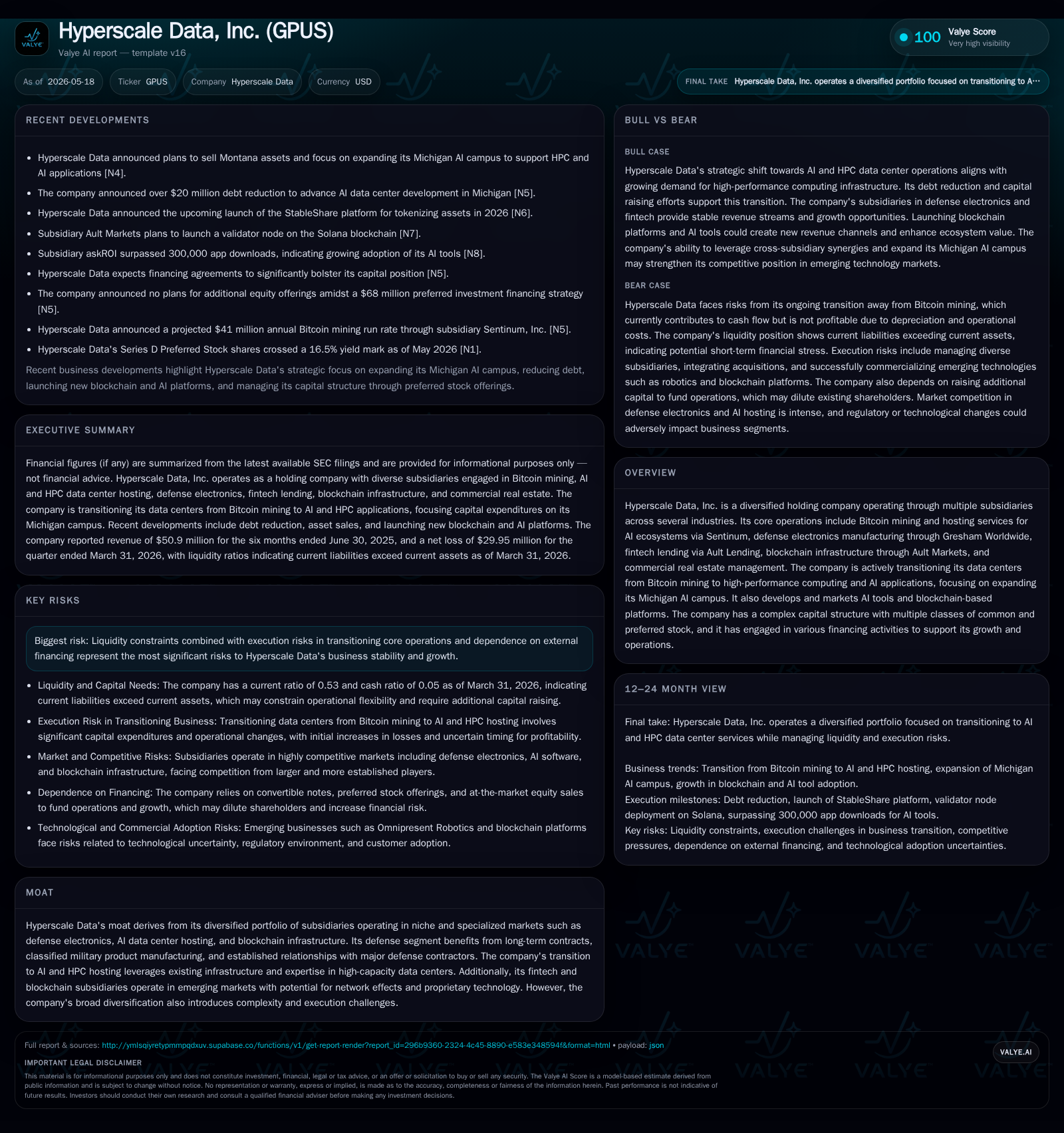
In its latest quarterly filing, Hyperscale Data, Inc. detailed progress in transitioning its core data center activities from Bitcoin mining towards high-performance computing (HPC) hosting for AI ecosystems, spearheaded by its Michigan campus expansion. The company’s diversified holdings span defense electronics manufacturing, fintech lending, blockchain infrastructure, and commercial real estate management, creating strategic breadth but also operational complexity. While growth momentum is driven by surging demand for AI infrastructure and blockchain platforms, liquidity constraints and a heavily leveraged balance sheet underline notable execution risks. Senior management’s central role further heightens operational dependency as the firm navigates its transformation.
Latest Quarterly Operating Update and Strategic Shift
Hyperscale Data's Q1 2026 filing [S2] confirms a deliberate strategic shift away from Bitcoin mining—a historically core yet volatile revenue source—towards developing colocation services for high-performance computing (HPC) with a focus on artificial intelligence workloads. This evolution is anchored by the expansion of their Michigan campus, an energy-efficient 617,000 square-foot facility designed to meet growing demand from enterprise-level AI cloud providers. The quarter also featured dividend payments announced on both the 13.00% Series D and 10.00% Series E cumulative redeemable perpetual preferred shares [S3], signaling a commitment to cash returns even during elevated capital demands.
This quarterly pivot underscores a move from commodity-driven crypto mining—subject to price cycles and regulatory uncertainty—towards structurally attractive HPC hosting driven by secular AI adoption trends. However, this transition exists alongside considerable liquidity pressure, with the balance sheet showing only approximately $10.5 million in cash against over $91 million in total debt [F1]. The company’s current ratio stands at around 0.53 [F1], reflecting potential short-term funding strains.
Business Model Overview and Core Subsidiaries
Hyperscale Data operates primarily as a holding company with multiple subsidiary businesses generating diversified revenue streams [S1]. Its original backbone was Bitcoin mining through Sentinum and related entities like Alliance Cloud Services (ACS). While Bitcoin mining generated direct revenue from cryptocurrency production volume translating into sales on digital asset markets, this segment is increasingly being repurposed towards HPC colocation—renting data center capacity to AI ecosystem participants requiring dense compute power.
The defense electronics segment through Gresham Worldwide offers custom-designed radio frequency communication systems and precision electronic solutions for aerospace and military clients worldwide [S1]. This segment benefits from specialized engineering resources, long-term contract visibility, and classified product offerings that contribute defensive moat characteristics despite being cyclical with military spending patterns.
Fintech lending via Ault Lending engages in structured credit arrangements under California Financing Law licensing—offering relatively stable interest income tied to digital finance growth trends [S1]. Complementing this is blockchain infrastructure through Ault Markets and its control of Ault DAO LLC which manages the Ault Blockchain network infrastructure supporting decentralized financial platforms.
Commercial real estate assets combined with niche businesses such as equipment rentals and hotel operations round out a diversified portfolio that spreads risk but imposes operational complexity [S1]. This multilayered business model exposes Hyperscale Data to sector-specific dynamics including technology adoption cycles for AI hosting and blockchain platforms versus manufacturing cadence in defense electronics.
Competitive and Industry Structure Implications
The market for hyperscale HPC data center hosting is characterized by intense competition among established cloud operators (e.g., AWS, Azure) as well as specialist colocation providers offering power density optimized for AI training tasks requiring heavy GPU clusters. Hyperscale Data’s Michigan facility targets this niche with large-scale physical infrastructure investment leveraging existing energy efficiencies accrued during its Bitcoin mining phase. However, switching costs for clients hinge on uptime guarantees, latency performance, pricing models tied to power consumption, and access to adjacent AI ecosystem partnerships—a challenging field dominated by hyperscalers.
Within defense electronics manufacturing, Gresham Worldwide operates in a fragmented industry typically populated by smaller specialized contractors integrating into prime defense OEM supply chains. The company’s multi-subsidiary structure benefits cross-selling opportunities but must navigate lengthy proposal-to-contract durations influenced by government budgeting cycles [S1]. Its status as a recognized BAE Systems Silver Supplier elevates credibility but competition remains fierce among Tier II/Tier III suppliers.
Blockchain infrastructure players are at earlier stages where network effects govern adoption curves; success depends on proprietary technology platforms' security robustness and user engagement fostering liquidity within decentralized finance ecosystems coordinated by Ault DAO. Fintech lending similarly faces regulatory scrutiny balanced against growing demand for alternative credit products digitized for speed and accessibility.
Growth Drivers from AI and Blockchain Infrastructure Expansion
Accelerating corporate migration towards generative AI applications underpins structural demand for scalable HPC hosting facilities capable of handling GPU-heavy workloads that far exceed traditional cloud needs. Hyperscale Data’s Michigan campus represents a bet on sustained utilization growth supported by enterprise customers seeking controlled colocation environments relative to third-party hyperscaler clouds [S1]. Expansion efforts via acquisition of additional land parcels demonstrate plans for capacity scaling.
Parallel growth levers stem from expanding blockchain platform activity managed by Ault Markets/Ault DAO aiming to establish robust decentralized networks amidst rising interest in Web3 finance infrastructures [N1]. Network growth can translate into transactional volume increases underpinning demand for auxiliary services hosted within Hyperscale’s ecosystem.
Fintech loan portfolio expansion planned over the next year suggests active deployment of credit capital aligned with digital lending trends [S25]. Meanwhile, Gresham’s pursuit of technological advancements in radar systems and electronic warfare solutions taps into defense budget increases focused on next-generation aerospace capabilities.
Risks Linked to Complexity and Liquidity Constraints
Hyperscale Data’s highly diversified organizational framework introduces significant operational risks stemming from managing disparate subsidiaries ranging from capital-intensive data centers to specialized electronics manufacturing [S1]. This diversification complicates resource allocation decisions amid ongoing strategic pivots.
Moreover, senior management concentration — notably Executive Chairman Milton C. Ault III — introduces succession risk given his substantial influence over capital allocation decisions along with CEO William B. Horne and President Henry Nisser who collectively form the Executive Committee directing company strategy [S1][S29]. Any disruption to this team may delay execution of strategic initiatives or destabilize stakeholder confidence.
Corporate Governance and Management Dependence
Governance structures reflect founder-led control emphasizing experienced insiders who have guided Hyperscale Data through multiple business model iterations since inception in 2017 [S1]. This centralized leadership affords swift decision-making authority particularly critical during transitional phases shifting core business lines toward emergent markets such as HPC hosting for AI workloads.
Nonetheless, such consolidation of power amplifies operational dependence; loss or departure of key executives could materially impair project delivery timelines across subsidiaries or hinder capital raising efforts required given constrained liquidity positions [S29]. Employment agreements provide contractual stability yet do not fully mitigate intangible risk regarding talent retention amidst competitive pressures within technology industries.
Forward-Looking Outlook: Key Milestones and Watchpoints
Investors should monitor the ramp-up pace of Michigan campus occupancy as an early indicator of successful transition from legacy Bitcoin mining toward sustainable HPC colocation revenue streams [S2][S3]. Preferred stock dividend payments will serve as proximate tests of cash flow sufficiency; continuation or suspension could reflect evolving capital priorities under financial stress.
Further announcements relating to blockchain platform commercialization efforts or new defense contract awards via Gresham will offer insight into subsidiary segment health alongside any divestiture or restructuring initiatives intended to streamline the operating model [S6][S20].
In addition, watch for quarterly guidance updates regarding financing availability given current leverage levels; delay in securing refinancing options or incremental capital could constrain expansion plans or increase refinancing costs.
Brief Financial Profile: Liquidity, Debt, and Dividend Status
As of March 31, 2026, Hyperscale Data reported cash and equivalents totaling approximately $10.5 million against total debt near $91.2 million resulting in net leverage close to $80.7 million after adjusting for cash reserves [F1]. The firm’s current ratio stands low at about 0.53 indicating sizable short-term liability coverage gaps relative to liquid assets [F1].
Despite these constraints, the company maintains dividend payments on its Series D (13%) and Series E (10%) cumulative preferred stocks with recent payouts affirmed in May 2026 reflecting ongoing cash deployment commitments amidst prudential balance sheet management [S3]. This dividend policy signals prioritization of fixed income investor returns even as equity holders face risks linked to executing the multifaceted transformation strategy.
This analysis is based solely on information extracted from publicly filed SEC documents dated through May 18, 2026, supplemented by verified market sources cited herein. It does not constitute investment advice but aims to provide an informed industry perspective grounded in disclosed operating facts, recent corporate developments, and sector context relevant to Hyperscale Data's evolving business landscape.
Disclaimer: This is research-only, informational analysis and not investment advice. It may include AI-generated interpretation and general industry context. Always verify important details using primary sources.

Comments