
Greenland Mines Ltd Expands Into Mineral Resources with Nasdaq Debut
The company’s pivot from biotech to mining, marked by its recent Nasdaq listing and merger, ushers in new strategic growth avenues amid operational challenges.
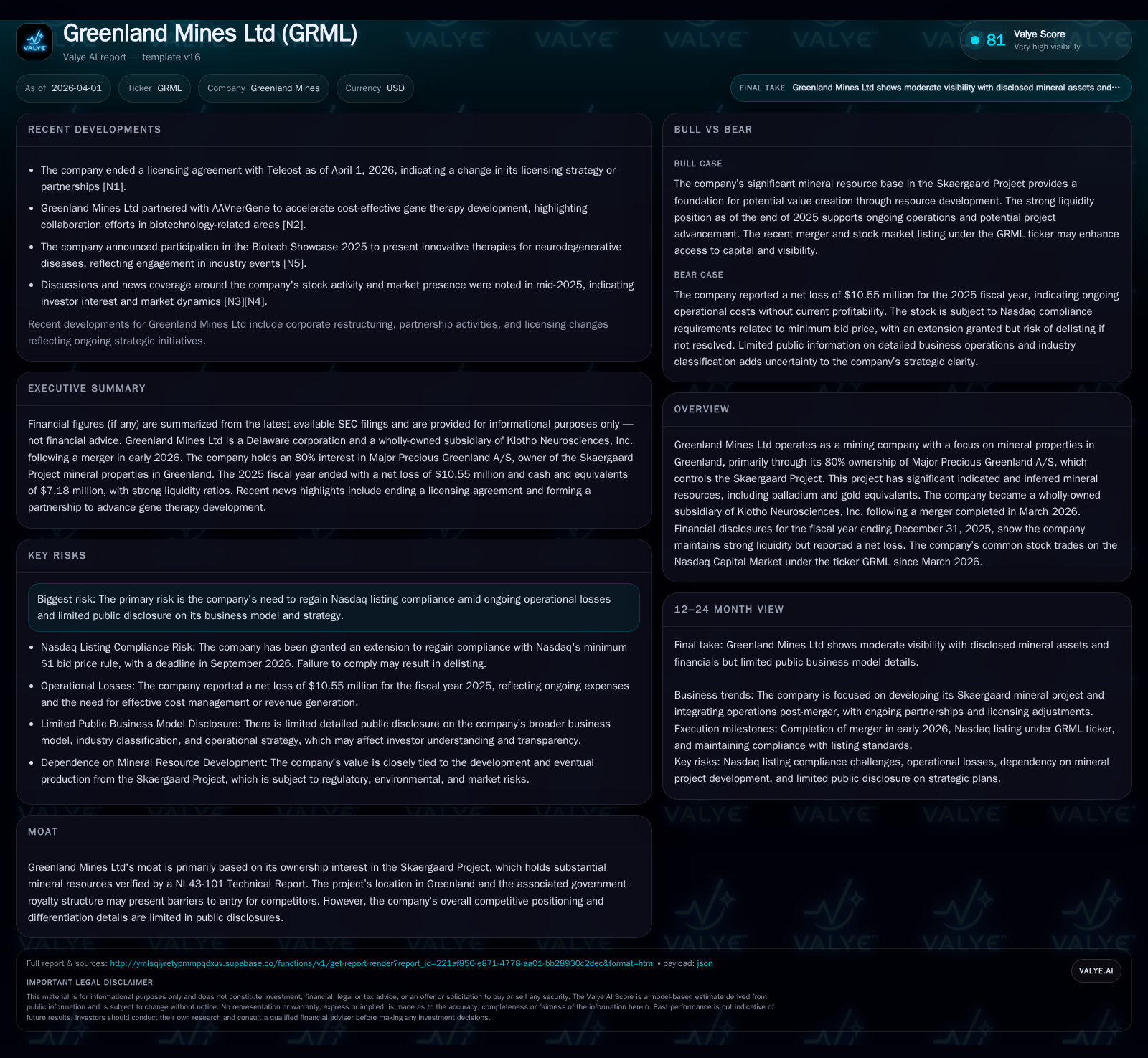
Greenland Mines Ltd transformed from a pharmaceutical-focused entity into a mining company following its March 2026 merger and Nasdaq Capital Market debut under ticker GRML. With control over the Skaergaard Project—a mineral-rich asset in Greenland holding substantial palladium and gold equivalent resources—the company’s future hinges on navigating regulatory compliance and capitalizing on this strategic resource ownership. Despite posting increasing net losses and operating cash outflows through 2025, Greenland Mines maintains robust liquidity, supported by recent capital raises and preferred stock issuance tied to its merger transaction.
Historic Financial Performance and Operational Evolution
Greenland Mines Ltd's financial trajectory over the past four years highlights a company undergoing transformative change. Originally focused on developing essential medicines for chronic diseases including cancer, cardiovascular, and neurodegenerative disorders, the firm shifted sharply toward mining only after its March 2026 merger.
Financials up to year-end 2025 reveal escalating losses typical of companies transitioning business models and investing in new assets. Operating income deteriorated sequentially from a negative $657K in FY2022 to nearly -$7.15M by FY2025, illustrating intensifying operating leverage pressures as costs scaled ahead of revenue generation [F1]. Net income swung from modest positive territory above $1.2M in FY2022-23 to a net loss exceeding -$10.55M in FY2025 — a drop of approximately 72% year-over-year reflecting investment burdens and absence of operational revenues intrinsic to R&D and mining development phases [F1].
Operating cash flow mirrored this pattern with cash burn nearly doubling between FY2024 (-$2.95M) and FY2025 (-$5.89M), underscoring continued investment burn amid limited external cash inflows [F1]. However, equity improved markedly in FY2025 reaching $9.46M from negative territory in prior years, which leveraged proceeds likely related to the impending merger and financing undertakings providing capital runway [F1].
These historical financials depict a firm absorbing considerable resource capitalization costs during an operational evolution from clinical-stage therapies toward exploration-stage mining activities.
Historical performance (annual)
| FY | Net ($mm) | CFO ($mm) | OpInc ($mm) | Net YoY |
|---|---|---|---|---|
| 2025 | -11 | -6 | -7 | -71.6% |
| 2024 | -6 | -3 | -6 | -556.9% |
| 2023 | 1 | -1 | -1 | +9.1% |
| 2022 | 1 | 0 | -1 |
Source: SEC companyfacts cache [F1].
Capital returns and efficiency (annual)
| FY | ROE% |
|---|---|
| 2025 | -111.5 |
| 2024 | -518.9 |
| 2023 | -18.3 |
| 2022 | -30.5 |
Source: SEC companyfacts cache [F1].
Note: Cash & Equivalents prior to FY2025 were not explicitly reported annually but are materially confirmed for FY2025.
Strategic Merger and Expansion into the Skaergaard Project
Greenland Mines' strategic inflection point came with the acquisition of Greenland Mines Corp., completed on March 4, 2026 [S1][S13]. As part of this transaction—treated as a reverse acquisition—the firm divested its Klotho Neurosciences pharma identity for the current mining focus under the new legal name Greenland Mines Ltd [S1]. Concurrently on March 12th the company commenced trading on Nasdaq Capital Market under ticker "GRML," signifying market acceptance of its transformed profile [S8].
Crucially underpinning its competitive moat is its ownership interest in the Skaergaard Project via an 80% stake in Major Precious Greenland A/S—a Danish corporation owning these Greenland mineral rights—with option rights over the remaining 20% [S13]. The project hosts substantial mineral resources validated by an NI 43-101 Technical Report issued by SLR Consulting Limited [S13], establishing combined Indicated plus Inferred resources exceeding 364 million tons averaging over 2 grams per tonne palladium equivalent (PdEq). This translates into approximately 25.4 million ounces PdEq or close to 23.5 million ounces gold equivalent (AuEq) reserves—a scale that positions Skaergaard as strategically significant globally.
In mining terminology: "Indicated resources" provide reasonable geological confidence forming a more concrete basis for feasibility assessments; "Inferred resources" are less certain but indicate promising exploration upside. Furthermore, Greenland’s government royalty rate stands at 2.5% payable upon commencing production—a moderate fiscal overlay compared to many jurisdictions but nonetheless a statutory barrier impacting project economics [S13].
The Mining Agreement provisions imbue barriers to entry against competitors lacking such direct operational control or governmental approval [S13]. However public disclosures offer limited granularity on development timelines or capital expenditure plans specific to Skaergaard beyond these fundamentals.
Risks Surrounding Nasdaq Compliance and Market Position
Regulatory risks remain nontrivial for Greenland Mines. As announced in March 2026 filings [S27], the Company was granted an additional six-month extension through September 14th to comply with Nasdaq’s minimum $1 bid price rule for equity securities after previously falling below this requirement since September 19th, 2025.
Failure to meet this requirement risks delisting from Nasdaq—an event that would compress liquidity and investor access significantly [S27]. This compliance challenge is compounded by limited public disclosure about the Company’s new business model post-merger—especially given ongoing operating losses—and potentially hinders investor confidence during this critical post-merger transition phase [S1][F1]. Additionally noted is exposure to market-entry constraints tied explicitly to Greenland’s royalty regime which affects project economics although it is comparatively moderate within the mining sector context.
These factors amplify execution risk while placing a premium on clear communication and progress reporting by management.
Financial Health Snapshot: Liquidity, Losses, and Cash Flows
Despite operating losses stretching deeper into fiscal year-end December 31st, 2025—for which net income reached roughly negative $10.55 million—the Company sustains meaningful liquidity buffers critical for funding ongoing operations [F1][S4][S5][S7]. Total cash and equivalents at year-end stood near $7.18 million with current assets totaling approximately $7.29 million versus minimal current liabilities around $77 thousand translating into an exceptionally strong current ratio near ~95 times—a measure denoting ample short-term solvency reserves [F1].
Capital management terminology relevant here includes "current assets management," denoting how easily liquid assets cover imminently due obligations; "cash runway" describes how long operating funds can sustain expense burn without external financing. Given freeze-frame financials preclude revenue generation so far outside licensed platforms/services phase—and mining projects entail upfront spending—it is notable that no debt burden appears reported enhancing financial flexibility at present [F1].
However continued negative cash flow trends (-$5.89M CFO in FY2025 vs. -$2.95M prior year) require careful monitoring especially given ongoing investment needs extending beyond resource acquisition towards advancement along exploration-to-production timelines [F1].[N1]
Capital Allocation Moves: Preferred Shares and Shareholder Returns
Capital structure adjustments played an integral role accompanying the acquisition transaction. As disclosed on March 4th when consummating the merger agreement with Greenland Mines Corp., the Company issued approximately 47,000 shares of Series C Preferred Stock as consideration paid directly to former Greenland Mines shareholders—representing newly designated equity instruments with specified dividend rights described as "pari passu" alongside common stock dividends once declared but prioritized before junior stock classes [S6][S9].
Each Preferred share currently lacks voting rights pending stockholder approval yet converts into multiple shares of common stock thereafter enhancing potential shareholder participation when conditions permit [S9]. No dividends or buyback programs have been announced or executed thus far associated with either common or preferred classes signaling nascent capital returns infrastructure as business fundamentals evolve post-merger [S8][S11]. This issuance constitutes "capital structure optimization" aiming at balancing ownership alignment while preserving financial flexibility in early-stage asset development context.
Future Growth Catalysts in Mineral Resource Development
Looking ahead the primary growth vectors are anchored around bringing substantial Skaergaard mineral resources towards production readiness—a journey spanning feasibility validations through permitting cycles culminating in extraction commencement governed by Greenland’s regulatory framework including governmental royalty structures limiting free cash flow until ramp-up stages begin.
Company disclosures describe potential upside embedded within indicated-to-inferred categorizations suggesting opportunity exists for resource reclassification upgrades that could enhance project valuation metrics intrinsic to palladium-gold equivalence calculations measured via NI43-101 reporting standards—a mine industry benchmark [S13]. Further exploration expenditures or joint venture strategies may unlock expanded mineral zones but remain speculative absent explicit evidence.
Developing infrastructure adapted for Arctic environments likely presents technical hurdles increasing capital intensity relative to conventional sites—demanding rigorous project management techniques tailored for high-cost remote conditions typical of Greenland mineral operations globally known for geopolitical complexity interlinked with environmental stewardship considerations impacting timeline assumptions beyond Company public filings scope.
Monitoring Milestones: What Investors Should Watch Next
Without explicit forward-looking numeric guidance provided publicly post-merger—a typical scenario following transformational corporate combinations—focus turns toward observable milestones offering insight into operational momentum:
- Updates concerning NI43-101 technical reports potentially revising resource estimates or economic feasibility studies,
- Capital raises or partnership announcements expanding financial capacity essential for construction phases,
- Compliance progression with Nasdaq listing requirements notably achieving bid price maintenance thresholds within extended relief period terminating September 14th,
- Regulatory approvals delivered by Greenland authorities related to environmental impact assessments or license grants underpinning commercial mining startups,
- Board composition changes linked to former Greenland stakeholders influencing strategy execution.
Active monitoring aligned with these material developments provides practical lenses through which market participants can evaluate tangible progress on Greenland Mines’ strategic pivot trajectory.
This analysis synthesizes available public disclosures up through April 1st, 2026 without speculating beyond documented facts regarding financial metrics or corporate events related to Greenland Mines Ltd's transition into mineral resource development.
Disclaimer: This is research-only, informational analysis and not investment advice. It may include AI-generated interpretation and general industry context. Always verify important details using primary sources.

Comments