
iShares S&P GSCI Commodity-Indexed Trust: Year-On-Year Performance and Market Dynamics
Review of the Trust's fluctuating financial results amid commodity market volatilities and operational complexities.
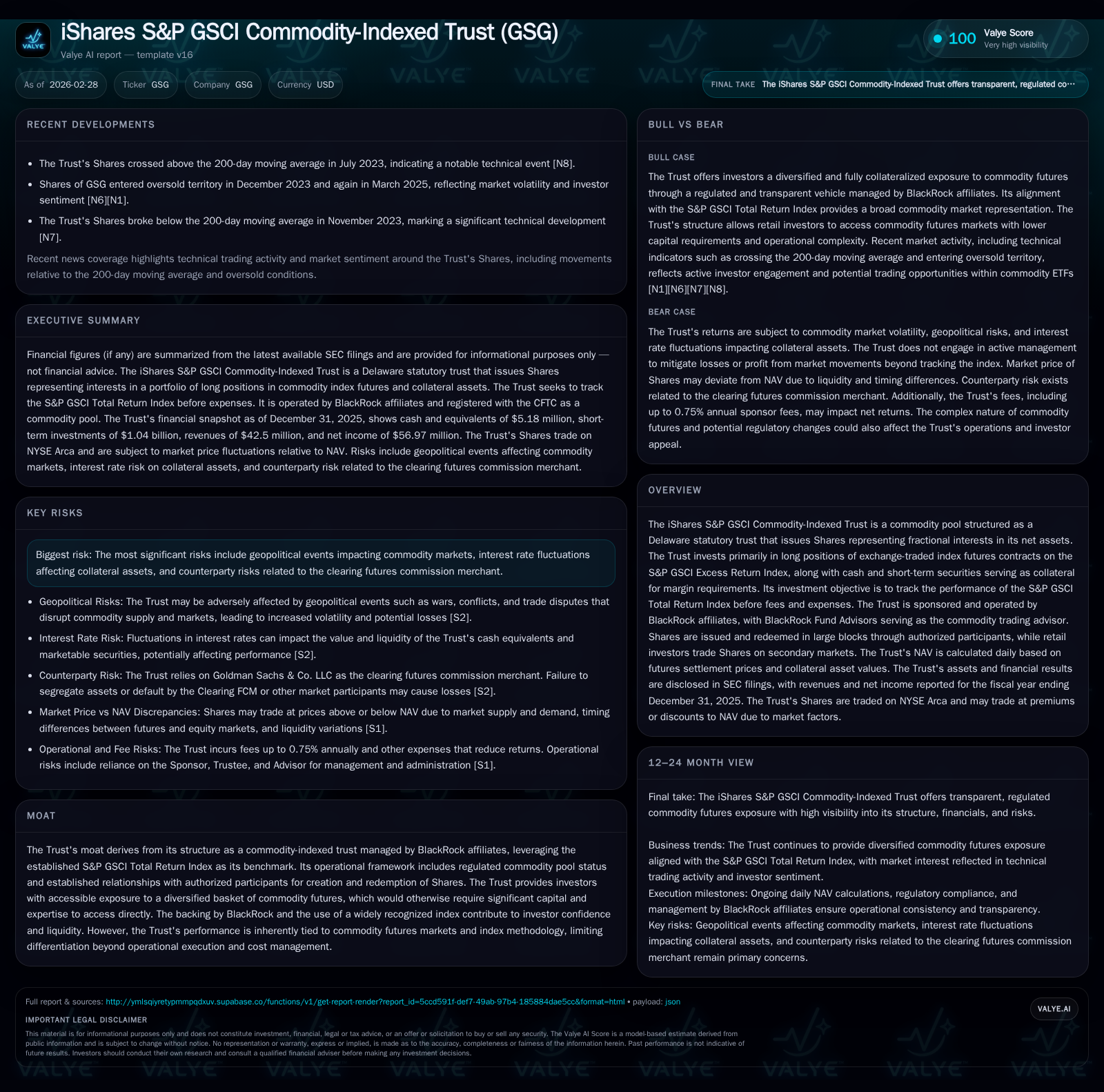
The iShares S&P GSCI Commodity-Indexed Trust experienced notable revenue and income volatility between FY2022 and FY2025, reflecting its direct exposure to commodity futures price dynamics. The Trust invests primarily in long positions on exchange-traded index futures of the S&P GSCI Excess Return Index, with performance influenced by geopolitical tensions, regulatory shifts, interest rate movements, and futures market volatility. Operationally supported by BlackRock affiliates and cleared through Goldman Sachs as Clearing FCM, the Trust faces risks related to margin requirements, clearing counterparty exposures, and regulatory position limits. Investors should monitor NAV volatility drivers, regulatory developments, margin requirements, and futures curve shapes as key indicators of future performance.
Navigating Historical Financial Performance: A Shift from High Gains to Volatility Impact
The iShares S&P GSCI Commodity-Indexed Trust’s financial results over the four years ending FY2025 reveal pronounced volatility consistent with commodity futures markets. Revenue expanded markedly from approximately $22.3 million in FY2022 to about $52.6 million in FY2023 (+136%), then declined to $51.3 million in FY2024 and further to $42.5 million in FY2025 [F1]. Operating income followed a similar trajectory rising from roughly $7.5 million in FY2022 to $43.7 million in FY2023 before falling back to $43.1 million in FY2024 and decreasing 20.6% year-over-year to about $34.3 million in FY2025 [F1]. Net income exhibited greater fluctuations with a substantial gain of $390.8 million in FY2022 contrasting a net loss of nearly $66.5 million in FY2023 followed by recoveries reaching $70.0 million in FY2024 and approximately $57.0 million in FY2025 [F1]. Operating cash flow also varied dramatically starting at $565.1 million (FY2022), dropping to $183.8 million (FY2023), dipping sharply negative at -$58.2 million (FY2025) after peaking near $69.6 million (FY2024) [F1]. These swings primarily reflect mark-to-market effects on index futures values tied directly to commodity price movements rather than traditional operating activities.
Historical performance (annual)
| FY | Rev ($mm) | Net ($mm) | CFO ($mm) | OpInc ($mm) | Rev YoY | Net YoY |
|---|---|---|---|---|---|---|
| 2025 | 43 | 57 | -58 | 34 | -17.0% | -18.6% |
| 2024 | 51 | 70 | 70 | 43 | -2.5% | +205.2% |
| 2023 | 53 | -67 | 184 | 44 | +135.6% | -117.0% |
| 2022 | 22 | 391 | 565 | 8 |
Source: SEC companyfacts cache [F1].
These financial patterns underscore the Trust’s direct exposure to commodity futures prices embedded within the S&P GSCI Excess Return Index.
Structural Foundations: The BlackRock-Backed Commodity Futures Exposure Model
Organized as a Delaware statutory trust issuing Shares representing fractional beneficial interests backed primarily by long positions in exchange-traded index futures contracts on the S&P GSCI Excess Return Index (S&P GSCI-ER), the Trust holds collateral assets including U.S. Treasury securities serving as margin deposits for these futures positions [S1][S24]. BlackRock Institutional Trust Company acts as Trustee while BlackRock Fund Advisors serves as commodity trading advisor registered with the CFTC [S1].
Shares are created or redeemed exclusively through authorized participants who transact large blocks (“Baskets”) via exchange-for-related-position (EFRP) transactions involving simultaneous transfers of Index Futures and collateral assets settled generally on T+1 basis [S24][S26]. Goldman Sachs & Co. LLC functions as Clearing Futures Commission Merchant (Clearing FCM), facilitating trade execution and managing margin accounts subject to initial and variation margin requirements reflecting daily mark-to-market adjustments [S9][S13]. This structure provides investors access to diversified commodity exposure without direct handling of physical commodities or individual futures contracts.
Market Risks and Geopolitical Influencers Shaping Value Fluctuations
Commodity price volatility remains the primary driver impacting Share price and NAV fluctuations underlying the Trust’s performance [S1]. Geopolitical events such as the Russian invasion of Ukraine have introduced supply disruptions and increased volatility particularly across energy commodities due to sanctions including bans on Russian oil imports by multiple countries [S2]. These factors have contributed to backwardation—where spot prices exceed future prices—in energy futures curves influencing roll yield outcomes during contract expirations.
Historic stress scenarios include April 2020 when WTI crude oil May futures briefly traded negative amid oversupply concerns exacerbated by limited storage capacity [S1]. Such anomalies illustrate systemic risks where futures prices can approach zero or negative values adversely affecting indices tracking these contracts.
Speculative trading activity also modulates pricing dynamics with shifts in investor sentiment creating episodic price spikes or declines; increased hedging by producers or sudden speculative positioning changes can exert downward pressure on prices impacting trust valuations negatively [S1].
Interest Rate Effects on Collateral Assets and Futures Pricing
The Trust’s collateral assets predominantly comprise U.S. Treasury securities or equivalent short-term instruments subject to interest rate risk which affects their market valuation [S2][S8]. Rising rates generally depress fixed-income security prices reducing collateral values which may increase liquidity pressures for margin postings [S8]. Longer duration securities held exhibit higher sensitivity amplifying valuation swings during volatile rate environments.
Moreover rising interest rates influence cost-of-carry embedded within index futures altering forward curve shapes which indirectly affect index levels and thus NAVs of the Trust’s Shares.
Regulatory Landscape: Position Limits and Trading Constraints
Operations are governed under the Commodity Exchange Act enforced by the CFTC alongside exchange rules governing position limits for speculative trading restrictions margin requirements and execution protocols [S4][S6][S20]. Position limits restrict maximum holdings potentially limiting trading flexibility especially when adjustments are needed for index replication.
NYSE Arca listing subjects Shares to compliance obligations; trading may be halted during extreme volatility invoking circuit breaker rules affecting liquidity availability for secondary market transactions [S4]. Regulatory changes remain a material risk factor given potential retroactive imposition or tightening that could impact creation/redemption processes or increase compliance costs.
Credit risk related to reliance on Goldman Sachs as Clearing FCM introduces exposure linked to possible segregation failures defaults or bankruptcy scenarios despite legal protections under bankruptcy codes applicable within derivatives markets [S6][S16].
Growth Outlook Linked Closely With Commodity Markets
The Trust’s growth prospects hinge on commodity futures market performance characterized by cyclical demand-supply factors influenced by geopolitical events trade policies macroeconomic cycles among others [S2][S1]. Diversification across multiple commodities within S&P GSCI offers some risk spreading but constrains ability for selective sectoral gains relative to active commodity funds.
Potential recovery drivers include easing geopolitical tensions normalization of demand post-pandemic inflation moderation all contributing to more stable commodity price trends conducive for index replication strategies.
Nonetheless heightened regulatory oversight combined with systemic market volatility may limit growth potential by raising capital costs margin requirements execution expenses increasing minimum scale thresholds required for efficient operation.
Capital Allocation: ROE Metrics and Cash Flow Volatility
Approximate return on equity computed from latest annual net income relative to historical equity levels stands near mid-single digits (~7.2%) reflecting leveraged market exposures rather than operational profitability alone [F1]. Operating cash flows show marked swings turning sharply negative (-$58 million) in latest fiscal year following prior positive years illustrating timing mismatches inherent in mark-to-market accounting based on index future valuations.
No dividends or share repurchase programs are disclosed indicating distributions are minimal or reinvested within trust collateral maintaining liquidity aligned with margin needs [S26]. Given recent negative CFO periods free cash flow for distributions appears constrained prioritizing structural stability over yield enhancement.
Key Metrics for Monitoring Stability and Performance Drivers
Investors should focus on:
- Evolution of futures curve shapes emphasizing contango/backwardation impacts affecting roll yields;
- Creditworthiness of clearing brokers especially Goldman Sachs given concentration risk;
- Regulatory updates regarding position limits margin rule amendments circuit breaker policies;
- Secondary market premium/discount trends versus NAV indicating liquidity or sentiment shifts;
- Macroeconomic variables including interest rate trends inflation expectations coupled with geopolitical developments influencing raw material pricing fundamentals.
These indicators provide insights into operational health prospects amidst inherently volatile commodity derivative fund environments.
This analysis synthesizes disclosures from February 27th 2026 Form 10-K filings together with audited financial data from companyfacts snapshot [F1], without extrapolation beyond documented figures or unsupported forward-looking statements. No investment advice is provided; readers should conduct independent evaluation before investing in instruments tracking broad commodity indices such as iShares S&P GSCI Commodity-Indexed Trust.
Disclaimer: This is research-only, informational analysis and not investment advice. It may include AI-generated interpretation and general industry context. Always verify important details using primary sources.

Comments