
Healthcare Services Group Strengthens Contracted Service Model Despite Rising Costs
HCSG’s latest quarterly report reflects strategic adaptations to labor and supply inflation, reinforcing its service contract model amid healthcare reimbursement uncertainties.
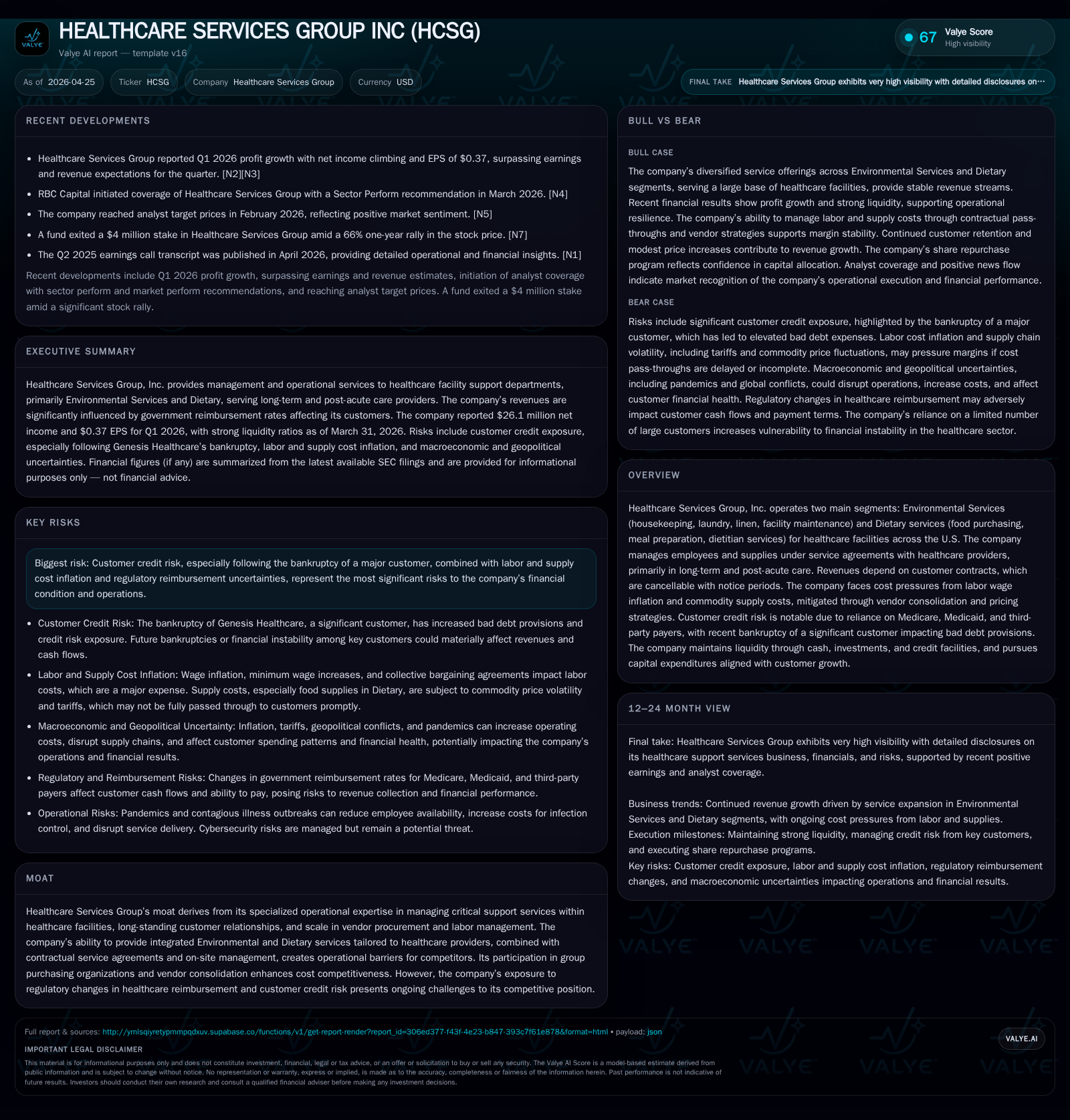
Healthcare Services Group Inc (HCSG) reported solid operational resilience in Q1 2026 despite rising labor costs and supply chain inflation pressures, partly offset by strategic vendor consolidation and pricing adjustments. The company faced increased bad debt provisions due to a major customer bankruptcy but maintains strong liquidity and a conservative capital structure. Its differentiated business model, integrating Environmental and Dietary services under cancellable contracts with notice periods, supports stable customer relationships in the long-term care sector. Going forward, HCSG’s financial performance will hinge on effective cost pass-through, contract renewals, and credit risk management amid an evolving regulatory environment.
Q1 2026 Operational Update: Cost Pressures and Customer Credit Risks
Healthcare Services Group’s (HCSG) first quarter 2026 filing [S2] underscores ongoing headwinds from labor wage inflation and commodity cost escalation across its Environmental Services (EVS) and Dietary segments. Labor remains the principal expense driver for EVS at over 78% of segment revenues [S9], while Dietary costs are significantly exposed to food commodity pricing—over 30% of its revenues [S9]. Recent geopolitical instability has aggravated input cost volatility, including energy prices influencing transportation and supply chain expenses [S10].
Margin pressure from increased costs was partially alleviated through negotiated pricing adjustments within contractual frameworks where the company has rights to pass through cost increases to customers. However, timing lags inherent in billing reviews can delay full absorption of supply spikes, particularly in Dietary.[S1][S10]
Additionally, Q1 saw an uptick in bad debt expenses driven by the bankruptcy filing of Genesis Healthcare, a key customer representing approximately 7.3% of consolidated revenues in 2025 [S22]. This event heightened credit risk awareness, reflected in increased provisions against accounts receivable. HCSG manages this risk through rigorous ongoing credit evaluations and has initiated contractual amendments like management-only agreements or adjusted payment terms for financially distressed customers.[S15][S16]
Despite these challenges, Q1 earnings surpassed analyst expectations [N2], signaling resilience supported by tight operational controls and contract management.
Business Model: Integrated Environmental and Dietary Services in Long-Term Care
HCSG generates revenue primarily via full-service agreements providing comprehensive Environmental and Dietary support to over 3,900 U.S.-based healthcare facilities including nursing homes and post-acute care centers [S1][S10]. These agreements encompass workforce management, supply procurement, quality assurance protocols, and onsite departmental supervision by assigned managers.
Contracts are cancellable upon 30 to 90 days’ notice following initial periods of up to 120 days [S23], offering clients flexibility but also necessitating continuous service excellence for retention. The bundling of EVS (housekeeping, laundry, linen) with Dietary services (food purchasing, meal prep, dietitian consultations) allows for operational synergies that appeal to healthcare operators seeking administrative relief alongside quality improvements.[S13][S23]
By staffing previously employed facility workers under new management structures and embedding district oversight roles specialized per service segment, HCSG maintains high-touch engagement that reduces client switching incentives while enhancing operational efficiency.[S13][S27]
Supply Chain Efficiencies and Vendor Consolidation as Defensive Strategies
To counteract inflationary pressures magnified by tariffs on imported goods and commodity market disruptions—including livestock diseases impacting food supplies—HCSG has consolidated key purchases through national vendors such as Sysco Corporation which supplies over half of its dietary-related products [S5][S12].
These procurement consolidations empower HCSG to negotiate prospective pricing agreements and obtain volume discounts unavailable to smaller operators. While such measures do not eliminate exposure to volatile input costs entirely, they provide a tactical buffer permitting smoother pass-throughs under contract terms.[S1][S5]
Strategic sourcing diversification complements vendor consolidation efforts but does not fully diminish the timing mismatch risk when sharp commodity price rises precede billing updates,[S1] requiring vigilant inventory management and targeted cost control initiatives.
Competitive Positioning in a Fragmented Healthcare Support Services Market
The healthcare support services industry is highly fragmented with competition stemming from regional providers as well as customers’ option to maintain in-house support personnel.[S8] HCSG’s competitive advantage stems less from generic scale economies but more from nuanced operational specialization tailored to healthcare facility needs—including infection control compliance for EVS teams—and integrated dietary planning services with clinical consultation capabilities.[S13]
Contractual frameworks embedding cancellable terms with notice periods create moderate switching friction while onsite management oversight ensures consistent service standards that build customer loyalty.[S18]
Pricing power is inherently constrained by underlying reimbursement regimes dominated by Medicare/Medicaid funding models impacting client cash flows.[S21][S29] Nonetheless, HCSG’s ability to bundle services with pass-through clauses for labor/supply cost fluctuations affords some insulation from direct margin erosion.
Growth Drivers: Contract Expansion, Pricing Mechanisms, and Service Differentiation
Revenue growth hinges principally on securing new customer contracts across the long-term/post-acute care landscape while deepening service penetration within existing accounts through expanded offerings or enhanced nutritional programs.[N1][S8][S9]
Contractual mechanisms allow for structured price increases linked to inflation indices or direct pass-throughs of elevated wage/supply costs.[S8] This capability is critical given the persistently inflationary macro environment.
The company also leverages demonstrated operational efficiencies as part of pitch narratives emphasizing administrative relief coupled with quality improvements aligned with evolving healthcare standards—the latter increasingly valued by providers facing regulatory scrutiny.[N1]
Constraints: Regulatory Reimbursement Uncertainty and Customer Bankruptcy Exposure
Systemic uncertainties surrounding Medicare/Medicaid reimbursement policy reforms pose material risks to customer solvency profiles impacting their payment capacity under service agreements with HCSG.[S21][S29]
The July 2025 bankruptcy of Genesis Healthcare exemplifies this vulnerability with consequential bad debt expense surges affecting short-term earnings visibility.[S22] Though no single remaining customer exceeds a 10% revenue concentration threshold,[S6] such events underscore industry concentration challenges.
Persistent labor market tightness exacerbates wage inflation risks while evolving collective bargaining agreements inject further variability into personnel costs particularly within EVS operations where labor comprises over three quarters of segment revenues.[S9]
Compliance risks also emanate from shifting regulatory landscapes governing health facility operations monitored by CMS and local authorities requiring continuous adherence investments that may increase operational costs beyond contractual pass-through mechanisms.[S17]
Upcoming Milestones and Key Execution Signals to Monitor
Investors should closely track quarterly margins reflecting the company’s effectiveness at implementing pricing pass-throughs amid input cost surges as featured in upcoming earnings releases.[N1][S2]
Contract renewal rates or new contract announcements would serve as tangible markers validating customer acceptance amidst challenging economic conditions.
Monitoring bad debt trends post-Genesis bankruptcy is essential for understanding the trajectory of credit risk provisions influencing cash flow stability.[S2]
Any regulatory clarifications or legislative developments affecting long-term/post-acute care reimbursements will be pivotal for reassessing demand sustainability.
Consolidated Financial Profile: Liquidity, Cash Flow, and Capital Structure
Historical performance (annual)
|
| FY | Net ($mm) | CFO ($mm) | Capex ($mm) | Net YoY |
|---|---|---|---|---|
| 2025 | 59 | 145 | 6 | +49.6% |
| 2024 | 39 | 31 | 6 | +2.8% |
| 2023 | 38 | 43 | 5 | +10.8% |
| 2022 | 35 | -8 | 5 |
Source: SEC companyfacts cache [F1].
Capital returns and efficiency (annual)
|
| FY | Div ($mm) | Buybacks ($mm) | FCF ($mm) |
|---|---|---|---|
| 2025 | 62 | 139 | |
| 2024 | 0 | 5 | 24 |
| 2023 | 0 | 11 | 38 |
| 2022 | 63 | 0 | -13 |
Source: SEC companyfacts cache [F1].
As of March 31, 2026, HCSG maintained $136 million in cash and equivalents against $193 million in current liabilities yielding a robust current ratio of approximately 3.11 reflecting strong near-term liquidity [F1][S2].
The company benefits from an undrawn $300 million revolving credit facility recently amended on April 7, 2026 extending maturity through April 2031,[S20] providing financial flexibility for capital needs or opportunistic investments.
For fiscal year 2025 reported in the annual filing,[F1] operating cash flow surged nearly fourfold year-over-year to $145 million supporting net income growth while capital expenditures remained modest around $5.8 million indicating disciplined reinvestment levels.
Significant share repurchase activity totaling nearly $62 million demonstrates confidence in underlying cash generation capacity despite sector headwinds.[F1][S11]
| Fiscal Year | Revenue (mil USD) | Net Income (mil USD) | Operating CF (mil USD) | Capex (mil USD) | Current Ratio |
|---|---|---|---|---|---|
| 2025 | 1837.2 | 59.1 | 144.97 | 5.82 | N/A |
| Latest Q1’26 | N/A | N/A | N/A | N/A | 3.11 |
This liquidity profile provides ample runway for absorbing temporary receivable shocks while executing growth initiatives.
Disclaimer: This analysis is provided solely for informational purposes based on publicly available data without investment advice or recommendations.
Disclaimer: This is research-only, informational analysis and not investment advice. It may include AI-generated interpretation and general industry context. Always verify important details using primary sources.

Comments