
Global Gas Corp Focuses on Modular Hydrogen and Carbon Recovery Amid Liquidity Strains
Global Gas is building modular onsite hydrogen and carbon recovery projects targeting industrial gas customers but faces financial and execution challenges.
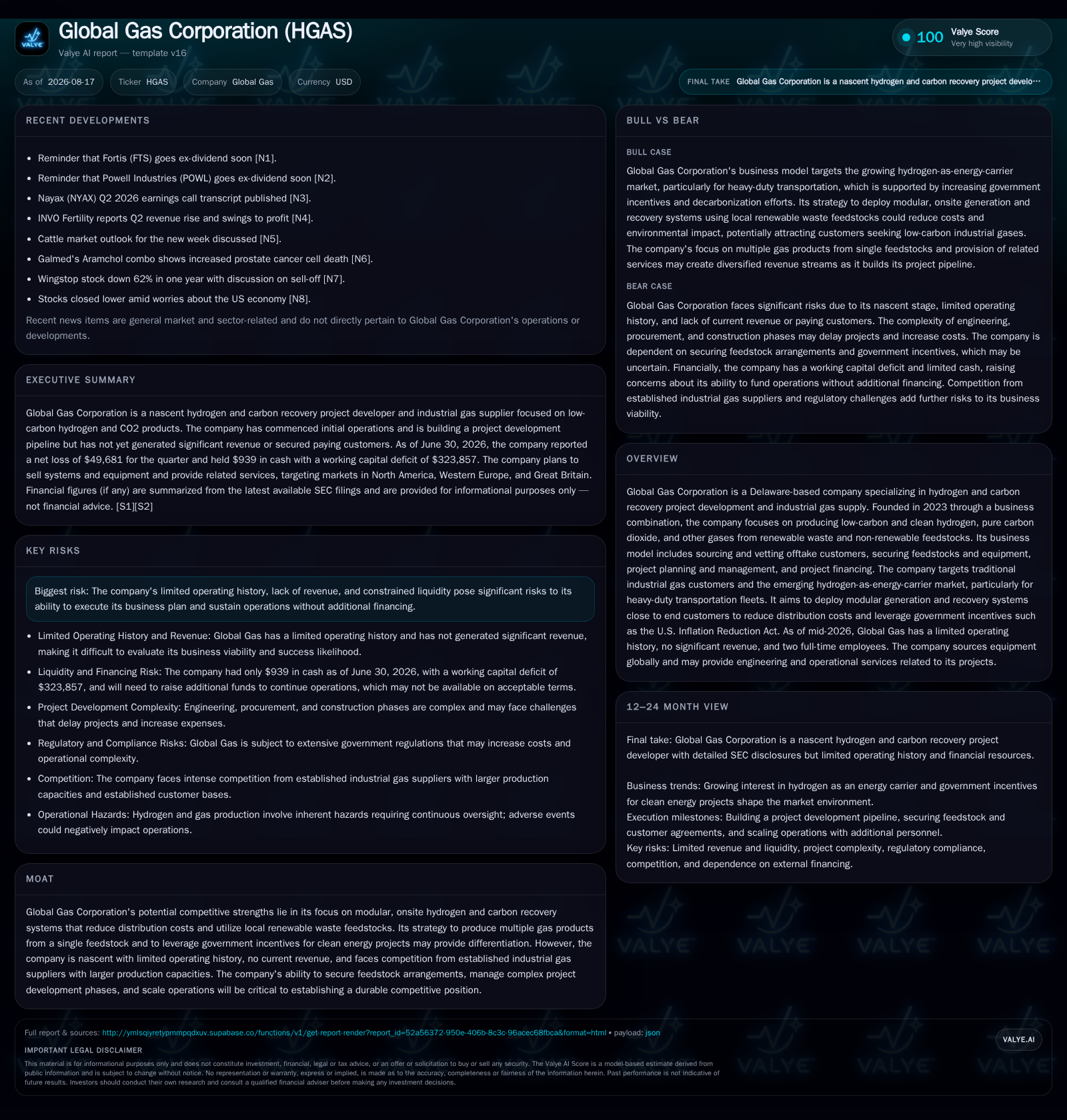
Global Gas Corporation is an emerging hydrogen and carbon recovery project developer specializing in modular onsite gas generation to serve traditional industrial and expanding hydrogen fuel markets. Its recent quarterly filing highlights efforts to localize production near end customers and leverage government clean energy incentives. However, the company remains in its nascent stage with no material revenue, limited operating history, and substantial liquidity constraints that raise going concern doubts. Its ability to secure feedstock, finalize customer offtake arrangements, and finance project development will be critical to scaling operations and competing with large industrial gas incumbents.
Recent Operating Update
Global Gas Corporation’s latest quarterly filing for Q2 2026 underscores its continued focus on developing modular hydrogen production, carbon recovery, storage, and dispensing solutions located close to end customers — often onsite — aiming to reduce traditional distribution cost burdens inherent in the industrial gases market [S2]. The company plans to generate multiple outputs such as clean hydrogen and pure carbon dioxide from a single feedstock input. This approach intends to replicate cost efficiencies typically associated with larger scale plants but through localized smaller footprint modular units. Management monitors operating expenses closely given the nascent business stage and limited revenues, emphasizing cash management during significant funding needs [S2].
Despite strategic intent, Global Gas remains early-stage with no material revenue generated beyond modest recognition of approximately $33,000 in 2025 from a project accounted for on a net basis [F1]. The project development pipeline consists of potential deals only after preliminary discussion with customers around scope and feasibility but none have yet matured into closed contracts or commissioned facilities [S11]. Scaling this pipeline into cash-generating operations rests on overcoming significant technical and commercial challenges.
Business Model Analysis
Global Gas operates primarily as a project developer and industrial gas supplier targeting two overlapping markets: traditional industrial users of gases such as hydrogen and carbon dioxide for manufacturing and emerging users requiring low-carbon hydrogen as an energy carrier — notably heavy-duty transportation fleets adopting fuel cell technologies [S18]. The business model centers around four operational pillars: (1) sourcing and vetting offtake customers; (2) securing local renewable or non-renewable feedstocks (often waste-derived); (3) planning, managing, and constructing modular gas generation facilities; and (4) structuring financing for projects leveraging government incentives such as the U.S. Inflation Reduction Act’s tax credits [S18, S19].
Revenue streams are anticipated from equipment/system sales (electrolyzers, reformers, compressors), gas sales under long-term offtake contracts, project management fees, and possibly equipment leasing. The strategy to produce multiple gases from a single feedstock improves utilization efficiency and diversifies revenue lines. Onsite generation reduces reliance on costly centralized distribution logistics common in industrial gases supply chains.
However, monetization depends heavily on advancing projects through permitting, construction, commissioning stages while confirming feedstock access and securing creditworthy customers under binding contracts. Early sales focus is expected on system/equipment sales where customers assume responsibility for site-related approvals [S18]. This staged approach reflects the developmental nature typical in this sector but introduces timing risk before recurring gas sales materialize
Industry Structure And Competitive Position
The industrial gases sector is characterized by dominant global players like Air Liquide and Linde with extensive large-scale production capacity, entrenched customer relationships across diverse industries requiring stable supply contracts, broad geographic reach, deep technical expertise in gas purification/storage/dispensing technologies, and robust financial resources enabling sizeable capital expenditures for new plant buildouts.
Global Gas situates itself within the midstream/downstream slice focusing on modular onsite gas generation — a growing niche responding to demands for decarbonization via clean hydrogen supply closer to point-of-use to minimize distribution inefficiencies. This modular onsite model offers a differentiated competitive angle by potentially delivering low-carbon hydrogen at competitive prices even at smaller scale by leveraging local waste feedstocks reducing raw material costs.
Yet the company’s lack of operational history compared with incumbents limits its current bargaining power over feedstock suppliers or customers. Established competitors also benefit from decades-long safety track records important for industrial gas users confronting stringent regulatory requirements. The pathway for Global Gas to challenge these incumbents depends notably on successfully executing projects where proximity economics plus incentive utilization offset scale disadvantages.
Growth Drivers
Several trends underpin demand growth opportunities targeted by Global Gas:
- Robust growth in demand for low-carbon hydrogen driven by decarbonization goals across heavy industry sectors including steelmaking as well as transport segments transitioning to fuel-cell-heavy duty vehicles.
- Expanding government subsidies supporting clean energy technologies globally. The U.S. Inflation Reduction Act provides notable tax credits incentivizing installation of clean hydrogen projects rewarding both capital investments and production tax credits enhancing project economics substantially [S19].
- Increasing availability of renewable waste feedstocks enabling sustainable input sourcing aligning with corporate sustainability mandates that encourage circular economy approaches.
- Advancements in modular generation technology lowering costs per kg of hydrogen produced making onsite distributed production viable versus only centralized models.
- Rising interest among traditional industrial gas users seeking cleaner supply alternatives where intermittent renewable inputs become less feasible than reliable onsite systems.
These synergies favorably position Global Gas if it can convert early-stage pipeline discussions into financially viable projects while leveraging incentive regimes efficiently.
Risks And Watchpoints
Despite promising fundamentals in the clean hydrogen sector generally, Global Gas faces multiple acute risks:
- Execution risk arises from the company’s unproven ability to convert early stage pipeline opportunities into operational plants generating steady revenue streams. Project delays or cost overruns can strain already limited resources negatively.
- Its extremely constrained liquidity situation generates substantial going concern doubts; lack of financial flexibility constrains sustained investment before positive cash flow appears unless additional financing is secured promptly [S2].
- Feedstock supply volatility or scarcity could impact planned input costs adversely; local sourcing strategies reduce some risks but increase dependence on regional waste availability.
- Regulatory complexity around permitting new hydrogen production sites may induce prolonged timelines increasing capital burn.
- Competitive pressure from large incumbents with superior scale economies could squeeze pricing particularly without strong binding customer contracts.
- Market demand remains nascent specifically for low-carbon hydrogen fuel use cases; slow adoption among heavy-duty fleets or delays in infrastructure development could dampen prospective demand growth.
- Cost structure volatility can arise due to variations in utility prices impacting operating margins in early deployments.
To mitigate these risks watchpoints include securing binding long-term customer contracts (offtake agreements), achieving key project milestones including financing closure and construction start dates, progress reports showing improved liquidity or successful capital raises indicating operational runway extension.
What To Watch Next
Investors should monitor:
- Announcements regarding binding or long-term offtake agreements with industrial gas users or transport fuel providers which will signal market validation.
- Milestones related to financing rounds that ease liquidity constraints enable accelerated project development.
- Progress updates confirming permitting approvals or construction commencement providing evidence of pipeline maturation into revenue-generating assets.
- Utilization levels reported once initial plants are commissioned reflecting operational performance metrics like plant uptime and feedstock consumption efficiency.
- Updates on government incentive receipt such as verified tax credit qualification materially improving supportable pricing models.
A successful transition through these stages would mark critical inflections transforming Global Gas from an early-stage developer into a viable operator competing meaningfully within the industrial gases ecosystem.
Financial Profile Discussion
As of June 30, 2026 Global Gas reported critically strained liquidity with cash balances dwindled to only $939 against current liabilities totaling roughly $340 million yielding an extremely low current ratio around 0.05 highlighting severe short-term liquidity risk [F1], [S2]. The company also holds approximately $183 million total debt resulting in net debt near $135 million after adjusting for limited cash holdings [F1]. Accumulated deficits have grown close to $490 million reflecting operating losses typical at this infancy stage prior to substantial commercial activity [F1].
Operating expenses remain tightly managed as reflected by management’s active review process but the reliance on funding contributions from members or affiliates persists while no sizable external financing has been reported recently [S2], [S3]. Going concern assessments note substantial doubt regarding ability to continue without additional capital raising confirming financial fragility that may constrain strategic execution absent near-term funding success [S2], [S3], [S5].
This financial profile contrasts sharply with established industrial gas players boasting investment-grade balance sheets supporting multi-billion-dollar capex programs enabling high-capacity efficient production hubs. For Global Gas the imperative remains securing sufficient capital injection timed properly alongside operating progress milestones vital for survival and eventual value creation.
Disclaimer: This analysis is for informational purposes only and does not constitute investment advice or research views.
Disclaimer: This is research-only, informational analysis and not investment advice. It may include AI-generated interpretation and general industry context. Always verify important details using primary sources.

Comments