
Hamilton Lane Drives Growth Through Evergreen Funds and Global Private Market Access
Hamilton Lane’s latest quarterly results underscore expanding assets under management with a strategic focus on evergreen private market funds and diversification across global clients.
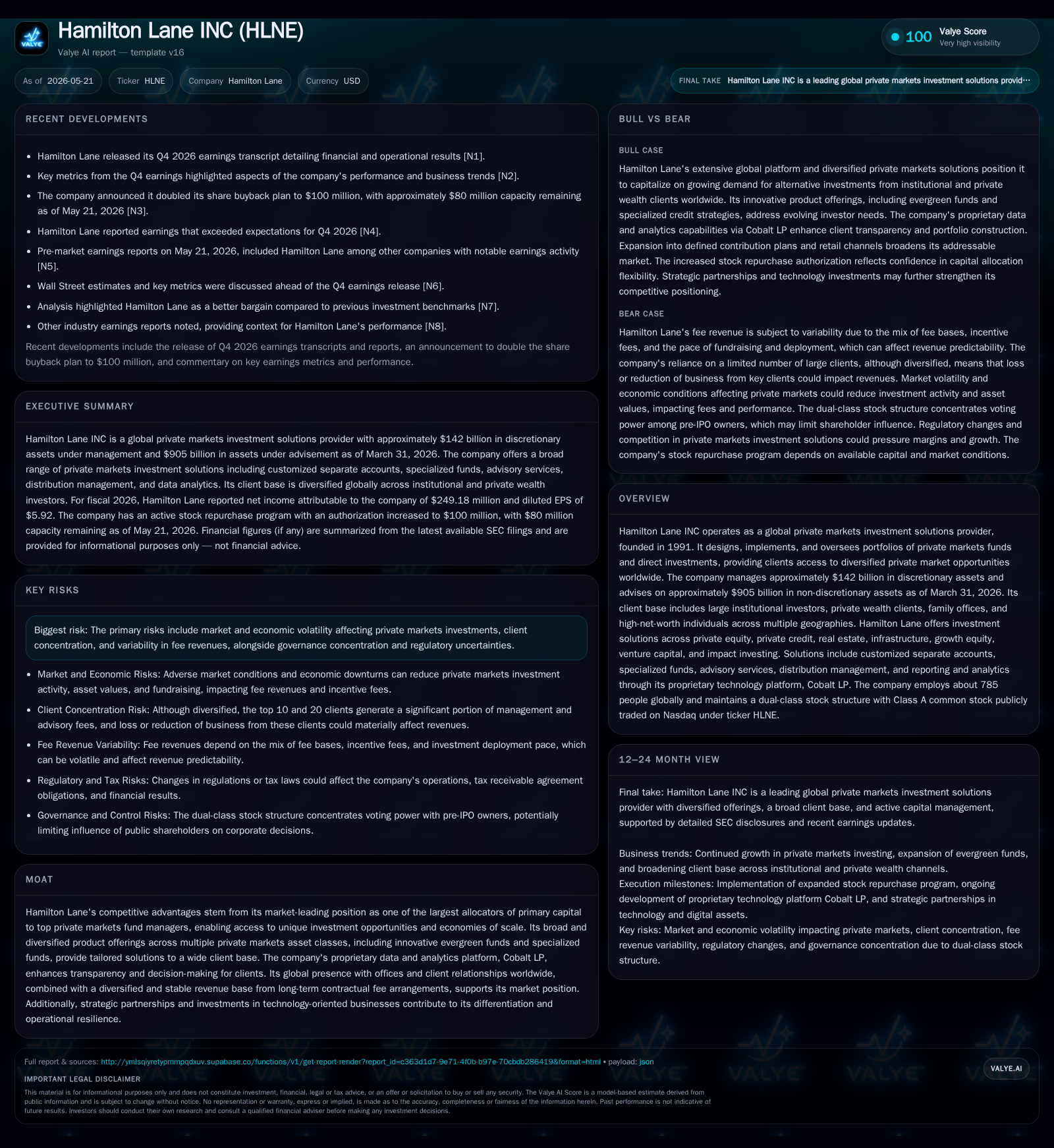
In its most recent quarter ending March 31, 2026, Hamilton Lane reported sustained growth in discretionary assets under management (~$142 billion) and a substantial advisory asset base (~$905 billion), reflecting strength in fee-generating segments. The firm’s business model capitalizes on customized separate accounts, specialized fund structures including evergreen vehicles, and advisory mandates spanning private equity, credit, real estate, and infrastructure. Its competitive moat is supported by scale as a leading allocator of primary capital, proprietary analytics through Cobalt LP, and broad global distribution channels. Growth is propelled by increasing penetration of evergreen funds catering to both institutional and private wealth clients. Key risks remain tied to market cyclicality impacting fee income, regulatory complexity, and governance concentration. Upcoming milestones to watch include quarterly KPIs on AUM/fee trends and progress in share repurchase execution.
Latest Quarterly Operating Update: Momentum in Assets and Revenue
Hamilton Lane's Q3 fiscal 2026 filing dated February 3, 2026 ([S2]) confirms continued growth momentum highlighted by approximately $142 billion in discretionary assets under management (AUM) coupled with an expansive non-discretionary advisory asset base totaling roughly $905 billion. This scale reflects both the firm's entrenched institutional relationships and growing penetration into private wealth channels. Fee revenues benefited from this broadened asset footprint alongside selective fee rate realizations driven by product mix shifts towards evergreen vehicles. Notably, earnings commentary post-quarter ([N1], [N3]) underscores operational resilience within a sensitive macroeconomic environment. This update lays the groundwork for evaluating Hamilton Lane's business model through the lens of evolving client demand for flexible private markets access.
Comprehensive Business Model: Multi-Asset Private Markets Investment Solutions
Hamilton Lane operates a multi-pronged business model structured around generating recurring fee revenue primarily from three principal sources: customized separate accounts (CSAs), specialized funds—including primary commitments, secondary stakes, direct co-investments—and advisory mandates ([S1]). The CSAs grant discretionary authority over tailored portfolios aligned to individual client return objectives and risk tolerances; they represented about $92 billion of AUM as of Q3 FY26. Specialized funds represent approximately $50 billion in AUM encompassing drawdown funds and the increasingly pivotal evergreen fund strategies that provide continuous subscription/redemption mechanisms with constrained liquidity features.
Through advisory services come non-discretionary mandates focused on portfolio monitoring, reporting analytics via proprietary tools like Cobalt LP, distribution oversight, and manager selection advice across private equity, credit markets, real estate assets, infrastructure projects, growth equity rounds, venture capital exposures, and impact investments. This diversified product suite is architected to address distinct investor needs ranging from large institutions optimizing asset allocation to family offices and high-net-worth individuals seeking bespoke alternatives access.
Quality and Differentiation in Product Offering
Central to Hamilton Lane’s competitive advantage is its role as one of the largest allocators of primary capital to top-tier private markets managers globally ([S1]). This scale delivers differentiated deal flow access—particularly important amid intensifying competition in private markets that compresses returns. The company's proprietary analytics platform Cobalt LP provides institutional-grade portfolio transparency enhancing clients’ ability to evaluate complex illiquid positions—a service layer increasingly demanded by sophisticated investors.
Evergreen fund structures exemplify innovation within Hamilton Lane’s offerings: these multi-strategy vehicles permit periodic liquidity events which align well with investor preferences for less rigid lock-up terms while maintaining exposure across traditional buyout funds plus adjacent strategies such as infrastructure or private credit. Such flexibility augments retention rates among both institutional accounts with evolving liability profiles and burgeoning private wealth sectors adopting longer-term alternative allocations.
Geographic breadth further buttresses product relevance—operating from 23 offices worldwide enables regionally nuanced portfolio construction responding dynamically to localized market conditions spanning North America, Europe, Asia-Pacific, and emerging markets ([S1]).
Competitive Positioning within the Private Markets Ecosystem
Within the competitive asset management landscape focused on private markets solutions—dominated by firms such as Blackstone's GSO division or Carlyle's investment platforms—Hamilton Lane distinguishes itself through a balanced combination of scale allocation advantages paired with technology-enabled service differentiation ([S1]). Unlike asset managers principally reliant on single-strategy funds or pure secondaries players lacking first-call access to top managers’ primary fundraisings, Hamilton Lane’s structure integrates discretionary CSA mandates permitting customized strategy overlays alongside commingled funds enhancing operational scale economies.
Client loyalty is reinforced via long-term contractual fee arrangements embedding smoothing effects through market cycles but does not fully insulate from macro-driven margin volatility given linkages between asset valuations impacting incentive fees ([S23]). Moreover, governance concentration stemming from dual-class share structures may influence strategic agility but also secures management stewardship continuity—albeit meriting ongoing scrutiny.
Key Growth Drivers: Evergreen Funds and Expanding Client Channels
Evergreen fund growth remains a critical lever for future scaling; these vehicles attract clients reluctant to commit capital to traditional closed-end funds with prolonged lockups while still capturing attractive yield premia inherent in illiquid asset classes ([S1]). The capacity for periodic liquidity events enhances appeal among family offices and high-net-worth individuals—a client segment increasing within the firm’s overall revenue mix due to broader adoption of alternatives beyond institutions ([N9],[N12]).
Additionally advancing client engagement are technology enhancements anchored by Cobalt LP that improve real-time portfolio insights fostering stickier client relationships through embedded analytics utility. Strategic partnerships aimed at integrating AI-driven data analysis tools further aim to reinforce competitive moats over digital-native entrants or pure data providers without an active investment mandate ([S10]).
Broader diversification across private credit—a growing alternative asset class given persistent demand for yield amid low interest rates—and venture capital exposure also underpin expansion into newer markets aligned with evolving investor appetites toward thematic or impact investing strategies.
Identified Risks and Structural Challenges
Despite solid fundamental positioning, Hamilton Lane faces cyclical headwinds characteristic of private markets investing: diminished fundraising volumes during periods of market stress reduce fee-producing AUM/AUA inflows; valuation mark-to-market revisions suppress incentive fees; elevated competition escalates pricing pressure on new funds potentially curbing margins ([S23]).
Regulatory complexity increasing compliance costs amid jurisdictional tax regime shifts introduce operational risks alongside governance concentration concerns related to voting rights structure potentially impeding minority shareholder influence ([S1]).
Forward-Looking Indicators and Next Milestones
Key trailing indicators will center on updated quarterly filings detailing AUM/AUA trajectories alongside nuanced breakdowns by solution type—evergreen versus drawdown funds especially—as well as composition shifts within institutional versus private wealth channels ([S3],[N2]). Fee revenue cadence relative to market conditions will be instrumental in gauging margin sustainability given mixed valuation outlooks.
Share repurchase program execution following recent authorization increase to $100 million (from $50 million) reflects management optimism; tracking buyback timing/pricing will offer clues on capital return philosophy alignment with growth aspirations ([N9],[S17]). Ongoing integration outcomes from technology investments marketing increasingly AI-powered analytic capabilities serve as qualitative milestones relevant for sustaining differentiation amid rising fintech-driven competition (310).
Corporate governance updates regarding Class B common stock voting sunsets or structural changes may materially affect strategic decisions pending shareholder actions post any triggering events described under governance framework sections ([S1]). Lastly, regulatory developments impacting adherence cost or disclosure burdens remain material monitors given ongoing scrutiny over private markets transparency globally.
Financial Snapshot Supporting Operational Trends
For fiscal year ending March 31st, 2026 (latest reported), net income attributable to Hamilton Lane was approximately $249 million reflecting profitability improvements concurrent with AUM/AUA expansion ([F1],[S15]). Total debt stood around $213.5 million as of March 31, 2023, with net debt approximately $126.5 million at the same date ([F1]). Cash and equivalents were about $87 million as of March 31, 2021 ([F1]). Cash flows from operating activities were robust at nearly $425 million illustrating strong cash generation capacity necessary for dividends—including recently announced quarterly dividend hikes—and significant share repurchases totaling about $20 million executed during Q3 FY26 under existing programs ([S13],[S17]). Capital allocation demonstrates balance between investing organically into product expansion while maintaining shareholder-friendly returns supported by disciplined debt levels ([S9],[S19]).
Disclaimer: This analysis is based solely on publicly filed SEC documents up through May 21st, 2026 and accompanying Nasdaq news reports cited herein. It does not constitute investment advice or research views. Readers should conduct their own due diligence when considering any financial decisions related to Hamilton Lane Incorporated (HLNE).
Disclaimer: This is research-only, informational analysis and not investment advice. It may include AI-generated interpretation and general industry context. Always verify important details using primary sources.

Comments