
Horace Mann’s Path to Growth: Educator-Focused Insurance Amid 2025 Financial Gains
Horace Mann’s specialized insurance model focused on educators, combined with disciplined capital management, underpinned solid revenue and profit growth in 2025.
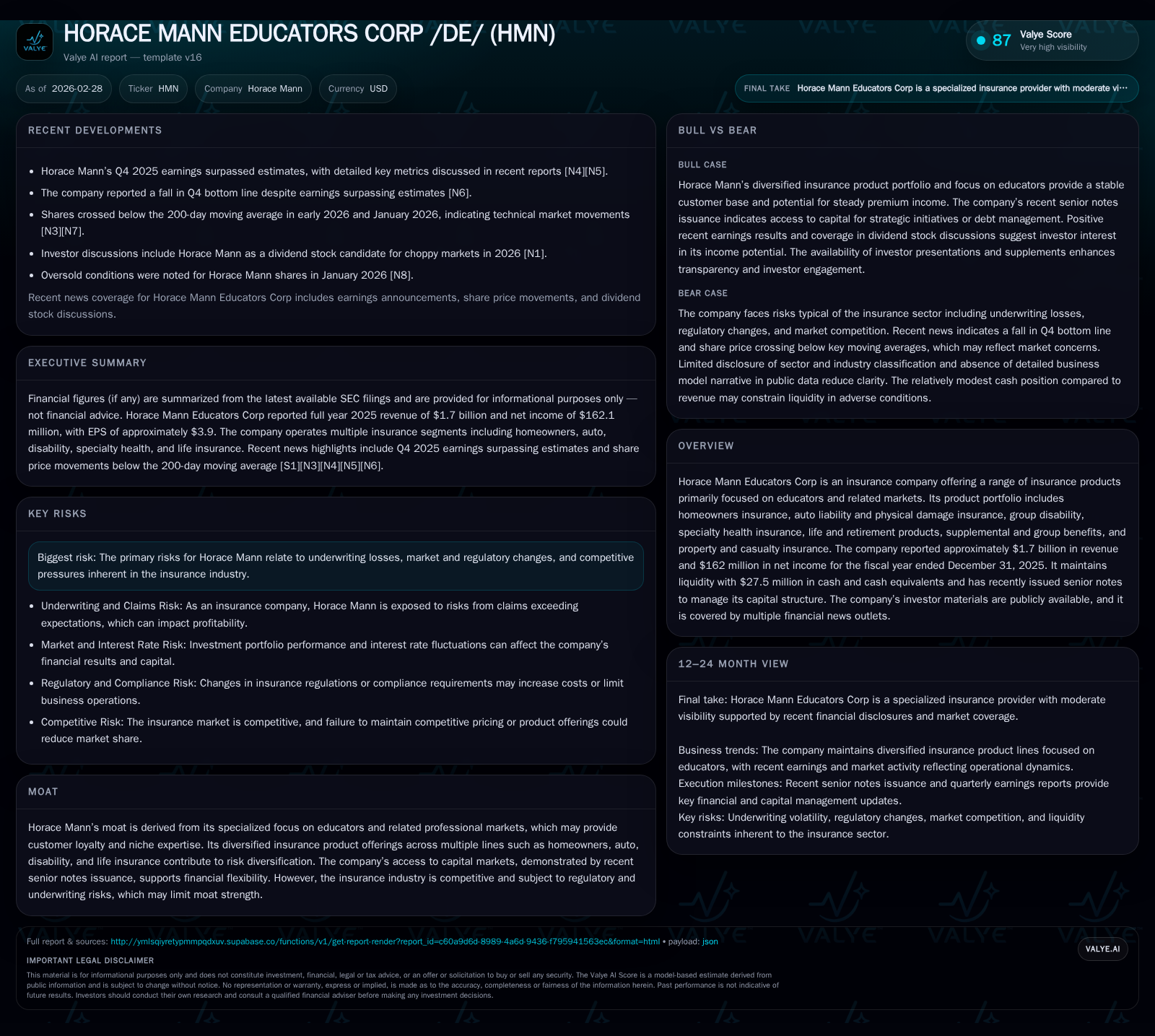
Horace Mann Educators Corp leverages its niche focus on educators and related professionals to offer a diversified insurance portfolio spanning homeowners, auto, disability, and life products. The company delivered a robust 6.7% revenue increase and 57.7% net income growth in fiscal 2025, driven by underwriting discipline and operational execution. Prudent capital management, including a healthy cash position and recent senior notes issuance, supports financial flexibility amid industry risks such as underwriting volatility and regulatory changes. Future growth depends on maintaining combined ratio improvements and navigating evolving sector pressures.
Strategic Focus: Serving Educators with Diversified Insurance Products
Horace Mann Educators Corp has carved out a distinct position as an insurer serving educators and related professional markets. Its product portfolio spans a broad array of offerings: homeowners insurance; auto liability and physical damage coverage; group disability; specialty health plans; life and retirement products; as well as supplemental and group benefits [F1][S1]. This specialization is pivotal to the company’s competitive moat—by targeting an entrenched customer base within education-related sectors it builds trust and customer stickiness uncommon among broader insurers.
The diversity of product lines across property & casualty (homeowners, auto) alongside life and health categories provides Horace Mann with valuable risk dispersion benefits. For insurers focusing solely on one line—such as auto—underwriting losses or claims spikes can significantly erode profits. Horace Mann's multi-line presence helps smooth these volatilities through cross-segment balance while leveraging its underwriting discipline honed for educator-specific risk profiles [S1]. Such diversification paired with focused expertise undergirds long-term resilience.
This sector-specific approach fosters enhanced pricing power, customer retention advantages, and operational knowledge that collectively contribute to its unique value proposition.
Financial Momentum: Reviewing Growth Drivers Through 2025
Over the past four fiscal years through December 2025, Horace Mann’s top-line revenue advanced steadily from $1.38 billion (FY2022) to approximately $1.70 billion (FY2025), representing compounded annual growth anchored by disciplined underwriting and strategic product deployment [F1]. This incremental increase amounts to about a 6.7% year-over-year boost in the latest reported period.
Equally notable is the sharp turnaround in net income: after registering a small net loss of -$2.6 million in FY2022, earnings surged to $162 million by FY2025 — a near sixfold increase amplified by both improved loss ratios and favorable investment returns [F1]. Operating cash flow mirrored this trajectory climbing from $171 million in FY2022 to over half a billion dollars ($553 million) in FY2025 — highlighting strong underlying cash generation supporting operational needs.
The company’s equity base expanded correspondingly from roughly $1.09 billion at end-2022 to $1.48 billion at end-2025, reflecting retained earnings accumulation alongside prudent capital management [F1]. Dividends displayed consistent growth albeit at conservative payout levels ($52.6 million paid in FY2022 rising steadily to $57.1 million in FY2025), indicating measured distribution aligned with profitability [F1][S10].
Historical performance (annual)
| FY | Rev ($mm) | Net ($mm) | CFO ($mm) | Rev YoY | Net YoY |
|---|---|---|---|---|---|
| 2025 | 1701 | 162 | 553 | +6.7% | +57.7% |
| 2024 | 1595 | 103 | 452 | +6.9% | +128.4% |
| 2023 | 1492 | 45 | 302 | +7.9% | +1830.8% |
| 2022 | 1383 | -3 | 172 |
Source: SEC companyfacts cache [F1].
Capital returns and efficiency (annual)
| FY | Div ($mm) | ROE% |
|---|---|---|
| 2025 | 57 | 10.9 |
| 2024 | 56 | 8.0 |
| 2023 | 54 | 3.8 |
| 2022 | 53 | -0.2 |
Source: SEC companyfacts cache [F1].
Note: Decline from negative net income in FY22 into material profitability reflects enhanced underwriting performance and investment yield improvements [F1].
Overall, Horace Mann’s historical financial momentum has been grounded in expanding volumes paired with tightening loss ratios—a hallmark of disciplined underwriting strategy prevalent among niche-focused insurers.
Recent Earnings Insights: Q4 Performance Versus Market Expectations
In early February 2026 releases covering Q4 fiscal results, Horace Mann reported earnings surpassing analyst estimates on revenue but saw some compression on net income margins [N1][N2][N6][S3]. While total revenue continued its upward course driven by premium renewals and new business gains, net income experienced a sequential decline primarily attributed to fluctuations in underwriting outcomes in the property & casualty segment.
This dynamic underscores typical seasonal challenges faced by insurers where claim events or catastrophe frequencies can impact quarterly profitability despite stable top-line trends [N6]. Management commentary noted initiatives aimed at tightening underwriting controls alongside product refinements targeting lower risk educator cohorts could improve margin consistency going forward [S3].
These Q4 nuances reflect the balancing act between volume expansion efforts versus maintaining combined ratios—a key ratio measuring underwriting profitability integral to insurer health.
Capital Structure and Liquidity: Recent Senior Notes and Cash Position
Horace Mann ended fiscal year 2025 holding around $27.5 million in cash and cash equivalents—a moderate but adequate liquidity buffer considering operating cash flow strength totaling over half a billion USD on an annualized basis [F1][S4]. The firm also recently issued senior notes as part of its strategy to optimize capital structure flexibility amidst fluctuating claim environments typical of specialty insurers.
According to disclosures, the company maintains staggered debt maturities extending into the mid-decade horizon supported by investment grade quality fixed-income securities within its portfolio [S4][S10]. This suggests prudent management of debt duration mitigating refinancing risks while sustaining access to capital markets for opportunistic funding.
Cash deployment judiciously balances between ongoing business needs including claims payments, potential acquisitions or technology investments aimed at improving underwriting analytics—all aligned with conservative leverage targets common among insurer peers managing regulatory capital requirements [S10].
Dividend History and Shareholder Returns: Yield Stability in Focus
Dividend payments have demonstrated steady incremental rises—from $52.6 million paid out in FY2022 to $57.1 million in FY2025—with no abrupt changes signaling management’s intent to preserve payout stability even during the early stages of profitability recovery [F1][S10]. Relative payout ratios remain well within sustainable bounds given robust net income growth.
No significant share repurchase programs were disclosed recently which may suggest a preference towards reinvestment or cautious balance sheet strengthening over aggressive buybacks notable in some other insurers [S10]. The dividend profile aligns with sector norms where firms emphasize reliable yield streams attractive particularly for income-oriented institutional investors.
Risk Factors and Industry Challenges Affecting Future Prospects
Horace Mann explicitly cites multiple headwinds centered on traditional insurance risks—chiefly underwriting losses stemming from unexpected claims severity or frequency shifts—as well as evolving regulatory frameworks that can impose constraints on product design or require heightened capital buffers [S13][S16].
Competitive pressures emerge both from larger diversified insurers encroaching into niche segments as well as smaller regional players potentially offering tailored local solutions challenging scale economies [S13]. Regulatory complexity around policyholder protections and solvency standards requires continuous compliance vigilance impacting operational agility.
In this context, maintaining discipline around adverse loss development while innovating coverage options tailored for educators will be critical going forward—the fundamental tension embedded within specialty-focused carriers attempting growth without compromising actuarial soundness.
Exploring Headwinds: Regulatory Environment and Underwriting Risks
Sector experience underscores how external shocks such as increased auto liability claim severities or natural disaster frequency can induce underwriting volatility materially affecting combined ratios unaligned with prior expectations [S13][S16]. For Horace Mann whose educator segment may have geographically concentrated exposure patterns, such risks warrant active mitigation strategies including reinsurance utilization or selective geographic targeting adjustments.
Recent stock price technicals crossing below the key 200-day moving average suggest some investor caution reflective not only of broader market cycles but sensitivities linked to these operational risks manifesting quarter-to-quarter earnings variability [N5]. This intersection of sentiment-based technical indicators with fundamental volatility points towards an environment necessitating careful scrutiny by stakeholders observing performance metrics ahead.
Milestones Ahead: Key Metrics to Monitor in Coming Quarters
Though explicit forward guidance remains limited beyond broad commentary [N3][N2][S3], market watchers should track premium growth trajectories especially any acceleration beyond historical ~6%-7% bands as signs of expanding footprint or upselling effectiveness within core educator policies.
Combined ratio improvements serve as bellwethers for underwriting effectiveness—the narrowing gap between earned premiums versus incurred claims plus expenses indicating better profitability sustainability.
Capital deployment plans—whether reinvesting in technology for predictive analytics or potential bolt-on acquisitions—could signal strategic shifts intended to enhance competitive position or diversify risk pools further [N3][S3]. Monitoring how cash flow generation supports or constrains these initiatives will be insightful.
Conclusion: Balancing Niche Strengths Against Sector Pressures
Horace Mann Educators Corp’s niche specialization tailored exclusively towards the educator community forms a durable moat supporting above-average revenue growth coupled with sharp profit expansion into positive territory by fiscal year-end 2025 [F1][N6]. This single-segment focus accentuates customer loyalty uncommon among more generalist carriers while enabling cross-sell opportunities across homeowners, auto, life, disability, and supplemental insurance lines enhancing overall portfolio stability.
Yet inherent operational risks linked to underwriting volatility compounded by regulatory uncertainties benchmarked against intense competition from diverse sector participants pose persistent challenges requiring meticulous risk management discipline [S13][S16]. The company’s recent senior notes issuance alongside ample liquidity reserve enhances financial flexibility positioning it well to navigate ongoing cyclicality encountered broadly within property/casualty specialties [S4][S10].
Progressive dividend policies affirm commitment to balanced shareholder returns without overleveraging growing earnings capacity thereby reinforcing confidence in sustainable cash flow generation driving return on equity currently estimated near double digits (approximate ROE ~10.9%) based on latest reported figures [F1]. Overall Horace Mann’s trajectory exemplifies successful execution within a targeted specialty insurance model anchored on educator affinity married with prudent capital stewardship vital amid evolving industry dynamics.
Disclosure: This report is for informational purposes only and does not constitute investment advice or a recommendation regarding any securities mentioned herein.
Disclaimer: This is research-only, informational analysis and not investment advice. It may include AI-generated interpretation and general industry context. Always verify important details using primary sources.

Comments