
Granite Ridge Resources Balances Diversified Asset Growth with Capital Discipline and Hedging
Scaled oil and gas holding company combines diverse U.S. unconventional assets, data-driven investment, and conservative leverage to deliver steady cash flows.
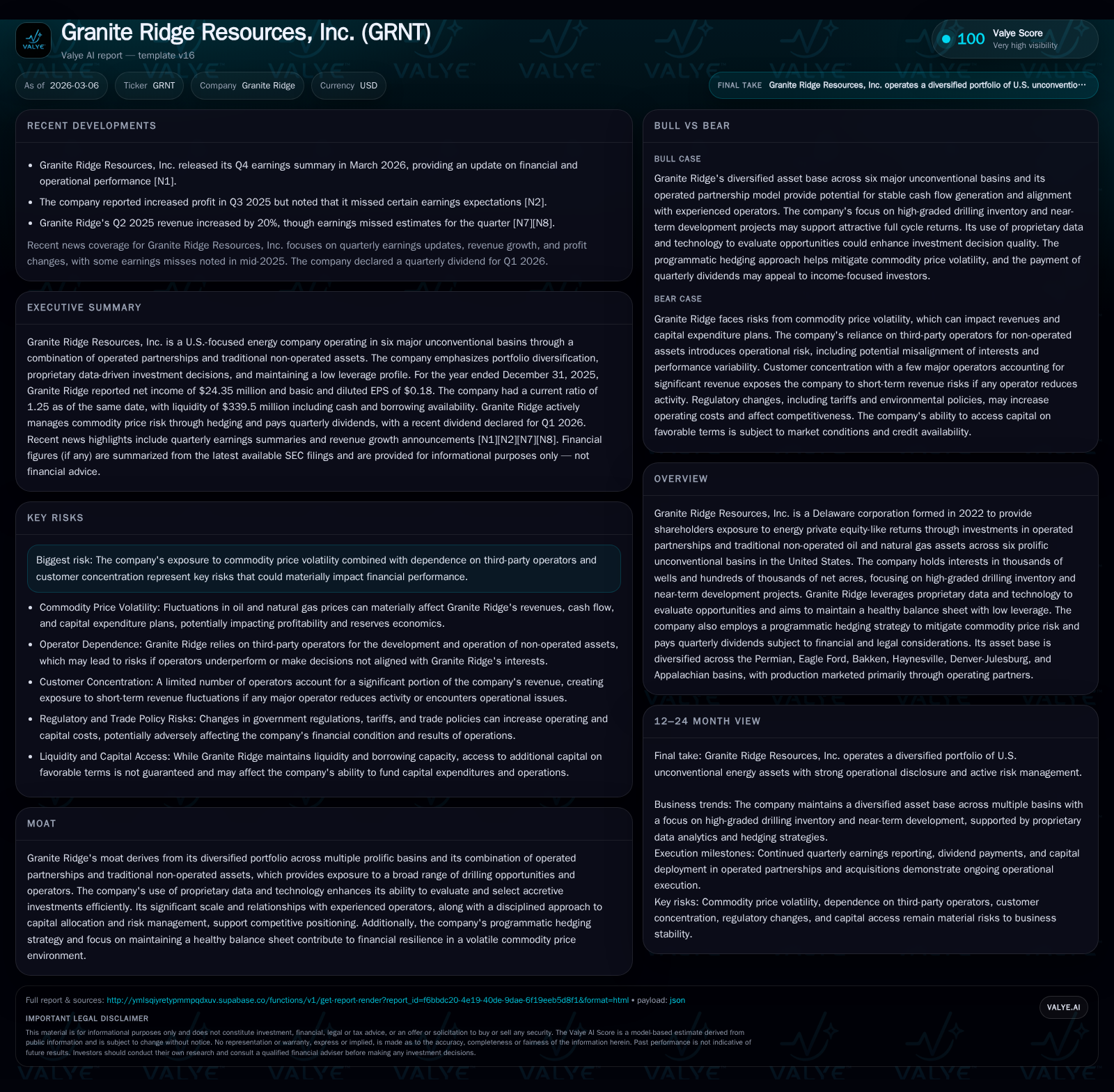
Since its 2022 business combination, Granite Ridge Resources, Inc. has built a diversified portfolio across six prolific U.S. basins, focusing on high-graded drilling inventory and near-term development projects. The company’s historical performance shows steady net income gains despite operating income decline, underpinned by disciplined capital allocation and active commodity price hedging. Looking forward, planned capital expenditures near $320–$360 million in 2026 aim to sustain production growth, funded by strong operating cash flow and ample liquidity. Granite Ridge maintains a prudent leverage profile anchored by $400 million of long-term debt with manageable covenants, while returning capital through quarterly dividends and a recently concluded buyback program.
Company Background and Business Model
Granite Ridge Resources, Inc., established in May 2022 as a Delaware corporation, emerged from a strategic business combination consummated in October 2022 that merged Executive Network Partnering Corporation (ENPC) and GREP Holdings into Granite Ridge [S1]. The company positions itself as a scaled energy firm offering shareholders exposure to oil and gas private equity-like returns through interests in both operated partnerships and non-operated assets across six prolific unconventional basins: the Permian (Delaware and Midland), Eagle Ford, Bakken, Haynesville, Denver-Julesburg (DJ), and Appalachian basins [S1].
Its asset base is extensive — as of December 31, 2025 Granite Ridge owned interests in approximately 3,602 gross wells (245 net) with over 355,000 gross developed acres (nearly 48,000 net) plus more than 33,000 gross undeveloped acres (12,500 net). The company focuses on high-graded drilling inventory and near-term development projects while pursuing diversification across geography, geology (hydrocarbon mix), operatorship (public/private), aiming for best-in-class full cycle returns balanced against low leverage [S1][S25][S17].
The business model relies on sourcing multiple smaller transactions directly rather than acquiring large packages — a strategy designed to secure attractive entry points by targeting non-marketed deals or creative partnerships that foster accretive investments with upside potential [S17]. Proprietary technology investments augment deal sourcing and operational evaluation effectiveness by harnessing comprehensive data sets from thousands of wells.
Historical Financial Performance
Revenue Drivers & Production
Granite Ridge derives revenue primarily from interests in oil and natural gas sales based on volumes produced—averaging roughly 32,000 barrels of oil equivalent per day in 2025—combined with prevailing market prices at time of sale [S1]. Transportation costs and oil quality also influence realized revenues. To reduce commodity price risk exposure amid cyclical volatility inherent in upstream energy markets, the company employs derivative hedging that smooths cash flows though it may limit appreciation potential during price upswings [S1].
Income Statement Trends
Operating income fell by approximately 21.7% year-over-year from $59.3 million in FY24 to $46.4 million in FY25 reflecting pressure from softer commodity prices impacting revenue less proportionally offset by operating cost management efforts [F1]. Meanwhile net income posted growth of nearly +29.8% over the same timeframe to $24.4 million aided by tax management and derivative gains contributing favorably after operating lines [F1]. This divergence suggests Granite Ridge’s hedge strategy plus cost controls partially offset softer top-line conditions.
Historical performance (annual)
| FY | Net ($mm) | CFO ($mm) | OpInc ($mm) | Net YoY |
|---|---|---|---|---|
| 2025 | 24 | 296 | 46 | +29.8% |
| 2024 | 19 | 276 | 59 | -76.9% |
| 2023 | 81 | 303 | 91 | -69.1% |
| 2022 | 262 | 346 | 302 |
Source: SEC companyfacts cache [F1].
Capital returns and efficiency (annual)
| FY | Div ($mm) | Buybacks ($mm) | ROE% |
|---|---|---|---|
| 2025 | 58 | 0 | 4.0 |
| 2024 | 57 | 0 | 3.0 |
| 2023 | 35 | 12.1 | |
| 2022 | 11 | 42.2 |
Source: SEC companyfacts cache [F1].
Source: [F1]
Cash Flows & Capital Spending
The company generated operating cash flow (CFO) of roughly $296 million in FY25—a healthy increase of about +7.5% versus FY24—despite heavy investing outlays which totaled approximately $419 million inclusive of capital expenditures for property development ($300.8 million) plus acquisitions ($118.5 million) during the same period [F1][S22]. This level of reinvestment underlines Granite Ridge’s commitment to sustaining production growth through active asset development despite market headwinds.
Free cash flow remains positive when adjusting for capital spending — CFO net of capex suggests robust cash generation capacity supporting ongoing investment alongside shareholder returns.
Capital Structure & Liquidity
Granite Ridge carries $400 million of consolidated debt comprised chiefly of two components: $350 million in senior unsecured notes due November 2029 issued at an effective coupon rate around 8.875%, alongside a senior secured revolving credit facility with borrowings totaling $50 million available against a commitment limit of $375 million [F1][S8][S9]. Interest costs averaged approximately 7.86% weighted rate during FY25 with no covenant breaches reported; the credit agreement includes customary leverage and asset coverage ratios alongside borrowing base redeterminations conducted biannually around April and October each year [S4][S6][S11].
Liquidity remains comfortable with approximately $340 million available including revolver capacity plus cash on hand positioning the company well for funding planned capital programs or opportunistic acquisitions without immediate refinancing concerns—a key credit metric emphasis given underlying commodity price cyclicality.
Capital Allocation & Returns
Since formation through its business combination closing date in late-2022 Granite Ridge has deployed capital selectively aimed at high-return drilling inventory while maintaining low leverage targets designed to preserve financial flexibility amid commodity price volatility [S17]. The Board authorizes quarterly dividends reflecting free cash availability balanced against debt service requirements; total dividends paid approximated $57.7 million (~$0.44/share) for FY25 consistent with prior years [F1][S12]. Additionally, Granite Ridge implemented a stock repurchase program approved through end-2023 which wound down after expending approximately $36 million mainly during calendar year 2023; buybacks since have been negligible indicating current preference toward strengthening liquidity or reinvestment over share reduction [F1][S10][S15].
Return on average equity appears modest at roughly ~4% based on latest annual figures but reflects early-stage growth phase combined with considerable reinvestment activity typical for diversified upstream players balancing near-term yield with longer-term value creation eye toward resilient total shareholder return profiles underpinned by hedging policy [F1].
Growth Prospects & Operating Outlook
Granite Ridge expects to continue pursuing disciplined expansion via accretive leasehold acquisitions alongside funding extensive drilling operations concentrated on high-graded prospects emphasizing rapid development conversion rather than purely flowing mature production acquisition strategies [N1][S17]. The company's ability to maintain diversified exposure across multiple core basins reduces single-basin risk while leveraging operator expertise across public-private partnerships enhances operational resilience.
For fiscal year 2026 management plans total capital expenditures between approximately $320 million to $360 million including an allowance of about $20–$30 million set aside for property acquisitions enabling both organic growth through drilling and portfolio optimization via bolt-on deals or non-marketed transactions sourced through proprietary channels enabled by comprehensive data management infrastructure [N1][S9][S12]. Funding is expected primarily through continued strong operating cash flows supported by stable commodity prices supplemented as necessary by available revolver capacity.
Key operational factors will be monitoring production metrics tied largely to development success rates along with commodity prices influencing revenue forecasts subject to macroeconomic geopolitical uncertainties affecting energy markets broadly such as tariffs introduced mid-2025 impacting input costs or changing regulatory frameworks around ESG considerations creating potential cost pressures or access constraints for fossil fuel operators over time [S20][S26]. While management keeps leverage levels conservative indicating focus on credit profile preservation, execution risk relates largely to operators’ performance given that Granite Ridge does not operate wells directly but depends on third-party operators handling all drilling/exploration/production activities across its working interests — hence operational oversight mitigations including contractual protections become critical beyond simple financial management frameworks.
Risk Considerations
The company’s primary risks include sustained commodity price downturns dampening revenue realizations notwithstanding hedging programs; operator execution failure given complete reliance on third-party operators could negatively impact production volumes or timing; cost inflation pressures exacerbated by trade tariffs or supply chain disruptions elevating capex needs; concentrated customer exposure where loss of major operators representing >10% revenue share could cause short-term setbacks; regulatory environment tightening causing increased compliance costs especially regarding GHG emissions protocols or litigation risk related to ESG claims; weather-induced operational delays materially affecting seasonality-sensitive activity windows typical across basins like Permian or Haynesville [S20][S24][S26].
Investor attention should remain focused on shifts in oil/gas prices informed by global market dynamics underlying hedge effectiveness evaluations plus any changes announced regarding capital expenditure pacing which could signal growth detours triggered either by cost environment evolution or balance sheet adjustments.
Conclusion
Granite Ridge Resources has rapidly established itself as a sizable independent energy holding entity characterized by geographic diversification blended with focused drilling opportunities cultivated through data-driven sourcing methodologies. Its historical financial results reveal resilience amidst cyclical headwinds supported by hedging discipline complemented by prudent leverage structures balancing investment needs against shareholder returns via dividends.
Near-term performance will hinge on efficient execution within its expansive basin footprint coupled with disciplined capital deployment aligning investment projects with desired risk-adjusted return thresholds while navigating persistent sector risks inherent in commodity price volatility compounded by escalated trade-related costs and evolving ESG regulatory scrutiny.
This analysis summarizes publicly disclosed information as of early March 2026 including company filings ([S#]), financial statement data ([F1]) and recent earnings disclosures ([N#]). It does not constitute investment advice but aims to elucidate Granite Ridge's business model dynamics, financial contours, strategic outlooks, and risk parameters for internal analytical reference purposes.
Disclaimer: This is research-only, informational analysis and not investment advice. It may include AI-generated interpretation and general industry context. Always verify important details using primary sources.

Comments