
Chime Financial’s Growth Model Fueled by Interchange Fees Faces Profitability and Regulatory Hurdles
Chime Financial relies on its digital-first platform and proprietary technologies to grow primary account relationships while navigating regulatory scrutiny and mounting losses.
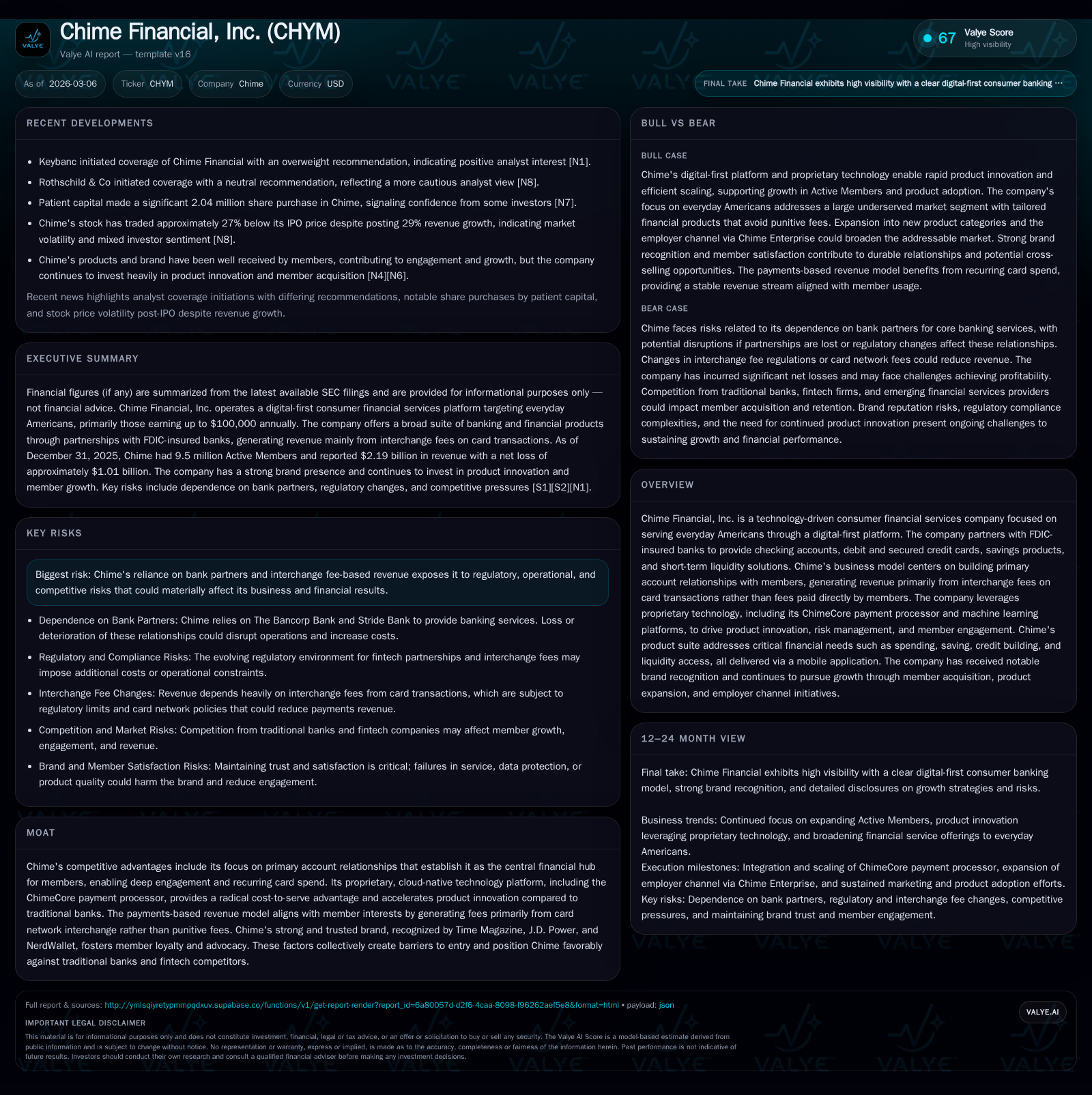
Chime Financial, Inc. has rapidly expanded its customer base to 9.5 million active members by leveraging a digital banking platform focused on serving everyday Americans. The company generates most of its revenue from interchange fees on card transactions, avoiding direct member fees, but this payments-driven model has not translated to profitability as net losses exceeded USD 1 billion in 2025. Regulatory risks related to partnerships with FDIC-insured banks and evolving consumer financial protections pose ongoing challenges. Chime maintains a strong liquidity position supported by a revolving credit facility and a share repurchase program while investing heavily in product innovation and customer acquisition.
Company Overview and Historical Performance
Chime Financial, Inc. operates as a technology-first consumer financial services company aimed at transforming banking for everyday Americans, particularly those earning up to $100,000 annually [S1][S20]. Unlike traditional banks that rely primarily on net interest income from deposits and lending, Chime predominantly monetizes through interchange fees paid by card networks whenever members transact using its debit or secured credit cards [S20]. This payments-based revenue model aligns closely with member interests by avoiding punitive fees directly charged to customers.
As of December 31, 2025, Chime reported approximately 9.5 million Active Members, most of whom consider Chime their primary financial relationship—a foundation that enables the company to embed itself deeply into members’ daily financial activities such as paycheck deposits and spending [S20]. This positioning fosters durable loyalty and transaction volumes critical for generating interchange revenue.
The company leverages proprietary technology including its ChimeCore payment processing system and machine learning platforms to accelerate product innovation and manage risk effectively compared to legacy banks [S1][S20]. Its cloud-native infrastructure offers a radical cost-to-serve advantage enabling rapid feature deployment and member engagement improvements.
Financial Summary
Historical performance (annual)
| FY |
|---|
| 2025 |
Source: SEC companyfacts cache [F1].
Revenue increased roughly 29% year-over-year as reported by corporate news sources reflecting strong top-line growth fueled by increased card usage among members [N3]. However, operating income remained sharply negative at over USD -1 billion in 2025 due to ongoing investments in technology development, marketing efforts to acquire new members, expanding compliance infrastructure amid heightened regulatory expectations, and costs associated with managing third-party partnerships [F1][S1][S20].
Free cash flow remains positive albeit modest relative to net losses—approximately USD 47 million after capital expenditures—indicating some operating cash generation capacity despite unprofitability [F1]. The strong current ratio of approximately 4.53 evidences ample short-term liquidity that can support ongoing operations [F1].
Business Model Nuances and Competitive Positioning
Chime's model is distinctively centered on creating primary banking relationships that facilitate paycheck deposits and daily spend transactions via Chime-issued cards rather than focusing solely on lending or deposit balances like traditional banks [S20]. This approach underpins consistent interchange fee revenue tied directly to member activity rather than volume-based deposit spreads.
Its cloud-native proprietary technology provides two structural advantages: an economically efficient cost structure versus legacy incumbents burdened by outdated core banking systems; and rapid iteration speed for product innovation enabled by machine learning-driven risk assessments [S20]. The latter is crucial for handling underwriting of short-term liquidity offerings such as SpotMe overdraft protection or instant small-dollar loans.
The trusted brand reputation underlies member loyalty—the company was recognized by Time Magazine as America’s top banking brand in 2025—while also elevating advocacy critical for organic growth [S20]. Nevertheless, sustaining brand trust requires continuous operational excellence especially given regulatory sensitivities around fintech practices.
Regulatory Environment and Risk Factors
Chime faces significant regulatory complexities primarily stemming from its non-bank status paired with critical dependencies on two FDIC-insured partner banks—The Bancorp Bank and Stride Bank—that originate most deposit accounts and loans held on their balance sheets [S7][S20]. This arrangement exposes the company indirectly to bank regulatory scrutiny including capital requirements impacting loan originations tied to tier 1 capital thresholds of partner institutions [S10][S14][S18].
Multiple enforcement actions have been publicly disclosed including a Consent Order with the Consumer Financial Protection Bureau (CFPB) in May 2024 involving penalties totaling nearly USD 4.55 million spread between fines and customer redress for delayed account closure checks [S11][S12][S17]. These highlight ongoing challenges meeting evolving consumer protection standards amid expanding product complexity.
The firm also confronts risks related to:
- Potential regulatory changes affecting interchange fees which comprise the bulk of revenue; any limitations or fee reductions could materially impact economics [S7][S21].
- Dependence on bank partners maintaining origination and balance sheet commitments for liquidity products. Any partner withdrawal or contractual change could disrupt access or scale [S10][S14].
- Compliance burdens related to data privacy laws encompassing GLBA federal regulations plus state-level regimes such as California's CCPA requiring complex cross-jurisdictional controls [S25].
- Litigation exposure from intellectual property disputes inherent in competitive fintech landscape where patent assertion entities may be active [S21][S22][S24].
- Risks around AI/ML usage given evolving regulatory interpretations impacting credit risk modeling or member interactions [S19].
- Operational risks linked to third-party system dependencies that underpin core offerings [S20].
Overall these factors underscore an environment requiring substantial legal expertise investment alongside robust internal controls.
Capital Structure and Liquidity Position
At year-end December 31, 2025, Chime held cash & equivalents of about USD 466 million supplemented by total current assets near USD 1.76 billion against current liabilities of approximately USD 388 million—a very healthy short-term liquidity profile shown by a current ratio over fourfold [F1].
The company also benefits from a $475 million senior secured revolving credit facility maturing in March 2030 with Morgan Stanley Senior Funding acting as administrative agent along with multiple major banks providing commitments [S5][S6][S16]. This facility is secured by substantially all assets available from Chime’s subsidiaries but contains restrictive covenants limiting merger activity, incurrence of additional debt, dividend payments above thresholds, asset sales without approval among others which may constrain strategic flexibility if liquidity tightens [S4][S6].
Although no dividends are currently planned with retained earnings deployed towards business growth initiatives including R&D and marketing expenditures [S13], the Board authorized a $200 million share repurchase program in November 2025 intending opportunistic buybacks via open market purchases or negotiated transactions subject to market conditions [S13][S15]. However repurchases could reduce cash reserves needed for operational scale or contingencies.
Future financings will likely be necessary if expansion continues at pace given the ongoing net losses and investments required; issuing additional equity could dilute existing shareholders while raising debt may increase leverage under existing covenants [S16][S18].
Growth Prospects and Forward-looking Considerations
Chime’s principal growth driver remains increasing its Active Member base through broadening product adoption amongst underserved segments of the US population seeking fee-free simplified banking solutions [N3][N9][N12]. Continued increases in transaction volumes via cards fuel recurring interchange fee income though membership growth rates serve as an important performance barometer.
Expansion of short-term liquidity products backed by paycheck deposits constitutes another revenue avenue but depends heavily on partner bank capacity limits connected to their tier one capital adequacy metrics restricting maximum loan inventory exposure per quarter [S10]. New product innovations integrated onto their scalable cloud platform leveraging AI for credit risk assessment could accelerate monetization opportunities if member uptake meets expectations without escalating credit losses.
However several factors could cap growth:
- Heightened regulation potentially reducing swap/merchant fee income or implementation complexity [S7][S19].
- Competition intensifying from traditional banks adopting digital channels plus emerging fintech players innovating aggressively around consumer financial services [N14].
- Requirement for ongoing substantial investments increasing burn rate before eventual profitability is achieved [F1].
- Challenges maintaining trusted brand reputation amid regulatory scrutiny or service disruptions impacting retention rates [S11][N11].
Despite operating losses exceeding $1 billion annually recently showing limited progress towards profitability [F1], the company's positive free cash flow suggests operational improvements may materialize assuming scale advantages persist. Investors appear cautiously optimistic given sizeable fund purchases reported post-IPO even as shares trade below IPO price levels reflecting valuation tension between growth potential versus margin realization timelines [N3][N9][N13]. Momentum indicators point toward watching membership trends combined with regulatory developments affecting interchange rules or lending constraints.
Returns and Capital Allocation Summary
Return metrics are depressed reflecting the company's early-stage growth investment phase; calculated return-on-equity is negative roughly -72% driven chiefly by large net losses relative to book equity value at the end of fiscal year 2025 [F1].
Capital allocation focuses heavily on reinvestment into platform development through cloud infrastructure enhancements plus expanding sales/marketing capacity aiming at scaling memberships rapidly rather than prioritizing shareholder distributions like dividends which remain off the table for foreseeable future [S13][S15].
A cautious share repurchase program ($200M authorized) reflects management’s intent to support stock price yet maintain flexibility given earnings volatility [S13].
Liquidity management is prudent given reliance on debt markets evidenced by extensive revolving credit agreements under strict covenants potentially limiting strategic optionality if adverse conditions arise [S4][S5].
Conclusion
Chime Financial’s approach—blending digital-first consumer banking powered by proprietary payments technology—is reshaping financial access for millions of Americans underserved by legacy institutions. The company has shown impressive top-line growth fueled by its scale in primary account relationships and interchange-driven revenue but faces clear headwinds stemming from persistent operating losses alongside intricate regulatory requirements tied both to external factors like CFPB enforcement actions and internal dependencies on partner banks' balance sheets.
Its technology advantage offers durability but must continually evolve within highly dynamic compliance landscapes. Liquidity remains solid bolstered by credit facilities though financial flexibility is circumscribed somewhat through covenants. Monitoring evolving government policy on interchange fees, CFPB supervision outcomes, bank partnership stability constraints related to loan originations/tier capital ratios represent key levers influencing trajectory.
In alignment with its mission to empower everyday Americans financially without punitive pricing models,whether Chime translates scale into sustainable profitability while managing risks will be critical as it progresses beyond establishing itself as a leading fintech brand recognized for innovation.
This analysis presents an overview grounded entirely in sourced disclosures without offering investment recommendations or price targets. Readers should consider all risks outlined herein when forming independent viewpoints about Chime Financial’s prospects.
Disclaimer: This is research-only, informational analysis and not investment advice. It may include AI-generated interpretation and general industry context. Always verify important details using primary sources.

Comments