
Horizon Quantum Holdings: Unpacking Early Challenges and the Road to Commercialization
An in-depth analysis of Horizon Quantum Holdings’ financial trends, product innovation, and strategic positioning within the evolving quantum software sector.
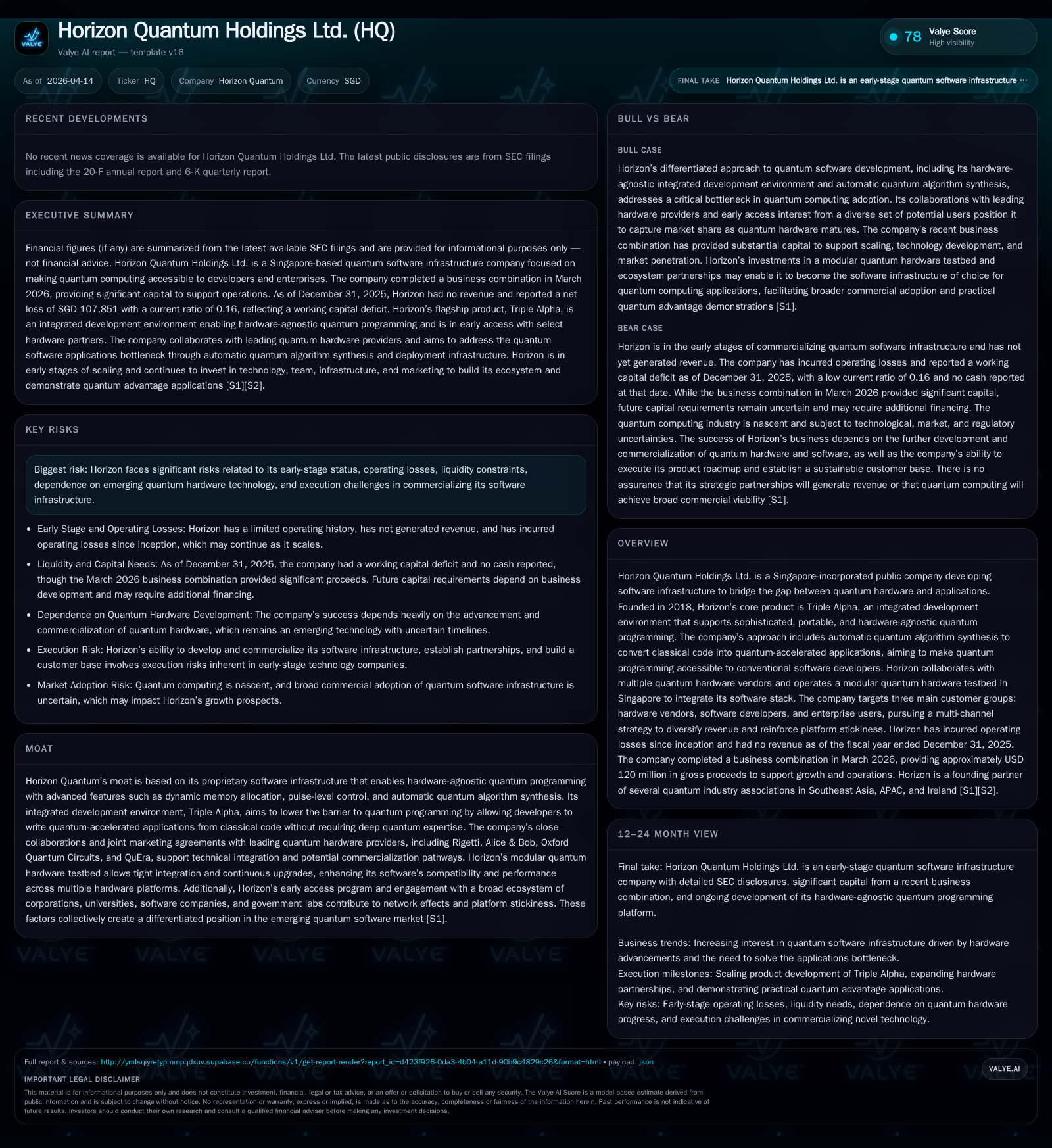
Horizon Quantum Holdings Ltd., a Singapore-based developer of hardware-agnostic quantum software infrastructure, remains in an early stage marked by operating losses and liquidity pressures despite recent capital infusion. Its flagship Triple Alpha platform leverages advanced features such as automatic quantum algorithm synthesis to lower barriers for developers, while strategic partnerships with leading quantum hardware providers underpin its growth potential. The company’s multi-channel business model targets hardware vendors, software developers, and enterprise users, aiming to diversify revenue streams as it transitions from foundational R&D into commercialization. Key risks persist around execution and dependency on nascent quantum hardware advancements; thus, monitoring milestones related to commercialization uptake and financing will be critical.
Historic Performance: Operating Losses Amid Foundational Development
Horizon Quantum Holdings Ltd., incorporated in Singapore in August 2025, recorded an operating and net loss of SGD 107,851 in fiscal year 2025 [F1][S10]. This early operating deficit reflects its position as a nascent company primarily focused on developing foundational quantum software infrastructure rather than generating revenue. Additionally, the company faced substantial liquidity pressures with current assets at only SGD 20,001 versus current liabilities of SGD 127,851 — a current ratio of approximately 0.16 indicating working capital stress before its business combination [F1].
This financial snapshot underscores the company's pre-revenue investment phase where significant capital deployment supports technology creation rather than commercial returns.
Historical performance (annual)
| FY |
|---|
| 2025 |
Source: SEC companyfacts cache [F1].
Triple Alpha and Strategic Partnerships: The Technical Framework Driving Growth
Central to Horizon's competitive moat is its proprietary software platform "Triple Alpha," an integrated development environment (IDE) enabling hardware-agnostic quantum programming [S6]. Triple Alpha differentiates itself through advanced features such as dynamic quantum memory allocation, pulse-level control enabling precise manipulation of quantum operations at the waveform level, and automatic quantum algorithm synthesis that converts classical programming code into optimized quantum-accelerated applications .
These capabilities position Triple Alpha not merely as an interface layer but as a robust quantum software stack that lowers the skills barrier for traditional developers entering quantum computing. Moreover, Horizon’s modular quantum hardware testbed hosted in Singapore facilitates tight integration testing across various qubit modalities.
Strategically, Horizon has established key collaborations with leading quantum hardware players including Rigetti Computing—participating in Rigetti's Novera QPU Partner Program—alongside annual partnership agreements for testing Triple Alpha compatibility with Alice & Bob, Oxford Quantum Circuits Ltd., and QuEra Computing Inc. These relationships provide technical co-development opportunities and potential joint go-to-market pathways without direct costs so far [S7][S8][S9][S11].
Emerging Revenue Channels: Hardware Vendors, Developers and Enterprise Customers
Horizon adopts a multi-channel strategy targeting three core customer segments: hardware manufacturers who embed or bundle Horizon's software tools; independent quantum software developers who use Triple Alpha as their primary coding environment; and enterprise end-users that deploy quantum applications internally or via cloud platforms [S6][S27].
Its business model integrates usage-based pricing on cloud-deployed applications (e.g., API calls or job runs) alongside annual licensing agreements granting software deployment on premises for clients requiring localized control over sensitive data or infrastructure [S8]. This dual approach blends scalability via cloud economics with predictable recurring revenues.
While yet to realize meaningful revenues from these channels due to industry nascency, the diversified routing establishes resilience against reliance on any single revenue stream. Academic access programs further reinforce pipeline development by training prospective users within key institutions [S7].
Financial Health Check: Capital Structure, Liquidity, and Going Concern Resolution
Prior to its public listing in March 2026 via a business combination with dMY Squared Technology Group Inc., Horizon experienced substantial working capital deficits [F1][S10]. This transaction provided gross proceeds of roughly USD 120 million (~SGD equivalent), combining trust account funds after redemptions and concurrent PIPE financing [S5][S22]. Post-merger management concluded that going concern doubts were materially alleviated owing to this substantial liquidity injection.
Nevertheless, the low current ratio pre-merger signals an ongoing need for prudent cash management. The company's continued capital requirements hinge on operational expansion and further R&D investment; additional financing rounds may be necessary if revenue generation lags projections [S10][S23].
R&D Investment Intensity and Operating Leverage: Scaling the Software Edge
Research and development remain highly capital intensive for Horizon given its ambition to push beyond mere access frameworks towards innovating algorithm synthesis engines and pulse-control primitives central to practical quantum advantage [S23][S28]. The modular testbed facility investment supports dynamic integration across heterogeneous quantum architectures.
This intense R&D focus underlines an operating leverage effect where future incremental revenue growth could yield outsized margin improvements as core infrastructure costs stabilize. Nonetheless, current losses persist until such scale manifests.
Risks Ahead: Commercialization Hurdles and Dependency on Quantum Hardware Maturation
As detailed in internal risk disclosures, Horizon confronts numerous challenges tied to its early-stage development including persistent operating losses threatening cash runway extension without adequate financing [S1]. Execution risk involves transitioning from technology validation to scalable commercial deployment amid uncertain quantum hardware trajectory.
The company depends heavily on third-party hardware advances remaining viable commercially; failures or delays therein could impair Horizon’s prospective client uptake. Furthermore, broader industry factors such as nascent developer ecosystems limit immediate addressable markets despite expansive long-term potential [S1].
Growth Prospects in a Multi-Channel Strategy Environment
Looking ahead, growth hinges on scaling adoption across its targeted user segments supported by strategic alliances that embed Horizon’s IDE at critical workflow junctures [S6]. Strengthening partnerships with diverse hardware providers reduces dependency risk while expanding total addressable market exposure.
Innovations like automatic translation of classical code into quantum-accelerated versions promise usability advancements essential for mainstream developer attraction. Horizon anticipates leveraging this capability along with demonstrated application successes through its Applications team focused on domain-specific algorithms [S25].
Capital Allocation Priorities: Returns, Cash Flow, and Shareholder Considerations
With ongoing operating losses dominating financial outcomes (an implicit negative return on equity considering net income relative to shareholders’ deficit per latest data) Horizon currently prioritizes capital preservation over distributions or buybacks [F1][S22]. No dividends have been declared nor are share repurchases planned given the need to sustain growth investments.
Cash flow considerations revolve around balancing burn rate against available funding from public markets post-Business Combination. Management communicates intention to support core technology scaling while maintaining sound governance over capital deployment decisions.
Outlook and Key Milestones to Monitor in Horizon’s Transition Phase
Absent explicit forward-looking guidance within filings—a typical limitation at this developmental juncture—observers should monitor for signs of:
- Early commercial revenue generation evidencing product-market fit,
- Expansion or deepening of partnership agreements into revenue-bearing contracts,
- Additional equity or debt financings augmenting runways,
- Demonstrations of practical quantum advantage delivered via Applications team initiatives,
- Growth in registered developer activity on Triple Alpha platform,
- Industry ecosystem endorsements such as embedding within major hardware manufacturer stacks.
Achievement of these milestones would validate Horizon’s trajectory from foundational R&D focus toward sustainable commercialization within the complex ecosystem that defines early-stage quantum computing ventures.
This analysis synthesizes publicly filed quantitative data alongside descriptive corporate disclosures pertaining strictly to Horizon Quantum Holdings Ltd., thereby avoiding speculative extrapolation beyond documented information presented through SEC filings dated April 2026. This memo intends solely informational purposes regarding corporate developments without expressing investment advice or recommendations.
Disclaimer: This is research-only, informational analysis and not investment advice. It may include AI-generated interpretation and general industry context. Always verify important details using primary sources.

Comments