
Humana’s Medicare Advantage Momentum and Cost Management Update in Q2 2026
Humana's Q2 2026 results reveal sustained Medicare Advantage enrollment growth, disciplined cost control, and strategic investments amid regulatory and inflationary challenges.
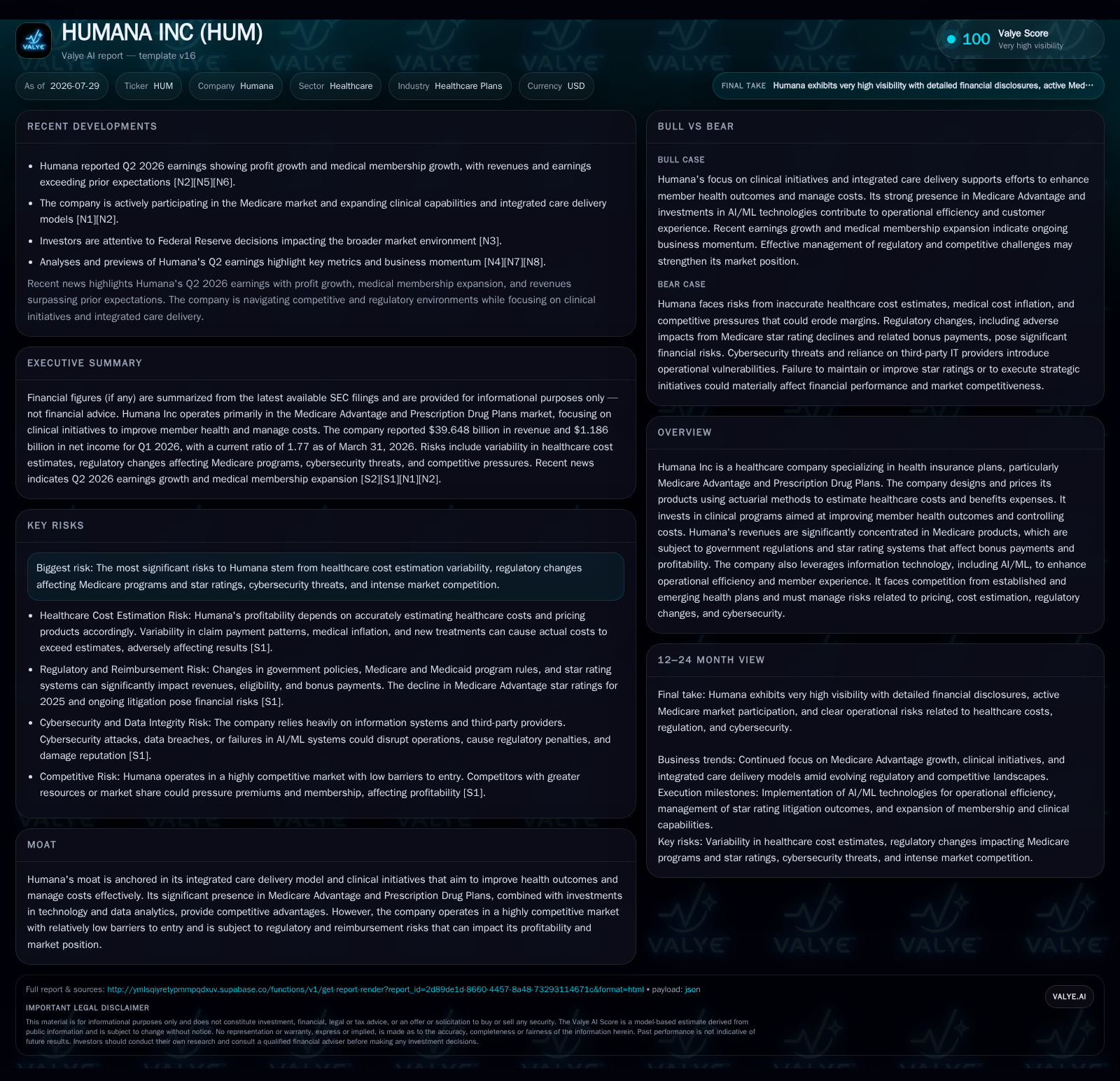
In its latest Q2 10-Q filing, Humana reported continued Medicare Advantage membership expansion alongside effective benefit cost management. The company posted impairment charges related to minority-interest investments that modestly affected near-term earnings but affirmed the strength of its actuarial pricing and clinical initiatives supporting profitability. Regulatory dynamics around star ratings and risk adjustment remain critical to financial outcomes, while demographic trends and technology investments underpin growth potential. Overall, Humana balances operational efficiency with competitive positioning in a complex healthcare plans environment.
Q2 2026 Operating Performance: Medicare Advantage Membership Growth Drives Revenue Expansion
Humana Inc.'s Q2 2026 10-Q filing reveals continued growth in Medicare Advantage membership, a core driver of its premium revenue under fixed contracts with the Centers for Medicare & Medicaid Services (CMS) [S2]. This enrollment expansion aligns with the broader demographic trend of an aging U.S. population increasingly opting for Medicare Advantage plans, which bundle Medicare Parts A, B, and often D benefits. Since premiums under CMS contracts are typically set annually and fixed for the contract year, Humana’s top-line revenue growth depends heavily on member enrollment increases rather than mid-year premium adjustments [S1][S2]. The quarter included a $21 million impairment charge related to minority-interest investments recorded within net investment income, a non-recurring item that modestly impacted net income but does not reflect ongoing operational performance [S2]. Maintaining disciplined claims and benefit cost management remains critical given the fixed premium environment and exposure to medical cost inflation [S1].
Actuarial Pricing and Clinical Programs Mitigate Medical Cost Inflation
Humana employs advanced actuarial pricing models to estimate healthcare costs and set premiums accordingly under CMS Medicare Advantage contracts [S1]. These models incorporate assumptions on claim payment patterns, medical cost inflation—including specialty drug utilization—and member health risk profiles. Because premiums are fixed for the contract year, any actual benefit expenses exceeding actuarial estimates cannot be recovered through premium increases, underscoring the importance of precise pricing and cost control [S1]. To counteract inflationary pressures, Humana invests significantly in clinical programs focused on chronic disease management, preventive care, and utilization management. These initiatives aim to reduce the benefit cost per member per month (PMPM) by improving health outcomes and limiting unnecessary or high-cost services [S1]. Such clinical programs are essential to controlling the medical loss ratio (MLR) and sustaining profitability in a competitive Medicare Advantage market.
Regulatory Environment: Star Ratings and Risk Adjustment Impact Profitability
CMS star ratings are a pivotal metric influencing Humana’s Medicare Advantage profitability and competitive positioning [S1]. These ratings, based on quality measures such as preventive care, chronic condition management, and member satisfaction, directly affect bonus payments and rebate levels, which can materially enhance plan margins. High star ratings also improve marketing leverage by enabling expanded enrollment periods and attracting new members [S1]. Maintaining or improving star ratings requires ongoing investment in quality improvement initiatives, accurate claims processing, and member engagement programs.
In parallel, Humana actively manages risk adjustment factor (RAF) scores, which calibrate CMS payments to reflect the health status and expected costs of enrolled members [S1]. Effective RAF management ensures revenue aligns with the complexity of the member population, optimizing reimbursement while minimizing regulatory risk. However, the company faces ongoing regulatory scrutiny and litigation risks related to CMS’s Risk Adjustment Data Validation (RADV) audits, which can result in financial clawbacks if coding or documentation deficiencies are identified [S14]. These regulatory dynamics necessitate robust compliance and data accuracy frameworks.
Competitive Positioning Among Medicare Advantage Peers
Humana competes in the Medicare Advantage market against large peers such as UnitedHealth Group, Centene Corporation, and CVS Health/Aetna [S1]. UnitedHealth leverages its scale and integrated care delivery platforms, including Optum’s provider services, to drive clinical integration and cost efficiencies. Centene’s strength lies in its diversified Medicaid and Medicare state-based contracts, offering geographic and product line breadth. CVS Health/Aetna combines insurance offerings with integrated pharmacy benefit management (PBM) services, providing a vertically integrated model.
Humana’s strategic focus emphasizes clinical programs supported by data analytics and care management without full vertical integration of PBM services, differentiating its approach from CVS Health/Aetna [S1]. This positioning reflects trade-offs between care coordination capabilities and pharmacy management integration. Across the peer set, star rating performance remains a critical KPI influencing bonus accruals, member retention, and competitive market share.
Growth Drivers: Demographics and Technology Investments
The aging U.S. population continues to drive Medicare Advantage enrollment growth, supporting Humana’s expansion opportunities [S1]. Additionally, government initiatives expanding Medicare benefits and eligibility further underpin demand. Humana is investing in artificial intelligence (AI) and machine learning (ML) technologies to enhance underwriting accuracy, claims adjudication efficiency, and personalized member engagement [S1]. These digital tools aim to improve risk selection, reduce administrative expenses, and lower member churn by enabling more targeted interventions and streamlined operations. As the healthcare plans industry increasingly embraces digitization, Humana’s technology investments may provide competitive advantages in operational efficiency and member experience.
Risks: Medical Cost Volatility, Regulatory Changes, and Cybersecurity
Key risks for Humana include volatility in medical cost trends, particularly specialty drug prices and utilization, which can elevate the medical loss ratio and pressure profitability given fixed premiums [S1]. Regulatory changes affecting Medicare Parts C and D reimbursement methodologies, eligibility criteria, or benefit design may require plan adjustments and impact revenue streams [S5][S14]. The company remains subject to ongoing governmental audits and investigations focused on risk adjustment coding accuracy; adverse findings could lead to financial penalties or clawbacks [S9]. Cybersecurity threats pose increasing risks, as breaches compromising protected health information could result in regulatory fines under HIPAA, reputational damage, and operational disruptions [S26].
Outlook: Key Milestones and Monitoring Points
Upcoming CMS star rating announcements will be critical for determining bonus payments and marketing leverage for the 2027 plan year, directly influencing Humana’s profitability and competitive positioning [S2][N10]. Enrollment trends for future contract years will provide insight into the sustainability of membership growth amid intensifying competition. Progress on enterprise-wide digital transformation initiatives, including AI-driven underwriting and claims processing, will be important to monitor relative to peers aggressively pursuing technology adoption [S6]. Regulatory clarity and developments related to RADV audits remain an unsettled factor with potential financial implications [S14]. These milestones and operational indicators will be key to assessing Humana’s trajectory in the evolving Medicare Advantage landscape.
Financial Position and Liquidity
As of March 31, 2026, Humana held approximately $5.0 billion in cash and cash equivalents, supporting liquidity and operational flexibility [F1]. The company reported current assets of $38.1 billion against current liabilities of $21.5 billion, resulting in a current ratio of approximately 1.77x, indicative of a solid short-term liquidity position [F1]. While total debt figures are not current in the available data, prior disclosures indicate manageable leverage consistent with investment-grade credit ratings [S4]. This financial profile supports ongoing investments in clinical programs, technology, and capital returns while maintaining regulatory capital requirements.
This analysis integrates Humana’s recent SEC filings with sector-specific perspectives on healthcare plans dynamics and competitive positioning without providing investment advice. Market participants should monitor regulatory developments, membership trends, and technology initiatives closely for their impact on Humana’s future operating and financial results.
Disclaimer: This is research-only, informational analysis and not investment advice. It may include AI-generated interpretation and general industry context. Always verify important details using primary sources.

Comments