
Idea Acquisition Corp.’s SPAC Liquidity and Timeline Set Stage for Initial Business Combination
With a strong trust account and no operational revenues yet, IACO focuses on completing its merger within the next two years.
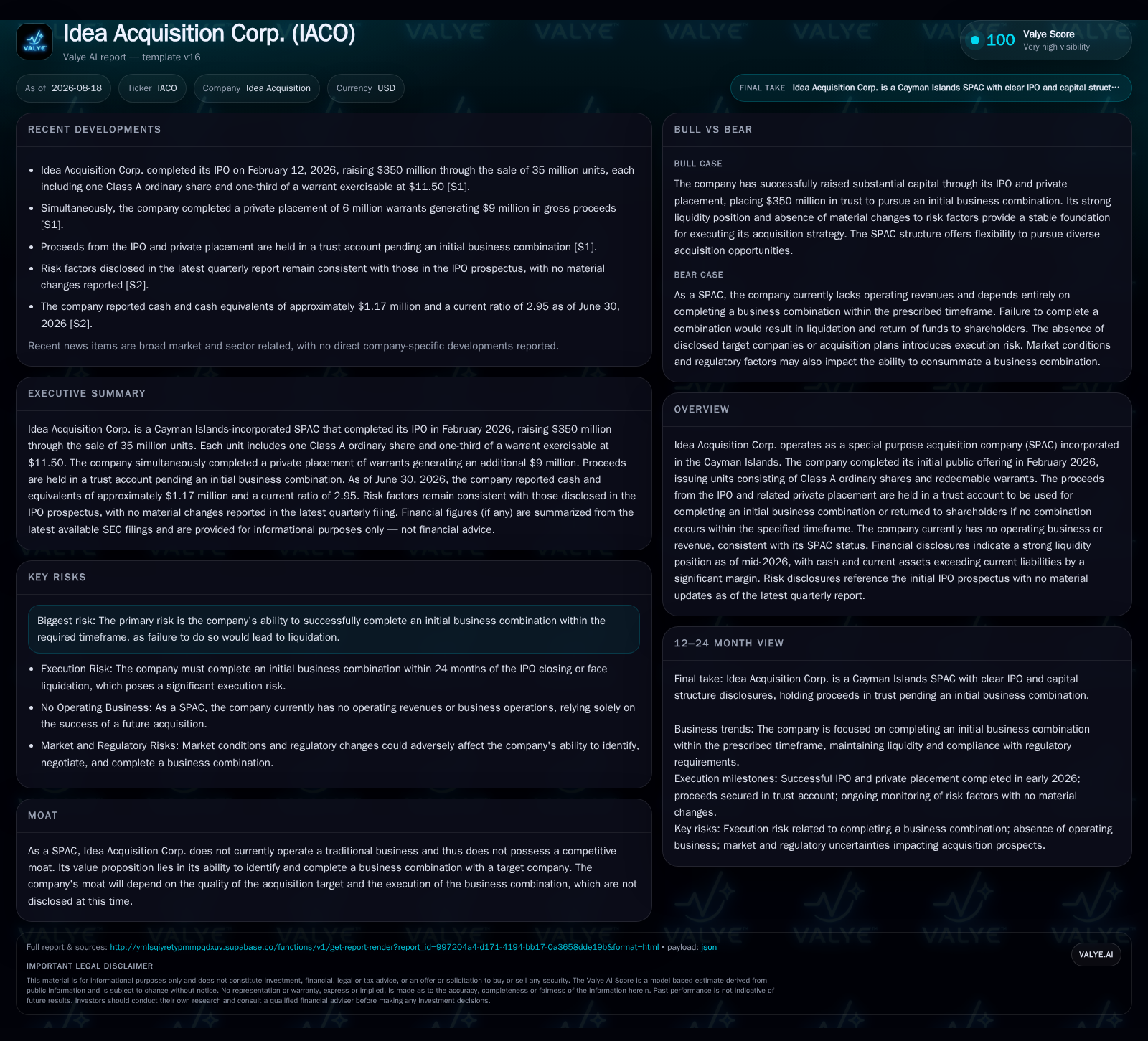
Idea Acquisition Corp. (IACO) completed its IPO in February 2026, raising $350 million to pursue a private operating company acquisition using the SPAC model. As of mid-2026, it holds over $1.16 billion in cash and short-term assets exceeding liabilities nearly threefold, positioning it well financially but with no revenues or operating business pre-merger. The key challenge remains executing a qualifying business combination before the 24-month deadline to avoid liquidation. Factors such as shareholder redemption rights, warrant overhang, and sponsor incentives will influence value creation. The absence of announced targets currently heightens execution risk amidst an evolving SPAC regulatory environment.
Recent Operating Update
As planned at IPO completion in February 2026, IACO’s units—which contain one Class A ordinary share and one-third of a redeemable warrant—began trading separately from April 6, 2026 [S11]. This separation provides investors greater liquidity options by enabling distinct trading of shares and warrants rather than bundled units
Business Model Analysis
IACO exemplifies the archetypal SPAC business model: it raises capital exclusively via an initial public offering selling units comprising common shares plus warrants at typically below-market pricing to attract institutional and retail investors. The proceeds—amounting to $350 million at IPO including underwriters' deferred commissions and private placement warrant proceeds—are placed into a U.S.-based trust account managed independently by Continental Stock Transfer & Trust Company [S9], [S17]. This trust structure legally confines funds so that disbursement occurs only upon successful completion of an acquisition or ordered liquidation after expiration of the merger deadline.
Revenue generation prior to a business combination is non-existent by design; IACO incurs operating expenses largely limited to administrative costs covered by limited interest income permitted from the trust account balance. The true economic potential crystallizes post-merger when the formerly private target company gains public listing through IACO’s shell, ideally unlocking equity appreciation opportunities for shareholders and sponsors.
The sponsor’s role also includes bearing initial organizational costs and securing potential targets but profits primarily derive from post-merger equity stakes often obtained via founder shares or promote interests.
Industry Structure and Competitive Position
Operating strictly as a blank-check vehicle, Idea Acquisition aligns with broader trends in the SPAC sector where issuance volumes fluctuate based on market appetite for alternative public listing routes compared with traditional IPOs. Competitors span other SPAC vehicles like Pershing Square Tontine Holdings (PSTH) known for high-profile target pursuits, the Churchill Capital series notable for multiple deals across sectors, and Altimeter Growth Corp., a specialist in tech acquisitions.
Key distinctions among SPACs usually emerge after target identification—via announced deals signaling strategic focus area or sponsor expertise—and efficacy in executing transactions that satisfy market expectations on valuation and growth potential. Since IACO has yet to announce any target nor definitive merger terms as of the latest filings, it remains at an early stage relative to peers who may be progressing into negotiations or shareholder meetings.
Growth Drivers
The principal growth driver for Idea Acquisition is successfully sourcing an attractive private company seeking expedited access to public markets with less regulatory friction than traditional IPO pathways. Favorable capital market conditions sustaining investor demand for speculative yet potentially lucrative pre-revenue investment vehicles support ongoing issuance of SPACs like IACO.
Institutional interest in alternative equity financing mechanisms continues encouraging so long as sponsors demonstrate transparent governance structures—as reflected by IACO’s appointment of independent directors with audit expertise—and compliance with SEC guideline evolutions aimed at enhancing SPAC disclosure quality.
Risks and Watchpoints
The critical existential risk rests on failure to consummate an initial business combination within the statutorily defined two-year window following IPO close—February 2028 for IACO—which mandates return of trust funds minus permitted expenses to public shareholders resulting in termination of the entity [S7]
Dilution arising from extensive warrant overhang (both public redeemable warrants issued at IPO exercisable above market price after merger completion and private placement warrants granted to sponsor and underwriters) may pressure post-combination share prices if warrants are exercised en masse.
An additional layer of uncertainty stems from sector-specific regulatory developments intensifying scrutiny over SPAC marketing practices and valuation presentations post-SEC guidance released recently though no new material regulatory impacts were cited in IACO’s latest filings [S18]
Sponsor incentive alignment will require monitoring as conflicts can arise where sponsors retain promote interests even if deals fail shareholder approval causing friction between founders’ upside versus public investors' downside exposure.
What To Watch Next
Market participants should track several key milestones indicative of IACO’s progress:
- Public announcement of any target company identified for initial business combination,
- Details around proposed merger agreement terms including valuation methodologies,
- Shareholder vote scheduling dates,
- Redemption rate indications ahead of vote,
- Potential PIPE financing commitments if required for transaction completion,
- Any amendments extending the statutory timeline given regulatory allowances or contractual modifications,
- Further separation statistics concerning unit components trading activity,
- Sponsor communications reflecting pipeline activity or strategic endorsements.
Henceforth, quarterly filings will remain critical touchpoints revealing operational updates beyond financial metrics reflecting execution posture toward merger realization.
Financial Profile Discussion
At June 30, 2026, IACO reported cash and equivalents totaling approximately $1.17 billion with current assets standing around $1.33 billion against current liabilities near $451 million yielding a current ratio close to 2.95—a solid liquidity position supportive of transactional flexibility [F1]. Total debt was relatively modest at about $251 thousand creating net debt leverage effectively negative due to strong cash holdings.
Operating losses reflect typical pre-combination cost burdens associated with administrative expenses incurred in pursuit of identifying viable acquisition targets—operating income was approximately -$228 thousand measured at quarter-end [F1]. Net income figures remain marginally negative as expected since no revenue streams exist pre-business combination.
This financial profile aligns well with peer SPAC norms focused on capital preservation until deployment through consummation of sponsored mergers offering clearer paths toward positive free cash flow generation within combined entities post-deal closure.
This analysis synthesizes available SEC documents up through August 13, 2026; data limitations preclude commentary on specific target candidates or transaction timing beyond regulatory timeframes outlined publicly. Readers should consider risks inherent to all pre-merger blank-check companies when evaluating investment implications.
Disclaimer: This is research-only, informational analysis and not investment advice. It may include AI-generated interpretation and general industry context. Always verify important details using primary sources.

Comments