
iShares Bitcoin Trust ETF’s Growth and Volatility: Securing Bitcoin Access in an Unstable Market
IBIT leverages regulated ETF structure and robust custody protocols to offer bitcoin exposure amid pronounced market swings.
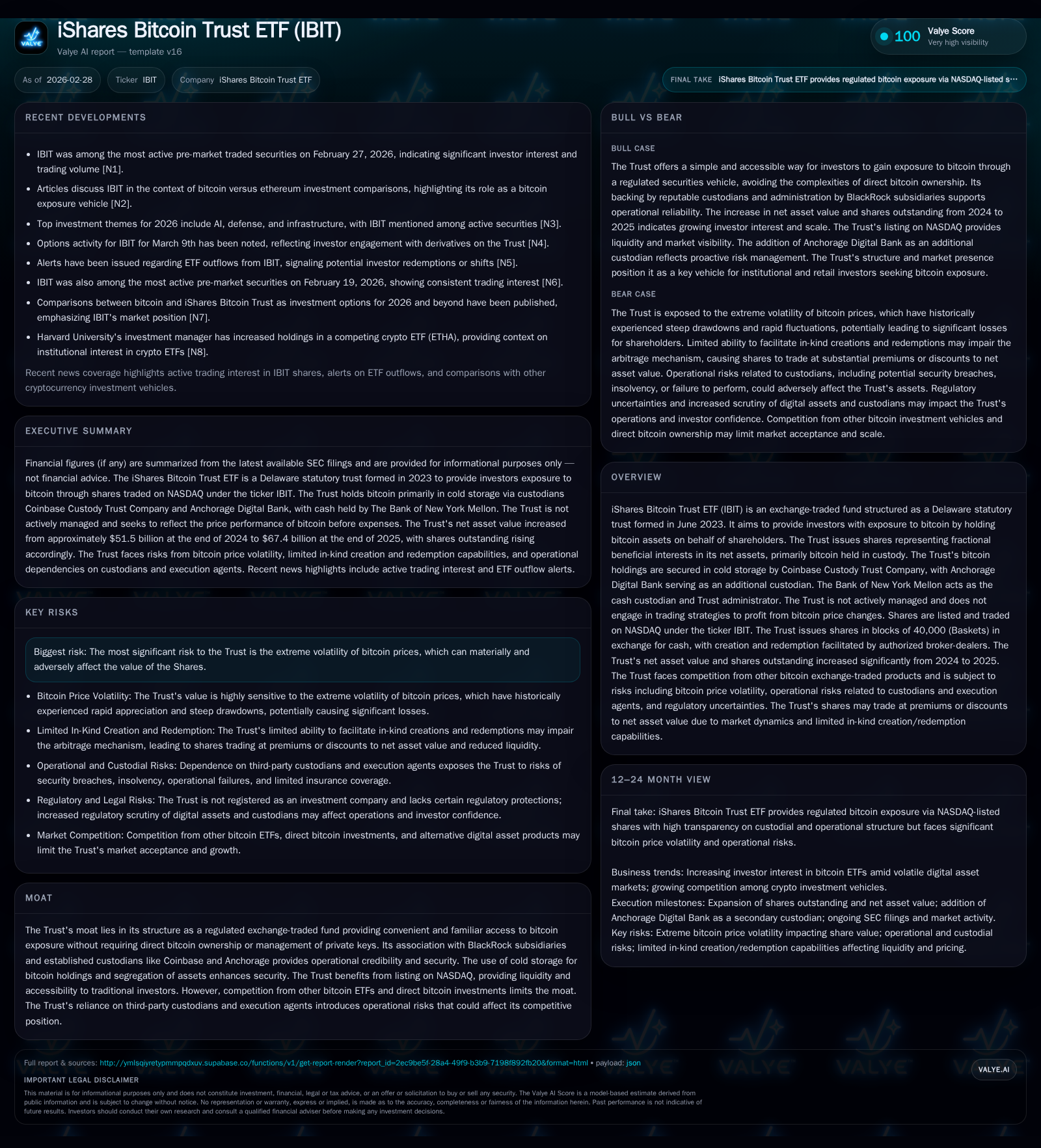
The iShares Bitcoin Trust ETF (IBIT), launched in mid-2023, provides investors with regulated, NASDAQ-traded exposure to bitcoin via fractional shares backed by cold-stored bitcoin assets. Since inception, its net asset value and share count have expanded despite extreme underlying bitcoin volatility averaging 65% annualized, which has produced significant fluctuations in operating and net income. The trust’s operational credibility is grounded in partnerships with Coinbase Custody and Anchorage Digital Bank for bitcoin safekeeping, along with oversight by BlackRock subsidiaries. However, regulatory uncertainties and custodial counterparty risks remain material concerns that could impact future trust operations and investor confidence.
Genesis and Structural Setup of iShares Bitcoin Trust ETF
The iShares Bitcoin Trust ETF (IBIT) was established as a Delaware statutory trust on June 8, 2023, marking BlackRock’s entry into providing institutional-grade access to spot bitcoin for traditional investors [S1]. The Trust issues shares representing fractional undivided beneficial interests backed primarily by bitcoin held in custody rather than futures or derivatives exposure. Its governance framework involves BlackRock subsidiaries acting as Sponsor and Trustee, a setup consistent with regulated exchange-traded funds registered under U.S. securities law.
Coinbase Custody Trust Company functions as the principal Bitcoin custodian securing the held coins via cold storage protocols — an offline safeguarding method preventing cyber intrusions [S1][S25]. Anchorage Digital Bank serves as additional Bitcoin custodian ready to assume custody if needed, enhancing resilience [S1]. Cash holdings related to subscriptions and redemptions are held under the aegis of The Bank of New York Mellon which also administers the Trust's daily operations.
Notably, the Trust does not engage in active management or tactical trading strategies to capitalize on short-term bitcoin price movements but aims solely to track underlying spot bitcoin performance through physical holdings [S1]. Authorized Participants (APs) transact in creation/redemption of shares using blocks called "Baskets" consisting of 40,000 Shares each [S1], facilitating arbitrage mechanisms typical of ETFs.
This structure endows IBIT with a moat rooted in providing familiar, secure access to volatile digital assets outside direct private key ownership—the latter often a barrier for broad investor participation.
Historical Growth Trajectory and Year-over-Year Financial Movements
From inception through fiscal years ending December 31, IBIT’s net asset value (NAV) demonstrated notable growth aligned closely with fluctuating demand for bitcoin exposure coupled with underlying bitcoin price dynamics. NAV increased from approximately $51.5 billion at end-2024 to $67.4 billion by end-2025 while outstanding shares rose from roughly 970 million shares to about 1.36 billion shares in the same timeframe [F1][S1].
Operating metrics have shown marked variability owing entirely to volatility of the underlying asset rather than operational inefficiency: Operating income swung from negative $47.5 million in 2024 to negative $174.6 million in 2025 (-267.5% YoY). Net income showed even more dramatic swings: a positive $14.2 billion reported in FY 2024 plunged to a negative $8.97 billion for FY 2025 (-163% YoY) [F1].
Operating cash flow remains deeply negative but improved from negative $37.3 billion in FY 2024 to negative $19.9 billion by FY 2025 (+46.6%) — indicating somewhat better cash conversion even amidst severe market gyrations [F1]. These financial swings primarily reflect mark-to-market valuation effects mirroring underlying bitcoin price cycles rather than core fund operations or cash-generative capabilities.
Historical performance (annual)
| FY | Net ($bn) | CFO ($bn) | OpInc ($mm) | Net YoY |
|---|---|---|---|---|
| 2025 | -9.0 | -19.9 | -175 | -163.0% |
| 2024 | 14.2 | -37.3 | -47 | |
| 2023 | 0.0 | 0.0 | 0 |
Source: SEC companyfacts cache [F1].
Table: Annual financial performance data illustrating IBIT's operating income volatility driven by bitcoin market swings [F1]
Bitcoin Market Volatility Impacting Trust Value and Investor Confidence
Bitcoin’s intrinsic high volatility profoundly shapes IBIT’s value trajectory and investor perceptions [S1][S2]. Over the past decade leading up to early 2026 Bitcoin has exhibited an average annual trailing volatility around 65%, measured across one-year rolling periods — far above traditional equity indices [S1].
Price cycles featuring rapid appreciation spikes followed by steep crashes have repeated multiple times: notable drawdowns include a peak of $67,734 falling below $16k during late 2021 through early 2022—a decline exceeding 77% [S1][S2]. Similar patterns occurred during prior cycles including crashes of 2013-2014 and late 2017-2018.
Recent events such as the "October 2025 Flash Crash," linked broadly to global trade tensions triggering forced liquidations exceeding $20 billion collateral across crypto markets—including perpetual futures contracts—reduced confidence further and exposed operational fragilities across exchanges [S1][S2]. Such episodes generate substantial NAV declines for IBIT since its shares represent direct fractional claims on physical bitcoins rather than derivatives buffering downturns.
Investor confidence thus remains tightly coupled to perceived stability within crypto ecosystems where systemic shocks cascade rapidly impacting liquidity spreads and prompting trading halts during distressed conditions [S10].
Custody and Regulatory Foundations Supporting Trust Credibility
The Trust’s reliance on custody infrastructure managed primarily by Coinbase Custody and secondarily Anchorage Digital Bank affords it structural security advantages over direct personal holdings or unregulated platforms [S1][S25]. Private keys controlling bitcoins are stored offline utilizing multisig cold storage facilities that significantly reduce hacking risks inherent when keys are kept online.
Access controls restrict key possession among trusted personnel only; no single employee holds full private keys—a critical security control certified annually against SOC attestations [S25]. These safeguards maintain asset segregation preventing commingling risks common at exchange level wallets.
BlackRock’s sponsorship lends regulatory credibility although heightened scrutiny following cascading failures of major crypto entities such as FTX (bankruptcy), Celsius Network, Voyager Digital et al., creates an environment where U.S regulators advance comprehensive oversight potentially modifying trust operational requirements or market viability [S3][S5][S7][S11].
While Coinbase Inc., affiliated as Prime Execution Agent and parent entity for Coinbase Custody backing IBIT holdings has faced past SEC enforcement actions unrelated directly to IBIT-held bitcoins—and these enforcement suits have been dismissed—continued litigation risks persist potentially impacting available services or cost structures marginally [S4][S12][S13].
Operational Snapshot: Creation/Redemption Mechanisms and Market Liquidity
IBIT functions within the classic Authorized Participant model enabling creation/redemption activities executed through designated brokers exchanging baskets of exactly 40,000 shares each against equivalent cash deposits cleared via cash custodian BNY Mellon [S1]. This process supplies arbitrage channels keeping share price closely tethered to NAV barring wide liquidity gaps.
Listing on NASDAQ affords comparatively transparent real-time trading accessibility albeit subject to episodic spreads widening due to cryptocurrency market disruptions or limited trading hours relative to continuous global crypto markets [N3][N7][S10]. This ecosystem allows professional market makers alongside retail investors reasonable latency-access while preserving overall liquidity.
Transactions driven heavily by bitcoin demand spikes reflected markedly increased volume among frequently traded contracts notably surrounding volatile news cycles or macroeconomic speculative moves seen in early Q1-2026 activity peaks [N3][N7].
Outlook on Pricing Dynamics, Share Issuance, and Market Positioning
Investors should monitor potential regulatory developments presently underway that could affect digital asset custody frameworks or impose new compliance costs affecting fee structures or share valuation methodologies impacting IBIT premiums/discounts versus underlying bitcoin levels [N6][N12]. Ongoing ETF outflows reported recently underscore challenges maintaining scale amidst competition from alternative products offering lower fees or index variations targeting crypto exposure indirectly via futures or hybrid vehicles thus fragmenting investor allocations [N12]. The path forward depends significantly on evolving U.S regulatory clarity toward digital assets including legislative support breakthroughs enabling stable long-term frameworks fostering institutional involvement.
Capital Allocation Strategy Including Fees and Returns
Operating results reveal absence of dividends or buybacks consistent with passive ETF handling physically backed crypto assets managed non-actively without yield generation beyond capital appreciation potential [F1][S1]. The sizable negative operating income reflects valuation declines tied tightly to volatile underlying bitcoin pricing rather than operational cash burn.
Cash flow performance is improving YoY (+46%) yet remains deeply negative because capital flows directly mirror asset revaluations within extremely volatile spot markets with no hedging overlay employed by management [F1]. The Sponsor charges standard fees deducted proportionate to NAV dampen overall net returns somewhat akin to expense ratios observed across traditional mutual funds but comparable ETFs focused on digital currencies face similar cost structures limiting upside net distributions.
Risk Profile: Regulatory Uncertainty vs. Security of Asset Custody
Core risk drivers encompass intense regulatory uncertainty unresolved within U.S federal/state authorities shaping future permissible activities concerning digital assets generally including custody provisioning specifically relevant for IBIT’s continued operation under current laws [S3][S5][S7][S11]. Pending legislation or enforcement standards could impose constraints escalating compliance costs or restricting platform capabilities incentivizing early termination scenarios.
Custodial risk persists although materially mitigated through cold storage safeguards; however limited indemnification caps (~$5 million plus fees paid) under Prime Execution Agent agreements plausibly expose shareholders ultimately if catastrophic breaches occurred absent insurance coverage fully absorbing losses [S6][S7][S9][S16]. Additionally, counterparty insolvencies within affiliated entities cannot be fully ruled out given ongoing litigation exposures faced by Coinbase Inc., albeit none presently directed at the Trust itself.
Operational continuity depends upon sustained third-party service availability across custodianship functions with mandated fallback activation procedures for transitioning custody providers designed but untested live within crisis scenarios—posing residual uncertainty acceptable only given nascent maturity statute covering digital asset ETFs relative to legacy funds.
Disclaimer: This is research-only, informational analysis and not investment advice. It may include AI-generated interpretation and general industry context. Always verify important details using primary sources.

Comments