
Inhibrx Biosciences Q2 2026: Ozekibart BLA Under FDA Review Amid Clinical and Regulatory Risks
Inhibrx faces regulatory uncertainty as the FDA reviews its biologics license application for ozekibart, while maintaining strong liquidity to support ongoing clinical programs.
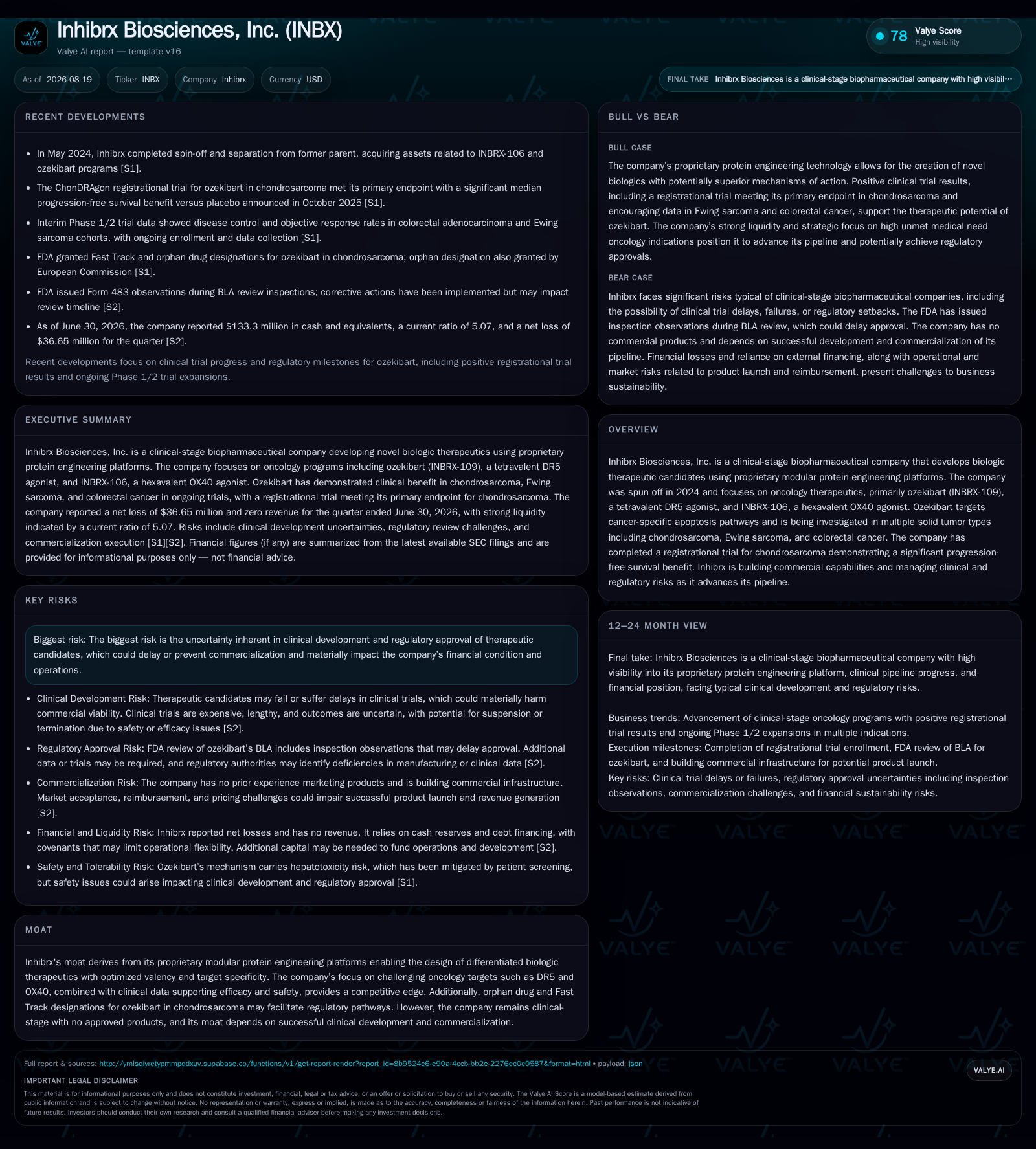
Inhibrx Biosciences is currently navigating a critical regulatory milestone with the FDA review of its biologics license application (BLA) for ozekibart, a tetravalent DR5 agonist targeting metastatic or unresectable conventional chondrosarcoma. The FDA has issued Form 483 inspection observations during the review process, which the company has addressed but which may still delay approval. Alongside ozekibart, Inhibrx continues clinical development of INBRX-106, a hexavalent OX40 agonist. The company’s cash position of $133.3 million as of June 30, 2026, with a current ratio of 5.07, provides a solid runway to support clinical and commercial activities. However, regulatory and clinical uncertainties remain significant near-term risks.
Regulatory Review and Clinical Development Update
Inhibrx Biosciences is currently engaged in a pivotal regulatory process with the U.S. Food and Drug Administration (FDA) regarding its biologics license application (BLA) for ozekibart (INBRX-109). Ozekibart is a tetravalent DR5 agonist developed for the treatment of metastatic or unresectable conventional chondrosarcoma, a rare and difficult-to-treat oncology indication. As of the second quarter of 2026, the BLA is under active FDA review [S2]. During the FDA’s clinical inspections related to this review, Form 483 inspection observations were issued both to Inhibrx and some clinical investigators involved in the ChonDRAgon trial. These observations typically indicate potential deficiencies in clinical trial conduct or manufacturing quality systems. Inhibrx has implemented corrective and preventive actions in response to these findings [S2]. Despite these efforts, the presence of inspection observations introduces a material risk that the FDA may delay approval, request additional data, or require further clinical or manufacturing changes before granting marketing authorization. This regulatory uncertainty is a critical near-term risk factor for the company’s ability to commercialize ozekibart [S2].
Alongside ozekibart, Inhibrx is advancing INBRX-106, a hexavalent OX40 agonist also in clinical development for oncology indications. This candidate represents an important pipeline diversification beyond ozekibart and contributes to the company’s long-term growth prospects [S1][S2]. The company held $133.3 million in cash and equivalents, with current assets totaling $142.2 million against current liabilities of $28.1 million, yielding a current ratio of 5.07 [F1]. This level of liquidity provides a substantial runway to fund ongoing clinical development programs and the building of commercial capabilities in anticipation of potential product approval.
Operating cash flow remains negative due to the inherent expenses of clinical trials and regulatory activities, but the cash balance and working capital position mitigate near-term financing risk [S2][F1]. Capital allocation continues to focus primarily on advancing clinical candidates, addressing regulatory requirements, and preparing for eventual commercialization.
Business Model and Competitive Positioning
Inhibrx operates as a clinical-stage biopharmaceutical company specializing in oncology biologics developed through proprietary modular protein engineering platforms. These platforms enable the design of multivalent therapeutic candidates with optimized valency and target specificity, as exemplified by ozekibart’s tetravalent DR5 agonism and INBRX-106’s hexavalent OX40 agonism [S1].
The company’s business model depends on successfully navigating clinical development and regulatory approval to bring novel biologic therapeutics to market. Future revenue generation will rely on obtaining FDA marketing approval, securing pricing and reimbursement from healthcare payors, and achieving market adoption. Margins and cash conversion potential post-commercialization will be influenced by manufacturing efficiency, pricing power, and scale of commercial operations.
While the proprietary engineering platform offers potential differentiation, the company faces significant industry-standard risks including clinical trial failures, regulatory delays, and reimbursement uncertainties [S2]. The FDA’s current inspection observations and review outcomes for ozekibart underscore these challenges.
Risks and Scenarios
The regulatory review of ozekibart’s BLA is the most immediate and material risk to Inhibrx’s near-term prospects. The FDA’s issuance of Form 483 inspection observations, despite corrective actions, signals possible deficiencies that could delay approval or necessitate additional clinical or manufacturing studies [S2]. Such outcomes would postpone commercialization, extend cash burn, and potentially require further capital.
Conversely, a base-case scenario envisions the FDA completing its review within expected timelines, possibly requesting minor additional data but ultimately approving ozekibart. This would enable Inhibrx to initiate commercialization efforts supported by its existing cash reserves and commercial infrastructure development [S2][S1]. The bear-case scenario involves FDA delays or a complete response letter due to unresolved inspection issues or data insufficiencies, requiring further trials or manufacturing changes. This would increase operational expenses, delay revenue generation, and heighten financing risks [S2].
Watchpoints
Key factors to monitor in the coming quarters include:
- The FDA’s regulatory decision on the ozekibart BLA and any communications regarding additional data requests or conditions.
- Updates on the resolution status of FDA inspection observations and manufacturing quality compliance.
- Clinical data readouts and enrollment progress for INBRX-106, which affect pipeline diversification.
- Cash burn rate trends and the company’s capital raising activities, if any, to sustain operations.
- Progress in building commercial capabilities necessary for a potential product launch.
In summary, Inhibrx Biosciences stands at a critical juncture with the FDA’s review of ozekibart’s BLA defining its near-term outlook. However, regulatory uncertainties and clinical risks remain significant. Observing how these factors evolve will be essential to assessing Inhibrx’s future value creation potential.

Comments