
Innventure Advances Sustainable Tech Commercialization Amid Liquidity Pressures
Innventure’s Q2 2026 report highlights progress in its disruptive tech portfolio but underscores acute liquidity concerns constraining growth execution.
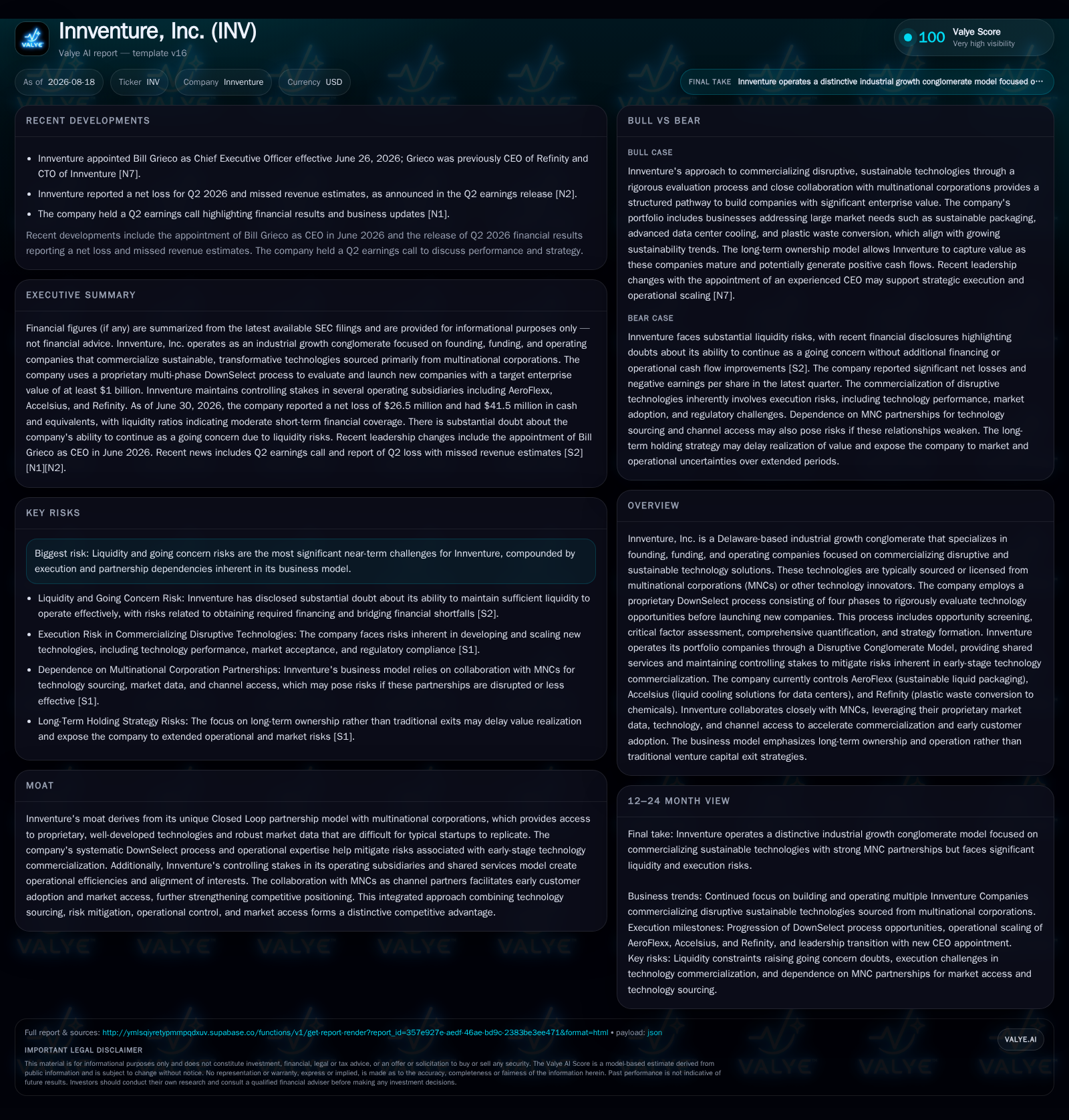
Innventure, Inc. remains focused on commercializing sustainable and disruptive industrial technologies through its proprietary DownSelect evaluation process and strategic partnerships with multinational corporations (MNCs). The latest quarterly filing confirms persistent liquidity challenges and going concern risks, which complicate the company’s capacity to fund and scale its portfolio companies. Innventure’s business model hinges on operating subsidiaries sourced from advanced technologies licensed or acquired from MNCs, combined with operational synergies via controlling stakes and shared services. Growth prospects center on expanding demand for sustainable packaging, advanced recycling, and high-density cooling solutions, yet capital constraints and partnership dependencies represent key execution risks.
Q2 Update Reveals Persistent Liquidity Constraints Impacting Growth Execution
Innovative DownSelect Process Fuels Disruptive Industrial Technology Pipeline
At the core of Innventure's industrial growth conglomerate approach lies a proprietary DownSelect process which rigorously evaluates technology opportunities sourced primarily from multinational corporations or established innovators [S1]. This four-phase process—beginning with initial opportunity screening to weed out less promising concepts—progresses through critical factor assessments that focus on scalability, regulatory fit, market potential, and technology maturity metrics. It culminates with comprehensive quantification using data-driven modeling and final strategy formulation tailored to optimize commercialization pathways. This methodical framework aims both to maximize conversion rates from technology screening to company launch and reduce the risk of pursuing unviable ventures typical in early-stage industrial innovation incubation. Compared with ad hoc venture approaches or traditional scouting used by generalist investors, this disciplined funnel approach builds a durable moat by enhancing deal selection quality and systematic pipeline replenishment.
Strategic Channel Partnerships with MNCs Vital for Commercial Scale-Up
Innventure leverages its unique Closed Loop partnership model positioning multinational corporations as pivotal licensors of proprietary technologies as well as early channel partners driving market adoption [S1]. The collaboration often begins with sourcing fully developed or near-commercial technologies from MNCs such as Procter & Gamble for AeroFlexx’s sustainable liquid packaging innovations or Nokia for Accelsius’ two-phase cooling technology. Additional partners like Dow Chemicals provide access to chemistry intellectual property fueling Refinity’s plastic waste transformation processes. These relationships not only facilitate credible technology sourcing but also translate into embedded sales channels through the MNC partner’s distribution footprint or customer network—addressing a critical bottleneck for startups: go-to-market access.
This dual role of MNCs reduces customer adoption risks by providing real-world demand validation and access to large-scale partners accustomed to incorporating advanced sustainability solutions into supply chains or infrastructure upgrades. Consequently, revenue mechanics derive from licensing fees paid by channel partners or sales generated by subsidiaries leveraging these connections.
Control and Shared Services Provide Operational Synergies But Limit Flexibility
Innventure maintains controlling stakes in its portfolio companies which allows it to operate them directly under its Disruptive Conglomerate Model while sharing core services such as finance, legal, human resources, and commercial functions across subsidiaries [S1]. This shared services arrangement achieves important operating expense leverage—limiting duplicated costs across diverse industrial sectors—and facilitates consistent management standards supportive of scaling disruptive technologies efficiently.
While this centralized control mitigates execution risk by enforcing governance rigor and uniform strategic priorities across companies at varying development stages, it can reduce portfolio agility common in decentralized venture formats where subsidiaries operate with greater independence. Balancing these trade-offs is essential given that industrial technology development requires both strict operational discipline during scale-up phases and tactical responsiveness during commercialization pivots.
Growth Opportunities Center on Sustainable Tech Demand and Market Expansion
Long-term value creation at Innventure is anchored in structural demand tailwinds favoring sustainable and disruptive industrial technology solutions globally. Regulatory drivers promoting reduced carbon footprints heighten interest in innovative packaging alternatives like AeroFlexx’s flexible pak technology that merges performance with enhanced recyclability compared to traditional rigid bottles, [S1]. Simultaneously, rapid expansion in data center infrastructure globally propels demand for efficient cooling systems; Accelsius’s edge data center optimized two-phase direct-to-chip cooling offers palpable energy-saving benefits over legacy refrigerated-air methods—a growth vector supported by emerging hyperscale client validation programs launched mid-2026 [N2], [S21].
Further diversification into chemical recycling through Refinity represents alignment with circular economy trends valued by policymakers incentivizing plastic waste reprocessing into valuable feedstocks rather than landfill or incineration disposal methods. These aggregated secular drivers engender multiple distinct markets providing diversified growth avenues for Innventure’s operating subsidiaries.
Key Risks: Funding Pressures, Execution Complexity, and Partnership Dependencies
Significant risk factors underscore Innventure’s disclosures centered around capital intensity typical for early-stage industrial incubation combined with high execution complexity required to scale hardware-centric disruptive technologies successfully [S1], [S2]. Without timely financing rounds or improved operating cash flow metrics from subsidiaries—a metric tracked internally though specific values remain undisclosed—funding shortfalls could impede development timelines critical for realizing commercialization milestones.
Moreover, reliance on multinational corporations as licensors and channel partners introduces dependency risk; failure in maintaining cooperative partnerships due to shifting strategic priorities at MNCs or competitive dynamics could detrimentally affect pipeline sourcing quality or limit effective market entry support. Additionally, market adoption unpredictability for novel products entails uncertainty regarding revenue ramp profiles influencing valuation potential versus impairment risk on equity investments accounted under the equity method per accounting policies outlined by management [S1]
Catalysts To Track: Milestones in Portfolio Company Scaling and Financing Events
Key upcoming evidence points will be instrumental in validating Innventure's strategy execution efficacy or signaling deeper structural challenges. Operational milestones such as volume production commencements or pilot program completions announced by AeroFlexx or Accelsius will indicate progress toward positive operating cash flows—a pivotal turnaround metric given cash burn pressures reported historically [N2], [S3]. Concurrently, announcements around successful financing rounds aimed at extending runway beyond near-term liquidity horizons will serve as crucial markers mitigating going concern uncertainty.
Likewise relevant are expansions of collaboration agreements or new channel partnerships adding commercial reach or technological enhancements supporting competitiveness relative to incumbent alternatives within sustainability-focused industrial tech markets.
Financial Profile Discussion
Disclaimer: This is research-only, informational analysis and not investment advice. It may include AI-generated interpretation and general industry context. Always verify important details using primary sources.

Comments