
Gossamer Bio Reacquires Seralutinib Rights and Faces Liquidity Constraints in Q2 2026
Gossamer Bio's Q2 2026 update details the reacquisition of seralutinib rights, clinical trial setbacks, and significant liquidity and debt covenant challenges.
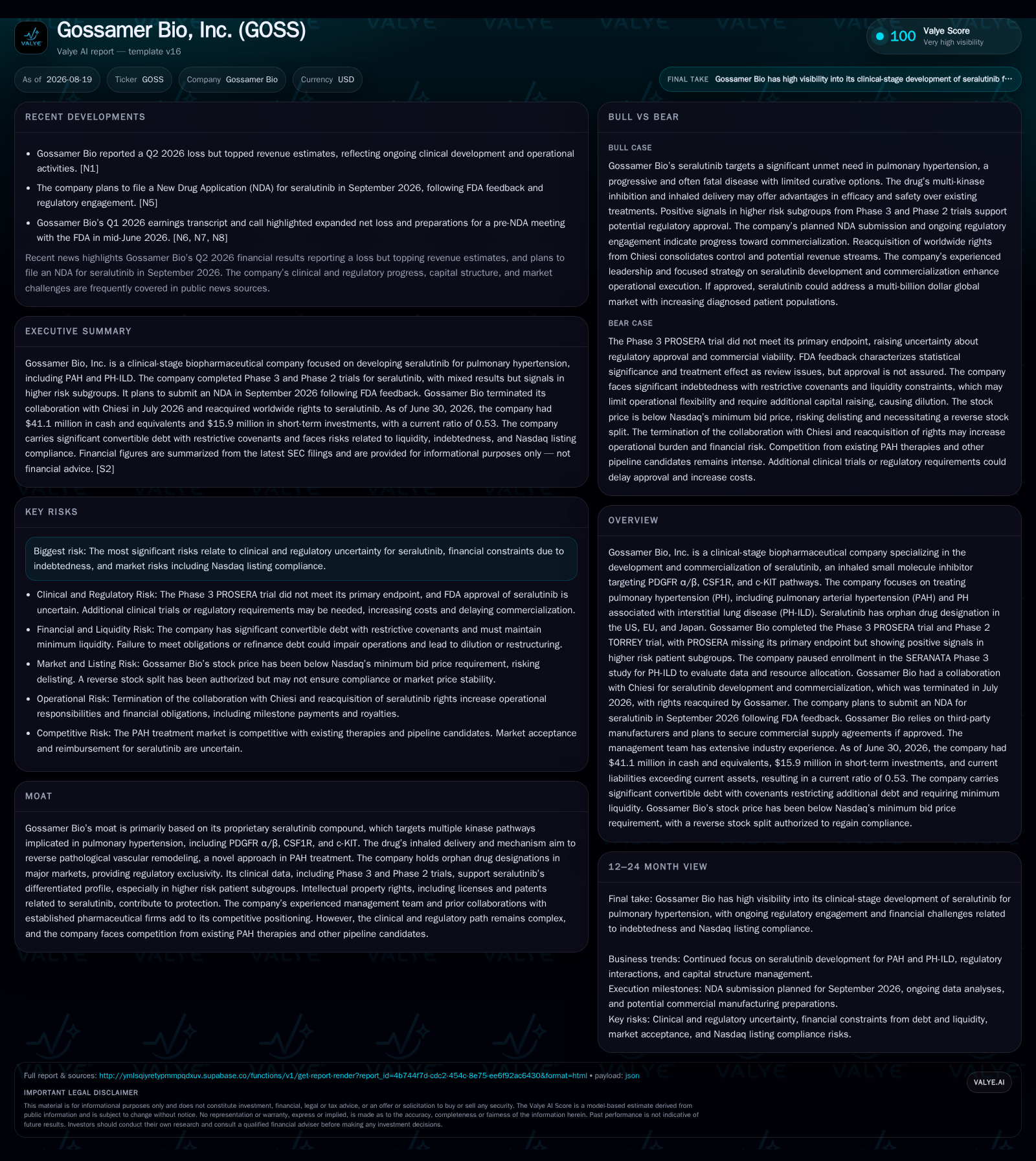
In July 2026, Gossamer Bio reacquired full rights to its lead asset seralutinib from Chiesi, ending their prior collaboration and assuming sole responsibility for its development and commercialization. The Phase 3 PROSERA trial missed its primary endpoint, prompting a pause in enrollment for the SERANATA study to reassess data and resource allocation. As of June 30, 2026, the company reported a constrained liquidity position with a current ratio of 0.53 and significant convertible note indebtedness subject to restrictive covenants, including minimum liquidity requirements and potential acceleration of debt maturities. These developments heighten Gossamer Bio’s operational and financial risks amid uncertain clinical outcomes and regulatory pathways.
Q2 2026 Operating and Clinical Development Update
In July 2026, Gossamer Bio, Inc. reacquired full rights to seralutinib from Chiesi, ending the previous collaboration agreement and assuming sole responsibility for the ongoing development and commercialization of its lead asset [S3][S7]. This strategic shift places Gossamer Bio in full operational control of seralutinib but also transfers all associated development costs and risks onto the company. The reacquisition terminated the cost-sharing arrangement with Chiesi, which had previously offset a portion of the clinical development expenses, thereby increasing Gossamer Bio's financial burden.
The clinical development landscape for seralutinib remains challenging. The Phase 3 PROSERA trial, designed to evaluate seralutinib's efficacy in pulmonary arterial hypertension (PAH), failed to meet its primary endpoint in 2026, although it demonstrated positive signals within higher risk patient subgroups [S1][S3]. These subgroup signals suggest potential therapeutic benefit in select patient populations but fall short of the overall trial objectives necessary for regulatory approval. In response, Gossamer Bio has paused enrollment in the SERANATA Phase 3 study targeting pulmonary hypertension associated with interstitial lung disease (PH-ILD) to reassess the clinical data and optimize resource allocation [S1][S3]. This pause reflects a strategic decision to evaluate the trial design and data in light of the PROSERA results, balancing the need for rigorous evidence generation with prudent capital deployment.
The reacquisition of seralutinib rights and the clinical trial developments underscore the uncertain regulatory and commercial path ahead for seralutinib. The company must now independently navigate the complexities of late-stage clinical development, regulatory submissions, and potential commercialization without the financial and operational support previously provided by Chiesi. This transition increases operational risk and necessitates careful management of resources to sustain development momentum.
Capital Structure and Liquidity Analysis
As of June 30, 2026, Gossamer Bio reported cash and cash equivalents of $41.1 million and total current assets of $72.7 million, against current liabilities of $137.8 million, resulting in a current ratio of 0.53 [F1]. This negative working capital position highlights significant liquidity constraints that could impact the company's ability to fund ongoing operations.
The company's indebtedness includes $18.9 million in 5.00% convertible senior notes due 2027 and $65.2 million in 7.50% convertible senior secured first lien notes due 2030 [S2][S9]. The 2030 Notes indenture imposes restrictive covenants limiting Gossamer Bio's ability to incur additional debt, make restricted payments, and mandates maintaining a minimum liquidity of $40 million, subject to milestone-based reductions [S2][S9]. These covenants are designed to protect noteholders by ensuring the company maintains a minimum liquidity buffer and restricts financial actions that could jeopardize debt repayment.
A critical provision includes a springing maturity date of March 2, 2027, which accelerates the maturity of the 2030 Notes if more than $4.0 million of the 2027 Notes remain outstanding at that time [S2][S9]. This clause creates a contingent liability risk, as failure to reduce the 2027 Notes below the threshold could trigger immediate repayment obligations on the larger 2030 Notes, potentially straining the company's financial resources.
Gossamer Bio currently generates no material product revenue and remains pre-commercial, with prior revenue primarily derived from collaboration cost-sharing payments prior to the July 2026 termination of the Chiesi agreement [S2][S3]. The absence of product revenue places further emphasis on the company's ability to manage cash burn and secure additional financing to support ongoing operations and clinical development.
The company's business model centers on developing seralutinib, an innovative inhaled small molecule therapy targeting pulmonary hypertension indications, including PAH and PH-ILD [S1]. Future revenue is expected to derive from product sales upon regulatory approval and commercialization. However, margins are currently negative due to substantial research and development expenditures, and cash conversion depends heavily on successful product approval and market uptake. The proprietary nature of seralutinib, with orphan drug designations and a novel multi-kinase inhibition mechanism, provides a competitive advantage, but this is tempered by the clinical trial outcomes and regulatory uncertainties.
Industry context for Gossamer Bio includes key performance indicators such as clinical trial success rates, regulatory approvals, cash runway, and orphan drug exclusivity [S1]. The company operates in a capital-intensive and highly regulated environment, similar to other clinical-stage biopharmaceutical firms developing treatments for pulmonary hypertension and rare diseases. Structural factors like clinical development timelines and regulatory processes are complemented by cyclical elements such as capital market conditions and financing availability.
Analytical Conclusions and Forward-Looking Considerations
The reacquisition of seralutinib rights from Chiesi centralizes Gossamer Bio's control over its lead asset but significantly increases its financial and operational risk profile. The termination of the collaboration agreement eliminates cost-sharing benefits, placing full responsibility for development and commercialization on Gossamer Bio amid uncertain clinical outcomes [S3][S7]. This shift requires the company to allocate greater internal resources toward clinical development and regulatory activities, heightening exposure to operational risks and financial strain.
Moreover, the company's liquidity position and debt covenants present material risks to its ability to sustain operations and advance seralutinib without securing additional financing or undertaking restructuring measures [S2][F1]. The current ratio of 0.53 as of June 30, 2026, indicates liquidity constraints, while restrictive covenants requiring minimum liquidity and debt reduction create potential for covenant breaches and acceleration of debt maturities, which could impair financial flexibility and operational continuity [F1].
These financial pressures are compounded by the uncertain clinical development trajectory of seralutinib following the PROSERA trial results and the pause in SERANATA enrollment. The company faces the dual challenge of managing near-term liquidity risks while advancing a complex clinical program with uncertain outcomes.
Key watchpoints for investors and stakeholders include the progress and outcome of regulatory review for seralutinib's New Drug Application (NDA) submission planned for September 2026, updates on clinical trial enrollment and data from the SERANATA Phase 3 study for PH-ILD, liquidity levels relative to the $40 million minimum covenant, and debt reduction progress on the 2027 Notes before the March 2027 springing maturity date [S2][S3][F1]. Additionally, any announcements regarding capital raises or debt restructuring will be critical to monitor as they will directly impact the company's ability to maintain operations and fund seralutinib's development.
These developments underscore the company's operational and financial risks as it navigates the uncertain regulatory and commercial path for seralutinib.
This article is based exclusively on publicly available SEC filings and does not constitute investment advice.
Disclaimer: This is research-only, informational analysis and not investment advice. It may include AI-generated interpretation and general industry context. Always verify important details using primary sources.

Comments