
RCM Technologies Reports Q2 2026 Earnings Beat with Strong Liquidity and Positive Net Income
RCM Technologies delivered better-than-expected Q2 2026 results, supported by solid liquidity and a stable governance framework.
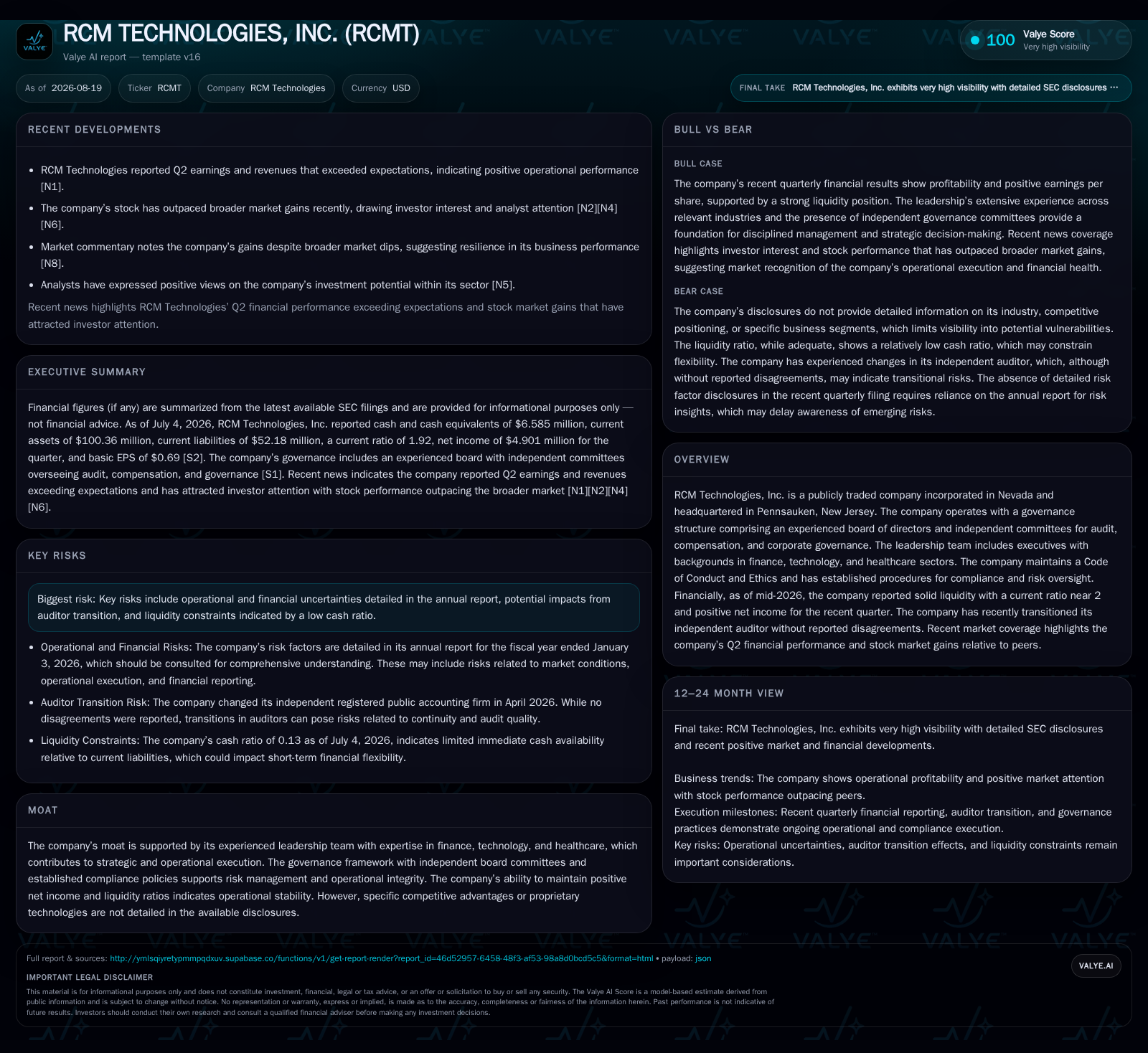
RCM Technologies, Inc. reported Q2 2026 earnings and revenues that exceeded analyst estimates, driven by positive net income and a strong current ratio of 1.92 as of July 4, 2026. The company’s liquidity position is bolstered by current assets of $100.36 million against current liabilities of $52.18 million, supporting operational stability. However, material weaknesses in internal controls identified by the prior auditor and a recent auditor transition present ongoing risks to financial reporting and operational integrity.
RCM Technologies, Inc. reported Q2 2026 earnings and revenues that exceeded analyst estimates, reflecting an improvement in both profitability and liquidity compared to the prior quarter [S2][N1]. The company achieved positive net income during this period, underscoring profitable operations, while maintaining a current ratio near 2, indicating a healthy short-term financial position and operational stability [S2][F1]. This financial strength supports investor confidence and positions RCM Technologies for potential growth.
Cash and cash equivalents stood at $6.585 million as of July 4, 2026, ensuring sufficient liquidity to meet near-term cash flow requirements [F1]. Current assets totaled $100.36 million against current liabilities of $52.18 million, yielding a current ratio of 1.92 as of the same date [F1]. This strong liquidity position reflects effective working capital management and provides a buffer against short-term financial obligations, which is critical in the technology services sector where cash flow timing can be variable.
The company’s Q2 2026 positive net income, which exceeded analyst expectations, signals operational efficiency and effective cost control within its software and technology services business [S2][N1]. This profitability is notable given the competitive and cyclical nature of enterprise IT spending, where contract renewals and client retention are key margin drivers. The earnings beat suggests that RCM Technologies is successfully navigating these dynamics in the near term.
In April 2026, RCM Technologies transitioned its independent auditor from EisnerAmper LLP to WithumSmith+Brown, PC without any disagreements on accounting principles, financial statement disclosures, or auditing scope [S3][S9]. EisnerAmper’s audit report for the fiscal year ended January 3, 2026, did not contain any adverse or qualified opinions, indicating overall compliance with accounting standards. However, EisnerAmper identified material weaknesses in the company’s internal controls, which present a significant governance concern [S4].
RCM Technologies’ governance framework includes an experienced board of directors with independent committees responsible for audit, compensation, and corporate governance oversight [S1][S14]. The Audit Committee plays a pivotal role in monitoring significant financial risk exposures and the effectiveness of internal controls, regularly reporting to the full board. This governance structure is designed to support risk management and operational integrity, which is particularly important given the identified internal control weaknesses.
The company’s business model centers on delivering software solutions and technology services tailored to enterprise clients and developers, with a focus on sectors such as healthcare [S1]. Revenue is generated through software licensing, service contracts, and technology partnerships. Margins and cash flow are influenced by operational efficiency, contract renewals, and client retention. While the company benefits from experienced leadership and a governance framework that promotes operational stability, it does not disclose proprietary technology that might provide a competitive moat. This positions RCM Technologies in a sector with structural demand for software services but also exposes it to cyclical factors such as enterprise IT spending patterns and regulatory changes.
Peer companies in software and technology services face similar challenges related to auditor transitions and governance practices, which can influence investor perceptions and risk assessments.
Despite the positive financial results and strong liquidity, the company faces ongoing risks from the material weaknesses in internal controls and the auditor transition [S2][S3][S4][S9]. These issues could affect the reliability of financial reporting and operational integrity if not adequately remediated. The transition to a new auditor, while smooth in terms of disagreement absence, underscores the need for continued focus on strengthening internal controls to maintain compliance and investor confidence.
Looking ahead, several watchpoints are critical for assessing RCM Technologies’ trajectory.
In conclusion, RCM Technologies demonstrated operational and financial stability in Q2 2026, supported by earnings and liquidity metrics that indicate positive near-term prospects [S2][F1][N1]. However, material weaknesses in internal controls and the auditor transition represent ongoing risks that require vigilant management and oversight to safeguard financial reporting integrity and operational effectiveness [S3][S4][S9]. The company’s governance framework and experienced leadership provide a foundation for addressing these challenges, but investors should closely watch remediation efforts and subsequent quarterly performance to gauge risk mitigation and growth sustainability.
This article is based on publicly available information and does not constitute investment advice.
Disclaimer: This is research-only, informational analysis and not investment advice. It may include AI-generated interpretation and general industry context. Always verify important details using primary sources.

Comments