
Jones Ventures INTL Acquisition1 Corp 2026 Q2: Balance Sheet Highlights Liquidity Shortfall
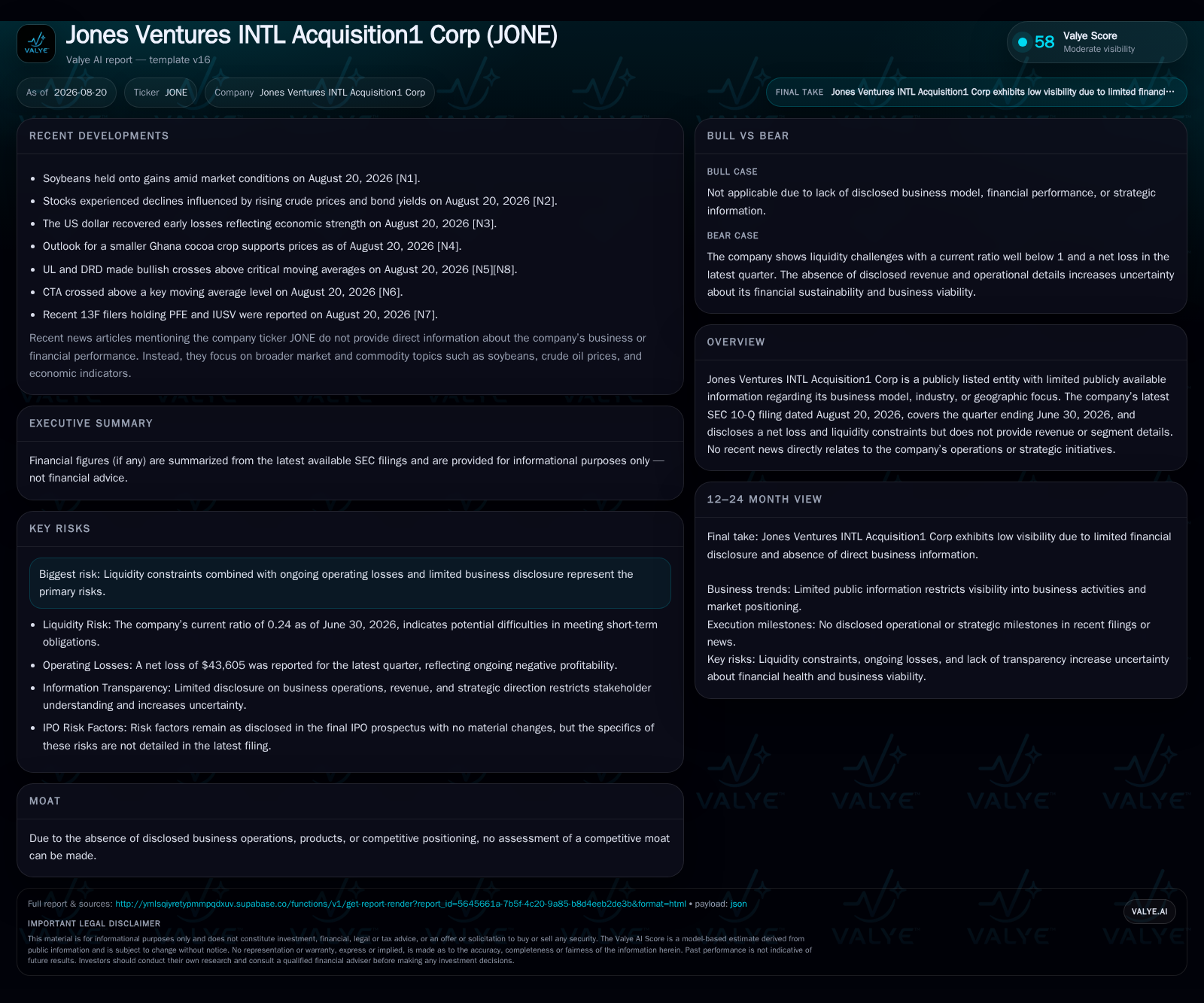
The company’s Q2 2026 filing reveals ongoing operating losses and a current ratio of 0.24, underscoring significant liquidity challenges.
Jones Ventures INTL Acquisition1 Corp reported a net loss for Q2 2026 without any disclosed revenue, consistent with its SPAC status prior to business combination. The company’s balance sheet as of June 30, 2026, shows current assets of $214,746 against current liabilities of $879,020, resulting in a current ratio of 0.24, indicating substantial liquidity constraints. These financial conditions emphasize the critical importance of completing a business combination or securing additional capital to sustain operations.
Latest Quarterly Operating and Financial Update
Jones Ventures INTL Acquisition1 Corp’s 10-Q filing dated August 20, 2026, for the quarter ended June 30, 2026, reports a net loss with no disclosed revenue or segment details [S2]. This operating loss aligns with the company’s status as a Special Purpose Acquisition Company (SPAC) that has not yet completed a business combination. Without operating revenue, the company’s financial performance depends primarily on capital raised through its initial public offering (IPO) and private placements, rather than operating cash flows. The absence of revenue disclosure limits insight into any operational progress or business development activities, which is typical for SPACs in this stage but increases uncertainty regarding future financial performance [S2].
Balance Sheet and Liquidity Analysis
The company’s balance sheet as of June 30, 2026, shows current assets of $214,746 and current liabilities of $879,020, resulting in a current ratio of 0.24 [F1]. The audited balance sheet included in the July 15, 2026, 8-K filing confirms these figures and the receipt of proceeds from the IPO and private placement [S3].
This liquidity position is structurally weak, as the current liabilities exceed current assets by over threefold, resulting in negative working capital of approximately $664,274 [F1]. Such a deficit constrains the company’s operational flexibility and heightens the risk of insolvency if additional funding or proceeds from a business combination are not secured. Investors purchase units consisting of one Class A ordinary share and one share right, which convert into shares upon consummation of an initial business combination [S3]. Prior to completing such a combination, the SPAC does not generate operating revenue and incurs operating losses related to administrative and other expenses [S2].
The company’s value proposition depends on successfully identifying and closing a business combination within a specified timeframe. Until then, the financial profile is characterized by liquidity management challenges and operating losses, as seen in the current disclosures [S2]. The absence of disclosed revenue or segment information is consistent with this business model, where the primary financial driver is the capital raised from investors rather than operating cash flow.
This imbalance constrains operational flexibility and increases the risk of insolvency absent new funding or proceeds from a business combination.
Operating losses without disclosed revenue reflect the typical SPAC pre-business combination profile, emphasizing the importance of completing a business combination to create value and improve financial metrics [S2]. The absence of revenue and ongoing net loss are consistent with a SPAC’s economic model prior to acquiring an operating business, where value depends on successful deal execution rather than operating cash flow.
This scenario is plausible given the SPAC structure and the pressure created by liquidity constraints [S2]. Without new funding or deal completion, the company risks insolvency or regulatory action. Confirmation would include disclosures of liquidity covenant breaches, announcements of liquidation or winding up, or delisting notices
Grounded Watchpoints
Investors and analysts should closely monitor announcements of business combination agreements or closings, subsequent quarterly filings for changes in liquidity ratios, capital raising activities or private placements, and any changes in risk factor disclosures related to liquidity or going concern [S2]. Given the structural liquidity constraints and operating losses, the company’s ability to execute a business combination or secure additional funding will be critical to its financial viability and continued listing on the Nasdaq Stock Market.
Overall, Jones Ventures INTL Acquisition1 Corp’s Q2 2026 financial disclosures highlight liquidity challenges typical of a SPAC prior to business combination, underscoring the importance of deal execution or capital infusion to sustain its public listing and financial health [S2]. The company’s financial trajectory remains highly dependent on external capital events rather than operating performance at this stage.
Disclaimer: This is research-only, informational analysis and not investment advice. It may include AI-generated interpretation and general industry context. Always verify important details using primary sources.

Comments