
Vivani Medical Advances Semaglutide Implant Trials with Strong Q2 2026 Liquidity
Vivani Medical initiated Phase 1 trials for its semaglutide implant NPM-139 and reported a solid cash position as of June 30, 2026.
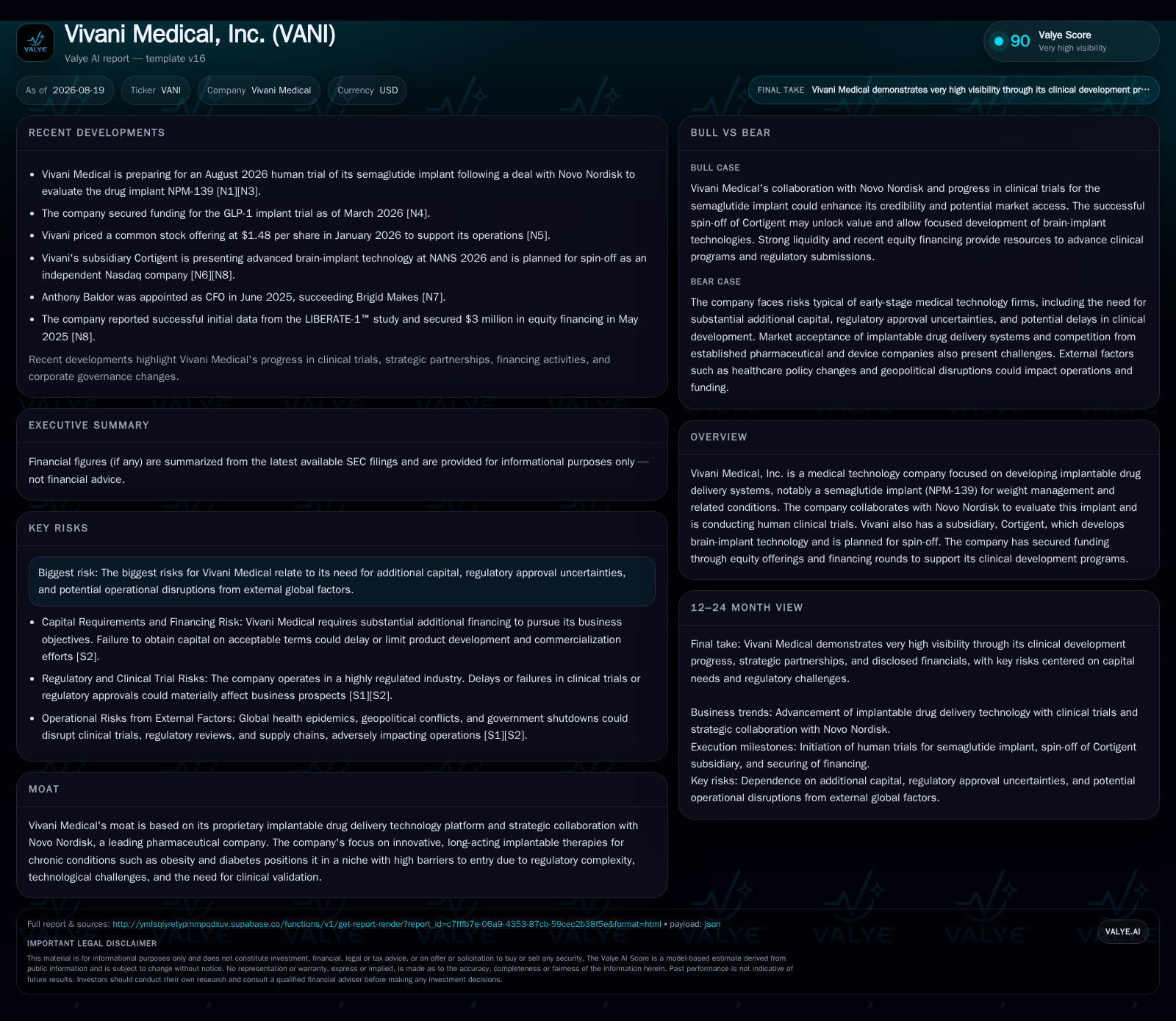
Vivani Medical, Inc. progressed its clinical development in Q2 2026 by initiating Phase 1 trials for the semaglutide implant candidate NPM-139 in partnership with Novo Nordisk. The company maintained a strong liquidity profile with $19.9 million in cash and equivalents and a current ratio of 3.25 as of June 30, 2026, supporting ongoing R&D activities. Despite remaining pre-revenue and reporting net losses of $13.2 million in the first half of 2026, Vivani continues to advance its proprietary NanoPortal implant technology and plans a strategic spin-off of its Cortigent brain-implant subsidiary.
Q2 2026 Clinical and Financial Update
Vivani Medical, Inc. advanced its clinical pipeline in the second quarter of 2026 by initiating Phase 1 clinical trials for its semaglutide implant candidate, NPM-139. This milestone reflects a significant step in the company's development of implantable drug delivery systems, achieved in collaboration with Novo Nordisk, a leader in diabetes therapeutics [S2][S3][S1]. The initiation of these trials marks a material clinical advancement in the company's development efforts.
Financially, Vivani Medical maintained a strong liquidity position as of June 30, 2026, with cash and cash equivalents totaling $19.9 million and a current ratio of 3.25 [F1][S2]. These metrics indicate ample short-term resources relative to current liabilities of $6.7 million, providing a runway to fund ongoing clinical development activities. Despite this liquidity strength, Vivani remains pre-revenue and reported net losses of $13.2 million in the first half of 2026, reflecting continued investment in research and development and operating expenses typical of a clinical-stage biopharmaceutical company [S2]. The net loss figure is consistent with prior periods, underscoring the company's ongoing commitment to advancing its pipeline without generating commercial revenues.
Business Model and Pipeline Overview
Vivani Medical operates as a clinical-stage biopharmaceutical company focused on developing miniaturized, subdermal implantable drug delivery devices targeting chronic diseases with high unmet medical needs. The company’s core technology, the NanoPortal implant platform, enables long-term delivery of medicines through implantable devices, positioning Vivani in a niche segment of the implantable drug delivery market [S1]. This proprietary technology is designed to provide sustained, controlled release of therapeutics, which could improve patient compliance and outcomes in chronic disease management.
Currently, Vivani has no approved commercial products and generates no revenues. Funding is sourced primarily through equity offerings and financing rounds to support clinical development. The company’s pipeline includes multiple candidates, with NPM-139 being the lead semaglutide implant now in Phase 1 trials. Other candidates include NPM-133 and NPM-115, with the latter having completed a Phase 1 study. Additionally, Vivani has partnered with Okava for the development of OKV-119, targeting cardiometabolic disorders in veterinary medicine [S1].
Vivani’s future revenue model anticipates commercial sales of implantable drug delivery systems and potential licensing or partnership agreements [S1][S2]. However, margins and cash conversion will depend heavily on successful regulatory approvals, manufacturing scale-up, and market adoption. Currently, negative cash flow results from ongoing research and development expenditures, reflecting the capital-intensive nature of clinical-stage biopharmaceutical development.
The company also plans to spin off its Cortigent subsidiary, which focuses on brain-implant technology. This strategic move aims to concentrate Vivani’s resources on its core implantable drug delivery assets, potentially enhancing operational focus and value creation [S1]. The spin-off could allow Cortigent to pursue specialized development paths independently, while Vivani streamlines its focus on drug delivery implants.
Industry Context and Competitive Positioning
Vivani operates in a structurally innovation-driven biotech niche characterized by long development cycles and significant regulatory hurdles. Key performance indicators for companies in this space include clinical trial progression and enrollment pace, regulatory milestones, cash runway, and validation through partnerships. Vivani’s collaboration with Novo Nordisk provides a notable partnership validation, which may enhance its competitive positioning in the implantable drug delivery sector.
Compared to peers, Vivani’s proprietary NanoPortal technology and strategic alliances offer potential differentiation. However, the company faces typical industry challenges such as the complexity of regulatory pathways and the need for clinical validation. The long development timeline and capital-intensive nature of clinical-stage biopharmaceutical companies mean that financial performance is cyclical, heavily influenced by clinical milestones and financing events.
Risks and Capital Requirements
Vivani’s continued operation and progress depend on securing sufficient capital to fund ongoing and future clinical trials. The company reported a liquidity position as of mid-2026, while its negative operating cash flow and net losses indicate the need for additional financing over time [S2][S1]. The company’s cash runway will require monitoring as clinical programs advance and expenses increase.
Regulatory uncertainties remain a significant risk, as successful clinical trial outcomes and regulatory approvals are prerequisites for commercialization. The early-stage status of NPM-139 and other pipeline candidates means that clinical and regulatory risks are elevated. Failure to meet clinical endpoints or obtain regulatory clearance could materially impact the company’s prospects.
The planned spin-off of the Cortigent subsidiary introduces execution risk related to restructuring and strategic focus. This process requires careful management to avoid disruption and to realize intended strategic benefits. Furthermore, the company’s reliance on partnerships, such as with Novo Nordisk, adds dependency risks that could affect development timelines and commercial prospects if collaborations do not proceed as planned.
Conclusion
Vivani Medical’s initiation of Phase 1 trials for its semaglutide implant NPM-139 in mid-2026 represents a key clinical milestone related to its NanoPortal technology and partnership with Novo Nordisk [S2][S3][S1]. This advancement is part of the company’s progression toward potential regulatory approval and commercialization.
Financially, the company’s liquidity position as of June 30, 2026, with nearly $20 million in cash and a current ratio above 3, supports ongoing clinical development in the near term [F1][S2]. However, Vivani remains pre-revenue and continues to incur net losses consistent with its clinical-stage status.
The company’s business model centers on implantable drug delivery systems for chronic diseases, with future revenue dependent on regulatory success and commercialization. Key risks include capital requirements, regulatory uncertainties, and clinical trial outcomes. Investors and stakeholders should closely monitor the progression and results of ongoing clinical trials, updates on regulatory submissions, cash burn rates, and any new financing activities, as well as developments related to the Cortigent spin-off and partnership expansions.
Overall, Vivani Medical is positioned at a critical juncture where clinical validation and financial resources will determine its trajectory in the implantable drug delivery market.
Disclaimer: This is research-only, informational analysis and not investment advice. It may include AI-generated interpretation and general industry context. Always verify important details using primary sources.

Comments