
Cross Timbers Royalty Trust Reports Stable Q2 2026 Operations Amid Commodity Price and Production Variability
Cross Timbers Royalty Trust's Q2 2026 update highlights income driven by net profits interests with production and commodity price fluctuations impacting distributable income.
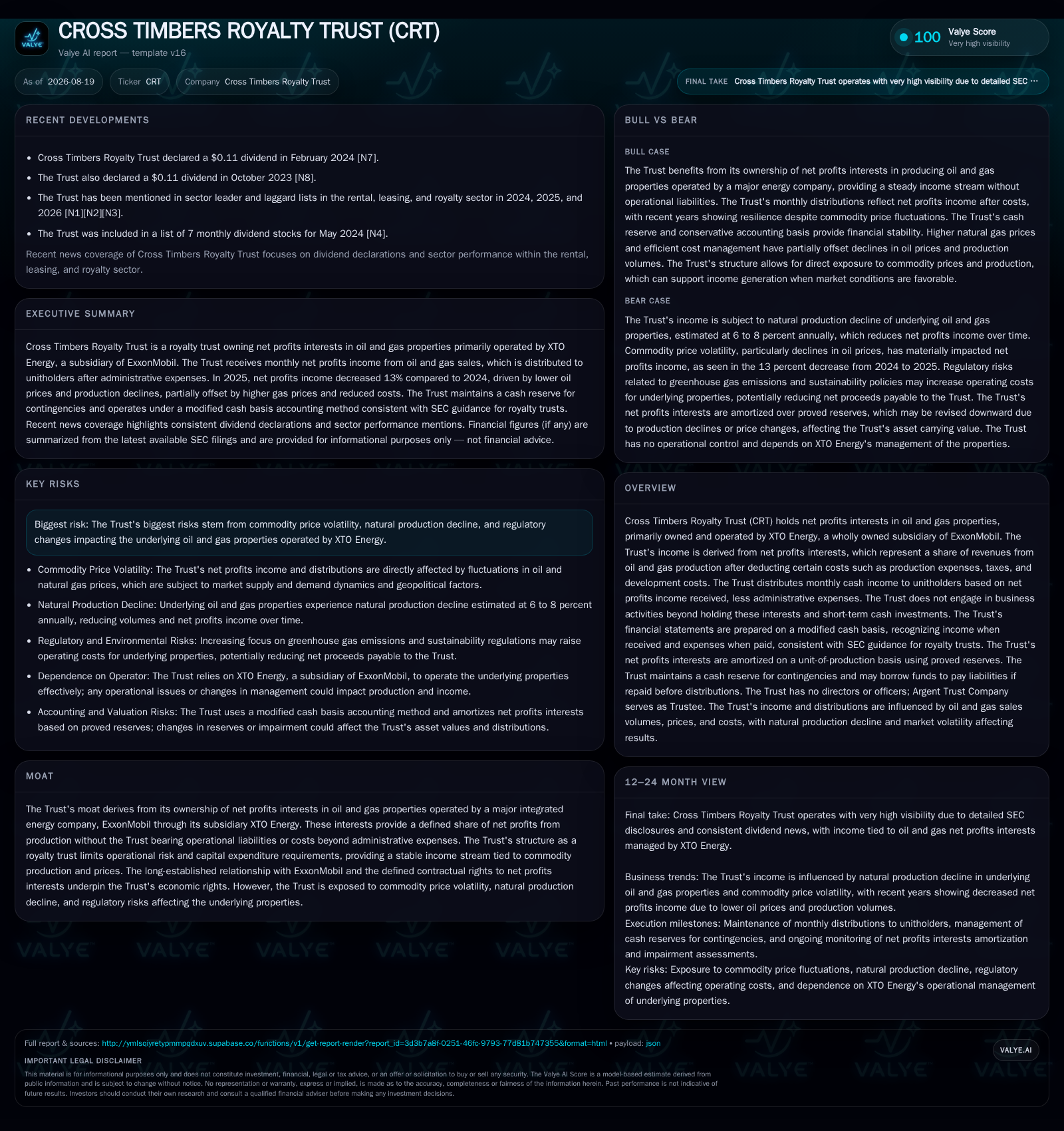
In its latest quarterly filing for Q2 2026, Cross Timbers Royalty Trust reported continued income generation from net profits interests in oil and gas properties operated by XTO Energy. Production volumes showed natural decline and timing effects, while oil prices declined and gas prices increased compared to prior periods. The Trust’s structure limits operational risk but exposes it to commodity price volatility and production trends, which remain key factors influencing monthly distributions to unitholders.
Latest Quarterly Operating Update
Cross Timbers Royalty Trust’s Q2 2026 operating update reflects ongoing income generation from its net profits interests in oil and gas properties operated by XTO Energy, a wholly owned subsidiary of ExxonMobil. The Trust’s income depends on production volumes and commodity prices, which exhibited variability in recent periods. While specific Q2 2026 production and price figures are not detailed in the latest filings, prior quarterly and annual data provide insight into recent trends.
Annual production trends from 2025 reflect a structural decline typical for mature oil and gas assets, with timing variations in revenue recognition under the Trust’s modified cash basis accounting [S1]. These trends illustrate the challenges in comparing year-over-year volumes due to timing effects and natural production declines.
Commodity prices also influenced net profits income. Average oil prices in Q4 2025 were $62.42 per barrel, down 14% from $72.32 in Q4 2024, while average gas prices increased 16% to $4.39 per Mcf from $3.78 in the prior year quarter [S1]. This divergence in oil and gas prices impacts the Trust’s distributable income, given its exposure to both commodities through its net profits interests.
Costs deducted by the operator in calculating net profits income increased modestly by 1% in Q4 2025 compared to Q4 2024. This increase was driven by higher taxes, transportation, and net excess costs, partially offset by decreased production expenses [S1]. These cost fluctuations affect the net profits income available to the Trust and, consequently, the monthly cash distributions to unitholders.
Business Model and Income Mechanics
Cross Timbers Royalty Trust holds net profits interests in oil and gas properties operated exclusively by XTO Energy. The Trust’s income is calculated as a share of revenues from oil and gas production attributable to these interests, less allowable costs including production expenses, taxes, and development costs borne by the operator [S1]. The Trust itself does not operate the properties, nor does it bear any operational liabilities or capital expenditure obligations.
Income recognition follows a modified cash basis consistent with SEC guidance for royalty trusts, meaning income is recognized when received, and expenses are recorded when paid [S1]. This accounting treatment results in timing differences between production and income recognition, which can cause variability in reported income and distributions.
The Trust distributes monthly cash income to unitholders based on net profits income received after deducting administrative expenses. It does not engage in operational activities beyond holding the interests and managing short-term cash investments [S1]. This structure provides unitholders with a relatively defined income stream tied directly to the performance of the underlying properties, subject to commodity prices and production volumes.
Risk Factors and Industry Context
As of Q2 2026, there have been no material changes in the risk factors disclosed in the Trust’s 2025 annual report [S2]. The primary risks continue to be commodity price volatility, natural production decline of the underlying reserves, and potential regulatory changes affecting the properties operated by XTO Energy.
Commodity prices for oil and gas are inherently cyclical and can fluctuate due to global supply-demand dynamics, geopolitical events, and regulatory developments. Such price volatility directly impacts the Trust’s net profits income and monthly distributions. Additionally, the structural decline in production volumes from mature oil and gas fields presents a long-term challenge to sustaining distributable income levels.
Regulatory risks include evolving environmental and sustainability policies, such as greenhouse gas emissions regulations, which could increase operating costs for the underlying properties and reduce net proceeds payable to the Trust [S1]. Cash distributions to unitholders are funded from this cash flow. The Trust does not engage in capital expenditures or operational activities, and it may establish cash reserves for contingencies but otherwise distributes income as received.
No fresh balance sheet data or working capital metrics are available for Q2 2026 [S1]. The Trust’s assets primarily consist of its net profits interests and cash equivalents. The Trust’s royalty interest structure limits operational risk and capital expenditure obligations, providing a defined income stream but one inherently tied to the performance of the underlying oil and gas assets operated by XTO Energy.
Key watchpoints include monthly net profits income receipts and distributions, trends in oil and gas commodity prices, production volume changes, operating cost deductions by XTO Energy, and regulatory developments impacting the underlying properties. These factors will continue to influence the Trust’s income profile and distribution sustainability going forward.
Disclaimer: This is research-only, informational analysis and not investment advice. It may include AI-generated interpretation and general industry context. Always verify important details using primary sources.

Comments