
Akari Therapeutics Reports Q2 2026 Operating Update Highlighting Pipeline Progress and Capital Challenges
Akari Therapeutics advances its lead ADC candidate AKTX-101 toward clinical trials while facing liquidity constraints as of mid-2026.
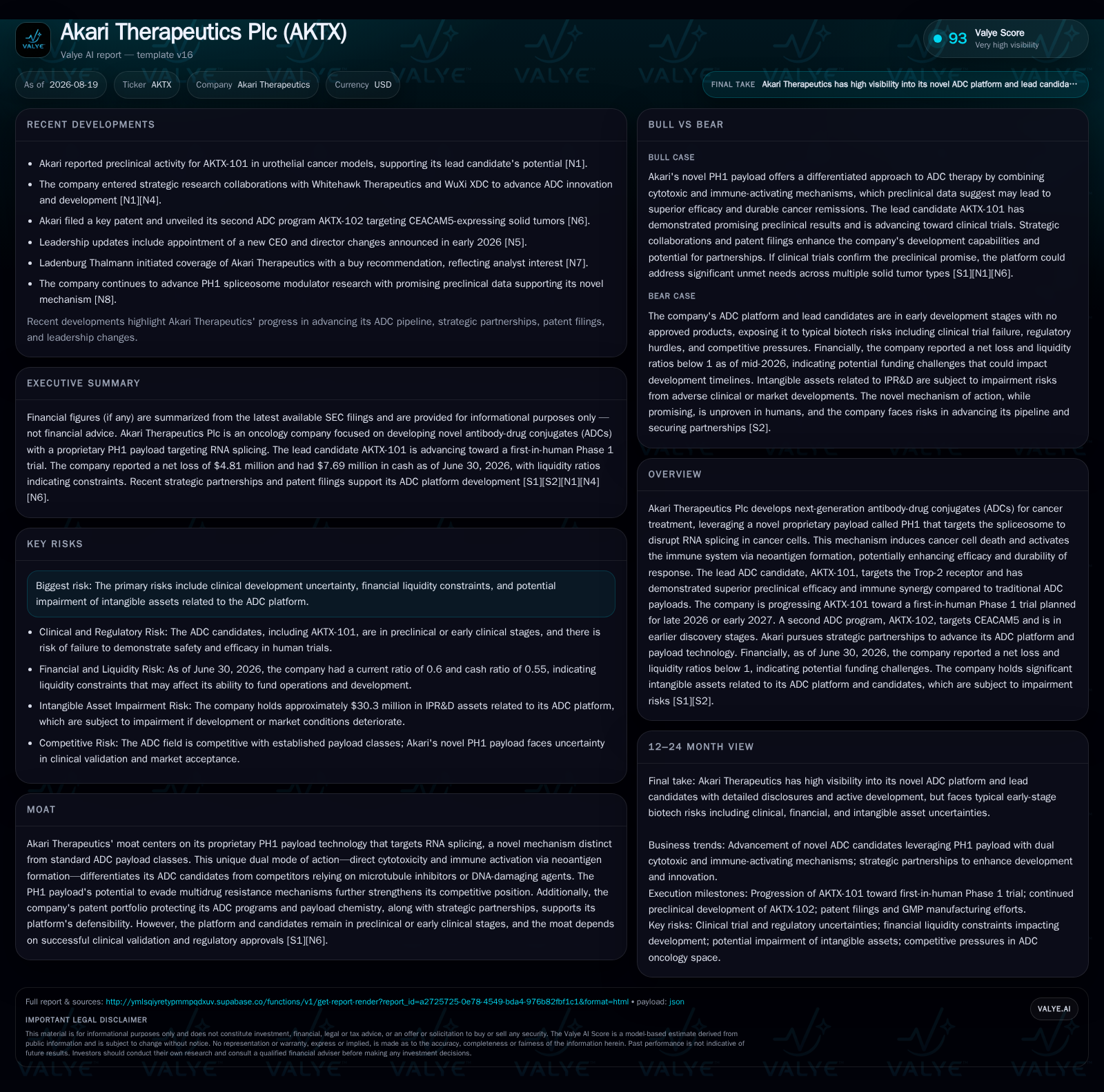
Akari Therapeutics is progressing its novel antibody-drug conjugate AKTX-101, which utilizes a proprietary PH1 payload targeting RNA splicing, toward a first-in-human Phase 1 trial planned for late 2026 or early 2027. The company reported a working capital deficit at June 30, 2026, with cash and equivalents of $7.69 million against current liabilities of $13.94 million, resulting in a current ratio of 0.6. This liquidity position underscores the financial challenges Akari faces as it seeks to advance clinical development and sustain operations.
Q2 2026 Operating and Financial Update
Akari Therapeutics Plc reported significant progress in the development of its lead antibody-drug conjugate (ADC) candidate, AKTX-101, in its latest quarterly 10-Q filing dated August 13, 2026. The company is advancing AKTX-101, which incorporates its proprietary PH1 payload targeting RNA splicing, toward a first-in-human Phase 1 clinical trial anticipated in late 2026 or early 2027 [S2][S1]. This milestone marks a critical step in validating Akari’s novel ADC platform, which aims to offer differentiated therapeutic options in oncology.
However, the financial disclosures reveal notable liquidity challenges. As of June 30, 2026, Akari reported cash and cash equivalents of $7.69 million against current liabilities of $13.94 million, resulting in a working capital deficit and a current ratio of 0.6 [F1]. This indicates that the company’s short-term obligations exceed its readily available assets, underscoring the need for additional capital to sustain ongoing research and development (R&D) and clinical activities.
Business Model and Pipeline Overview
Akari Therapeutics focuses on developing next-generation ADCs that leverage a proprietary cytotoxic payload, PH1, which disrupts RNA splicing by modulating the spliceosome complex. This mechanism induces direct cancer cell cytotoxicity and generates neoantigens that activate both innate and adaptive immune responses, potentially enhancing anti-tumor efficacy beyond conventional ADC payloads [S1].
AKTX-101 targets the Trop-2 receptor on cancer cells and is engineered with a proprietary linker designed to deliver the PH1 payload selectively to tumor cells, minimizing off-target effects. Preclinical studies have demonstrated AKTX-101’s superior activity and survival benefits in animal models compared to ADCs using traditional payloads such as topoisomerase 1 inhibitors. Moreover, the unique immune activation by PH1 suggests potential synergy with checkpoint inhibitors, which could improve therapeutic outcomes in combination regimens [S1].
The company’s pipeline also includes AKTX-102, an ADC targeting CEACAM5, relevant in several solid tumors including pancreatic, colon, and lung cancers. The PH1 platform’s flexibility supports the generation of multiple ADC candidates against diverse cancer antigens, positioning Akari to pursue a broad oncology portfolio [S1].
Financial Position and Capital Requirements
Akari’s financial position as of mid-2026 reflects the capital-intensive nature of early-stage biopharmaceutical development [F1][S2]. The reported working capital deficit, with current liabilities nearly double current assets, highlights a liquidity strain that could impact the company’s ability to maintain uninterrupted R&D and clinical trial progress
The company’s intangible assets include approximately $30.3 million in in-process research and development (IPR&D) primarily related to AKTX-101 and the ADC platform [S2]. These assets remain subject to impairment risk, which could materially affect future financial results if clinical or regulatory setbacks occur
Akari has not yet generated any product revenues and anticipates continued operating losses as it advances its pipeline through preclinical and clinical stages. Capital allocation is focused predominantly on R&D activities, including IND enabling studies and GMP manufacturing preparations for AKTX-101 [S1][S2]. Akari’s proprietary PH1 payload offers a competitive advantage through its novel dual mechanism of action—cytotoxicity and immune activation—that differentiates its candidates from those relying on traditional payloads [S1].
Nonetheless, the company faces significant risks including the inherent uncertainties of clinical trial outcomes, regulatory approval processes, and potential impairment of intangible assets [S2]. The working capital deficit and liquidity constraints further compound financial risks, emphasizing the importance of successful capital raises and efficient resource management
In the broader ADC market, innovation in payload technology is a key differentiator. Akari’s platform aims to address the limited diversity in payload mechanisms seen in existing ADC therapies, potentially enabling superior efficacy and combination treatment options. However, the company must navigate competitive pressures from other developers advancing their own novel ADC candidates and payload technologies.
Outlook and Watchpoints
Akari Therapeutics’ advancement of AKTX-101 toward a Phase 1 clinical trial represents a pivotal operational milestone validating its proprietary ADC platform. Monitoring the progression of IND enabling studies and the timing of trial initiation will provide critical insight into the company’s development trajectory.
Given the liquidity challenges evidenced by the negative working capital position with current assets of $8.32 million versus current liabilities of $13.94 million, yielding a current ratio of 0.6 as of June 30, 2026 [F1], attention should also focus on the company’s capital raising activities and cash burn rates in upcoming quarters. Additionally, updates on IPR&D impairment assessments and any strategic partnerships or licensing deals involving the PH1 payload technology will be important indicators of Akari’s ability to sustain and expand its clinical development efforts.
Disclaimer
This article is based on publicly available financial filings and company disclosures as of August 13, 2026. It does not constitute investment advice or a research view to buy or sell securities. Readers should conduct their own due diligence and consult professional advisors before making investment decisions.
Disclaimer: This is research-only, informational analysis and not investment advice. It may include AI-generated interpretation and general industry context. Always verify important details using primary sources.

Comments