
Bluerock Homes Trust Expands Rental Income with Stable Occupancy and Solid Balance Sheet in Q2 2026
Bluerock Homes Trust reported a 15.6% increase in rental revenues in Q2 2026, supported by stable occupancy and strong liquidity.
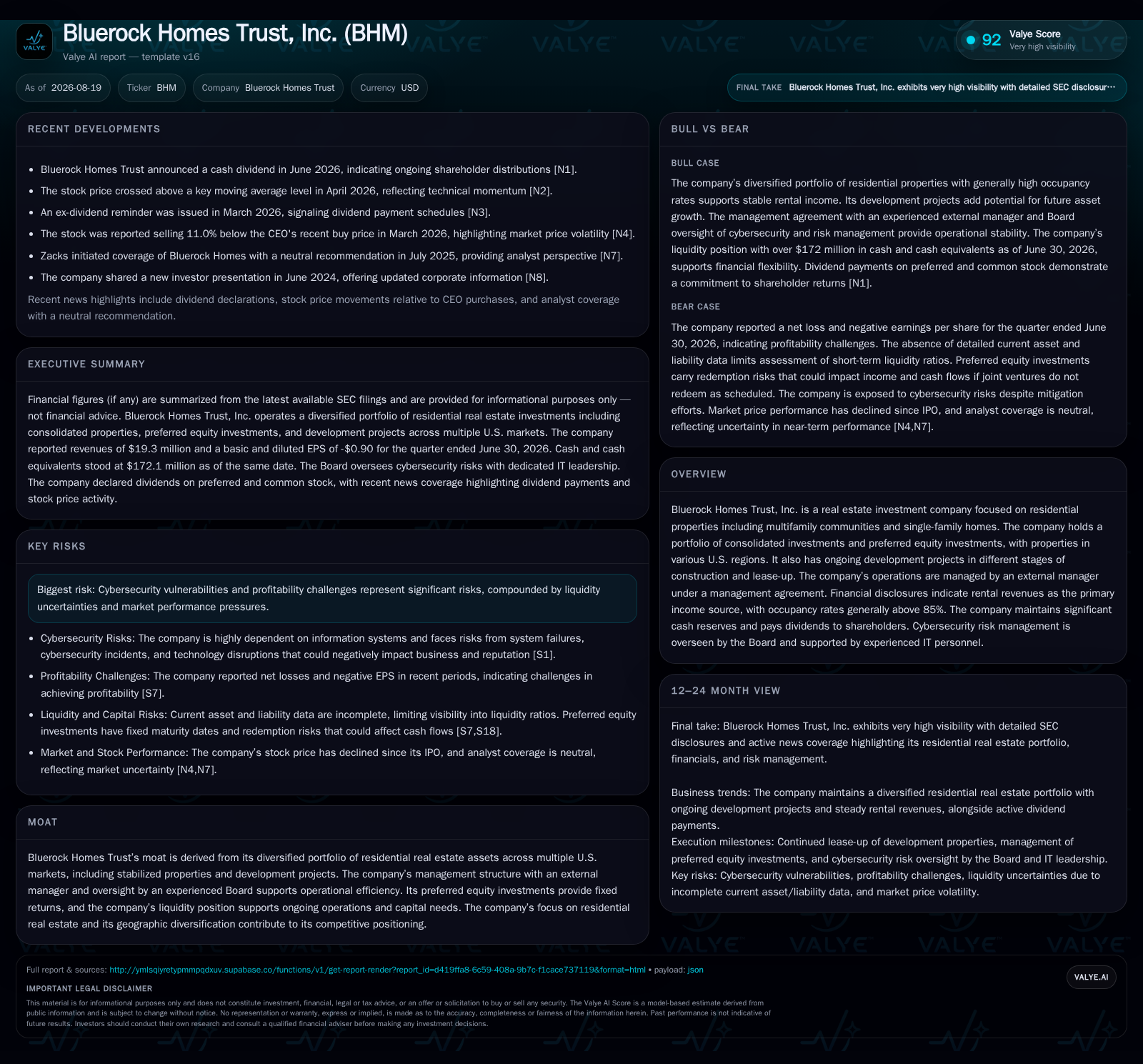
Bluerock Homes Trust, Inc. achieved a significant rise in rental and property revenues to $19.3 million in Q2 2026, up from $16.7 million in the same quarter last year. This growth reflects stable occupancy rates above 85% across its diversified residential portfolio. The company maintains a robust liquidity position with $172.1 million in cash and manageable net debt of approximately $261.4 million as of June 30, 2026, underpinning its ongoing development investments and operational flexibility.
Q2 2026 Operating Performance
Bluerock Homes Trust, Inc. reported rental and other property revenues of $19.3 million for the quarter ended June 30, 2026, marking a 15.6% increase from $16.7 million in Q2 2025 [S2]. This revenue growth is underpinned by the company’s diversified portfolio of residential properties, which includes both consolidated investments and preferred equity interests across various U.S. regions. Occupancy rates have remained generally above 85%, contributing to stable and growing rental income streams [S1][S2]. The company’s portfolio mix and geographic diversification help mitigate localized market risks and support operational resilience.
The increase in rental revenues reflects not only stable occupancy but also the contribution from ongoing development projects and preferred equity investments, which enhance income generation capacity. This operational growth is significant in the competitive residential real estate market, where maintaining high occupancy and rental rates is critical for sustained performance.
Balance Sheet and Liquidity Position
As of June 30, 2026, Bluerock Homes Trust held $172.1 million in cash and cash equivalents, providing a strong liquidity buffer [F1][S2]. The company’s total debt was $433.5 million at the same date, resulting in net debt of approximately $261.4 million after accounting for cash reserves [F1]. This leverage level reflects prudent capital management, balancing the need for funding ongoing development projects and preferred equity investments with maintaining financial flexibility.
The solid liquidity position supports the company’s ability to meet operational needs, invest in growth opportunities, and fulfill dividend obligations. The net debt level is manageable relative to the company’s asset base and income-generating portfolio, which is crucial for sustaining creditworthiness and access to capital markets.
Business Model and Risk Oversight
Bluerock Homes Trust’s business model centers on generating rental income from residential real estate assets, including multifamily communities and single-family homes [S1]. Tenants pay rent for housing units and related services, forming the primary revenue source. This governance framework supports operational discipline and risk mitigation. A material focus area is cybersecurity risk management, with dedicated IT leadership and Board oversight aimed at safeguarding information systems and mitigating technology-related risks [S1]. This emphasis on cybersecurity is increasingly important given the reliance on information systems for operational and financial processes.
Recent Management Fee Unit Issuance
On August 13, 2026, Bluerock Homes Trust issued Base Management Fee C-LTIP Units to management as partial satisfaction of fee obligations [S3]. This issuance reflects ongoing alignment of management incentives with company performance. The units were issued under exemptions from registration and to accredited investors with substantive relationships to the company. Such incentive structures are typical in externally managed REITs and aim to align management interests with shareholder value creation.
Business Economics and Forward-Looking Considerations
Bluerock Homes Trust’s revenue growth is structurally supported by sustained housing demand and a diversified portfolio that balances stabilized assets with development projects. The external management model and Board oversight contribute to operational efficiency and risk control, including cybersecurity governance.
This financial position provides a foundation for continued capital deployment in development and preferred equity investments while maintaining financial flexibility. This balance is critical in a sector subject to cyclical fluctuations in occupancy and rental rates, as well as potential interest rate changes impacting debt costs.
Risks and Watchpoints
Key risks to monitor include occupancy rate trends in upcoming quarters, which will directly affect rental income stability. Progress and capitalization of ongoing development projects are also important to watch, as delays or cost overruns could impact future revenues and cash flows. Changes in debt levels and liquidity position in subsequent filings will provide insight into the company’s capital management discipline. Additionally, dividend payment consistency and any modifications to management fee structures could influence investor returns and cost efficiency.
Conclusion
Bluerock Homes Trust demonstrated operational growth in Q2 2026 with rental and other property revenues of $19.3 million, up from $16.7 million in Q2 2025, supported by stable occupancy above 85%. Its diversified residential portfolio, external management oversight, and focused cybersecurity risk governance contribute to its competitive positioning and risk mitigation. Monitoring occupancy trends, development progress, and capital structure changes will be essential for assessing the company’s near-term performance and financial health.
This article is based on publicly available filings and does not constitute investment advice.
Disclaimer: This is research-only, informational analysis and not investment advice. It may include AI-generated interpretation and general industry context. Always verify important details using primary sources.

Comments