
RRE Ventures Acquisition Corp. Reports Strong Liquidity and Stable Position Post-IPO in Q2 2026
Following its May 2026 IPO, RRE Ventures Acquisition Corp. maintains a solid balance sheet and liquidity as it awaits a business combination.
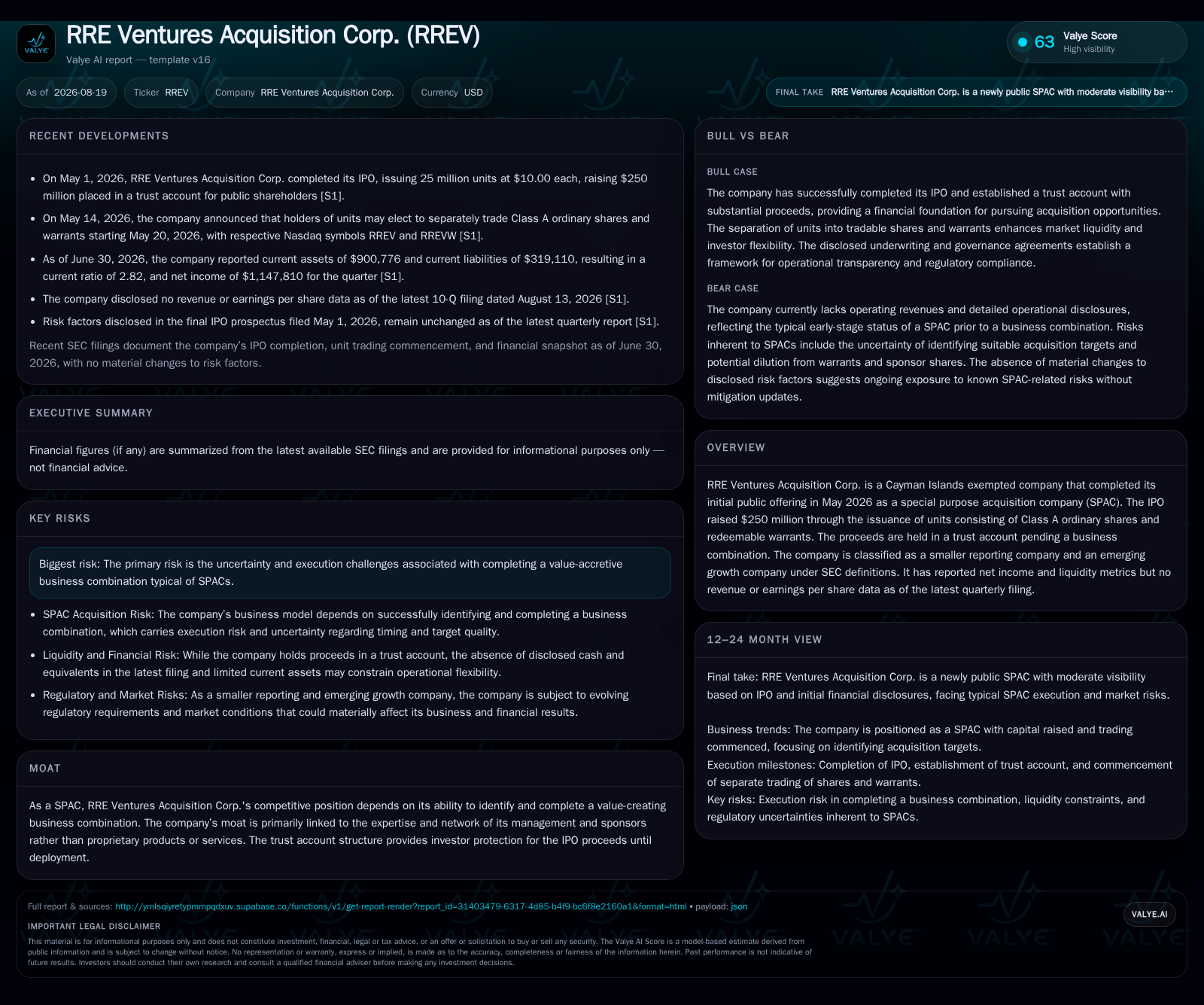
RRE Ventures Acquisition Corp., a special purpose acquisition company (SPAC), completed its $250 million initial public offering in May 2026. As of June 30, 2026, the company reported strong liquidity with current assets of $900,776 and current liabilities of $319,110, resulting in a current ratio of 2.82. The company has no operating revenue or earnings, reflecting its status as a blank-check entity holding IPO proceeds in trust pending a business combination. Its financial position is structurally sound, but future value depends on successful deal execution.
IPO Completion and Capital Structure
RRE Ventures Acquisition Corp. completed its initial public offering (IPO) in May 2026, raising $250 million through the sale of 25 million units [S2][S3][S8]. Each unit consists of one Class A ordinary share and one-third of one redeemable warrant, with each whole warrant exercisable for one Class A ordinary share at an exercise price of $11.50 per share. Alongside the IPO, the company completed a private placement of warrants generating an additional $7.01 million in gross proceeds. This capital structure is typical for SPACs, combining equity shares with warrants to provide investors with potential upside upon a successful business combination.
The private placement warrants were issued to RRE Sponsor, LLC and other parties at $1.00 per warrant, contributing to the overall capital raised. The net proceeds from the IPO and private placement are held in a trust account, which is a standard mechanism in SPACs to protect investor capital until a business combination is completed. This trust account structure ensures that the funds are preserved and segregated from the company’s operating expenses and liabilities prior to the acquisition.
Q2 2026 Financial Position and Liquidity
As of June 30, 2026, RRE Ventures Acquisition Corp. reported current assets totaling $900,776 and current liabilities of $319,110, resulting in a current ratio of 2.82 [F1][S2]. The bulk of the company’s capital remains preserved in the trust account, which holds the net IPO proceeds of $250 million [S2]. This structure is designed to protect investor capital until deployment in a business combination, ensuring financial stability during the pre-combination phase.
The company has no operating revenue or earnings per share as it has not yet completed a business combination [S2]. This absence of operating results is consistent with the SPAC business model, where value generation depends entirely on the identification and consummation of an acquisition. Until such a transaction occurs, the company’s financials primarily reflect the preservation of IPO proceeds and related administrative expenses.
Working capital, defined as current assets minus current liabilities, stands at approximately $581,666, reflecting the positive liquidity buffer available to cover short-term obligations [F1]. This positive working capital is structurally important for a SPAC, as it supports ongoing administrative functions and compliance costs while maintaining the integrity of the trust account.
SPAC Business Model and Value Drivers
RRE Ventures Acquisition Corp. operates as a blank-check company, raising capital through an IPO to acquire or merge with an existing business. Investors purchase units comprising ordinary shares and warrants, with the expectation that the company will complete a business combination that creates shareholder value. Prior to this event, the company does not generate operating revenue or profits, and its financial position centers on safeguarding the IPO proceeds in trust.
This structural liquidity and capital preservation are standard features among SPACs in their post-IPO phase [S2]. The company’s value proposition depends entirely on management’s ability to identify and execute a value-accretive business combination within the specified timeframe. Until then, the trust account acts as a protective mechanism for investors, ensuring that capital is not deployed prematurely or without shareholder approval.
The absence of operating revenue and earnings is expected and normal for a SPAC at this stage, indicating that the company’s value creation depends entirely on completing a successful business combination [S2]. This characteristic differentiates SPACs from traditional operating companies and underscores the importance of deal execution as the primary driver of future financial performance.
Risks and Outlook
The primary risk facing RRE Ventures Acquisition Corp. is the successful execution of a business combination. Failure to complete an acquisition within the allotted period could result in liquidation and return of capital to investors, potentially at a value different from the IPO price. This outcome would limit upside potential and could expose investors to market risk or dilution depending on the terms of the liquidation.
Additionally, changes in liquidity, trust account balances, or regulatory environments may impact the company’s operations and investor returns. For example, any unexpected expenses or regulatory changes affecting SPACs could reduce the funds available for acquisition or increase administrative costs.
Investors and market observers should monitor announcements related to business combination progress, any changes in the trust account, and potential share or warrant issuances or redemptions. The company’s $250 million IPO proceeds remain securely held in trust [S2], supporting a current ratio of 2.82 and positive working capital. The absence of revenue and earnings is expected at this stage and reflects the company’s blank-check nature. Ultimately, the company’s value will depend on its ability to complete a successful business combination that delivers shareholder value.
A grounded watchpoint is the timeline for completing a business combination, as SPACs typically have a limited period to consummate a deal before being required to liquidate. Any delays or difficulties in identifying suitable targets could increase risk for investors. Furthermore, changes in market conditions or regulatory scrutiny of SPAC transactions could affect the feasibility or attractiveness of potential acquisitions.
This article is based on the company's quarterly report filed on August 13, 2026, and related SEC filings. It does not constitute investment advice.
Disclaimer: This is research-only, informational analysis and not investment advice. It may include AI-generated interpretation and general industry context. Always verify important details using primary sources.

Comments