
Dune Acquisition Corp II's Capital Position and Path to Business Combination
Assessment of Dune Acquisition Corp II’s financial health, sponsor transition, and prospects for a pivotal initial business combination.
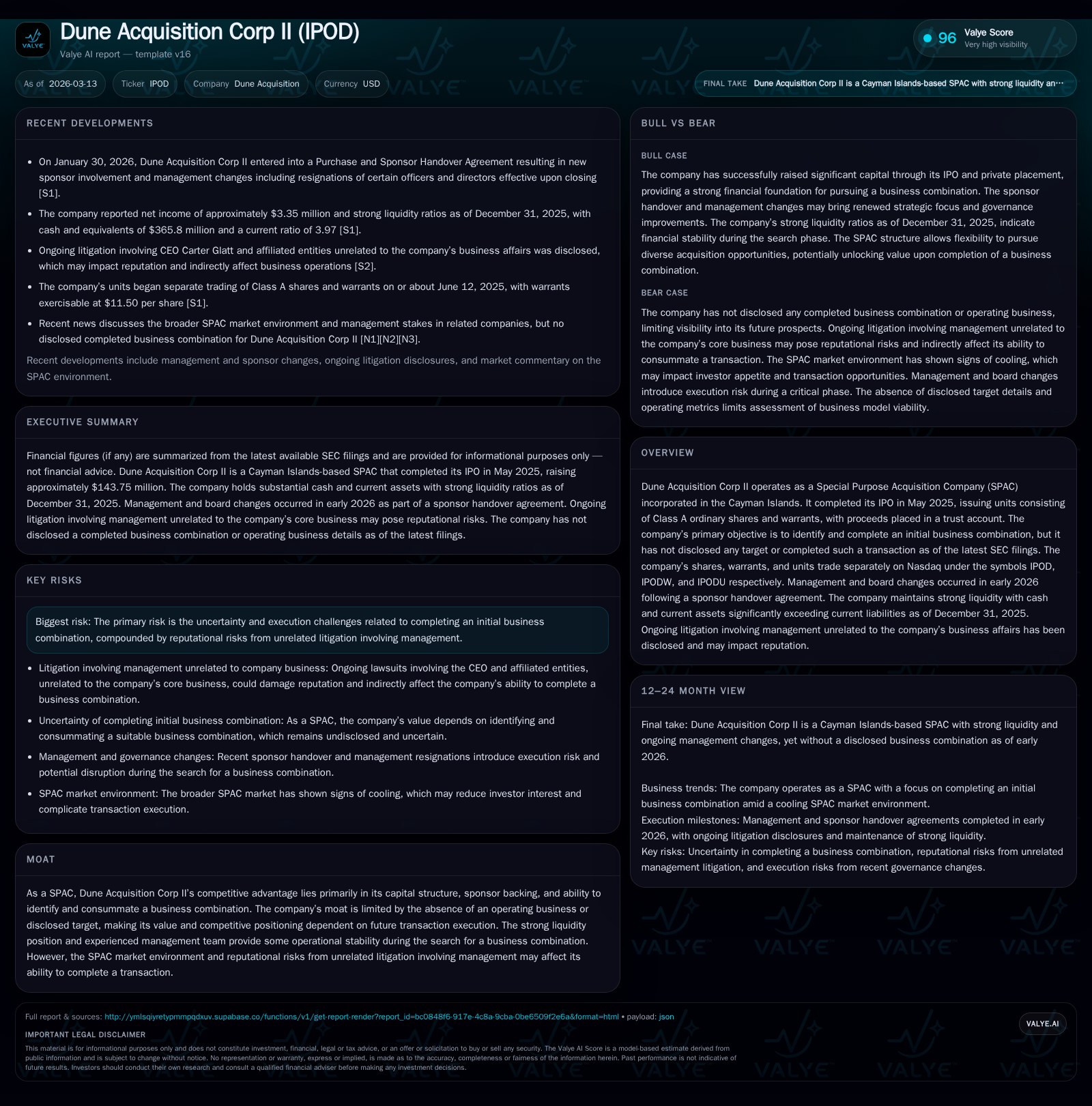
Dune Acquisition Corp II, a Cayman Islands-based SPAC listed on Nasdaq since May 2025, maintains its foundational liquidity primarily through trust-held IPO proceeds, positioning it well financially but without operating revenue as it searches for its first business combination. The early-2026 management transition introduces experienced leadership, aiming to strengthen strategic execution despite ongoing unrelated litigation involving key executives that poses reputational risks. Investors should focus on forthcoming milestones including target announcements and regulatory shifts to gauge transaction progress in a competitive SPAC environment.
From IPO to Today: Financial Foundations Without Operating Revenue
Dune Acquisition Corp II successfully launched its IPO on May 8, 2025, issuing 14.375 million units at $10 each inclusive of an exercise of the overallotment option. The combined proceeds from this offering and the private sale of warrants totaled approximately $144.1 million, all placed into a U.S.-based trust account held by Continental Stock Transfer & Trust Company with J.P. Morgan Chase Bank serving as trustee [S8][S10][S23].
The company operates as a blank check entity without any operating revenues or active businesses as of the latest fiscal year-end December 31, 2025 [S1]. This status is typical of SPACs before consummating their initial business combination.
Financially for FY 2025, Dune Acquisition recorded an operating loss of $451,915 reflecting expenses incurred during organizational and IPO-related activities [F1]. However, net income stood positive at about $3.35 million mainly due to non-operating income components inherent to the SPAC structure. Current assets totaled $387,016 with current liabilities at $97,477, yielding a current ratio of approximately 3.97—indicative of robust liquidity despite no revenues [F1].
Historical performance (annual)
| FY |
|---|
| 2025 |
Source: SEC companyfacts cache [F1].
Table shows key financials highlighting reliance on trust account funds underpinning capital strength.
Management Evolution and Its Impact on Strategic Direction
On January 30, 2026, the company underwent notable governance changes through a Purchase and Sponsor Handover Agreement whereby Collective Acquisition Sponsor LLC ("New Sponsor") acquired interests from the original Sponsor [S3][S21]. This agreement triggered resignations from CEO Carter Glatt (who transitioned to Special Advisor), CFO Michael Castaldy, and the entire existing Board upon fulfillment of regulatory notice periods.
Elliot Richmond assumed dual CEO and CFO roles with David Bailin and Jeremy Sziklay appointed as independent directors [S22]. Richmond brings extensive investment banking and SPAC advisory experience having steered capital markets transactions exceeding $75 billion. Bailin complements with deep wealth management credentials overseeing sizable client assets globally while Sziklay possesses multifaceted expertise in fund management and legal domains.
Despite these credentials enhancing operational capability and sector-acumen breadth across industries, reputational challenges loom due to ongoing litigation involving CEO Glatt unrelated to Dune’s direct business affairs but potentially affecting counterparty perceptions [S2][S4][S5]. The litigation details several allegations within previous associations but are stated by company disclosures not to materially impact daily operations [S1]. Nonetheless, such external risk layers complicate sponsor credibility during negotiations.
Liquidity Strength: Understanding Capital Structure Post-IPO
Dune Acquisition's capital structure remains straightforward and typical for SPACs: cash proceeds totaling approximately $144 million reside largely in the Trust Account safeguarded against general corporate expenditures pending initial business combination completion [S8][F1]. This custodian arrangement limits disbursement primarily to redemptions or transaction closings.
The separate trading of Class A ordinary shares (IPOD), warrants (IPODW), and units (IPODU) commenced mid-2025 allowing differentiated investor strategies [S9][S19]. No debt instruments have been issued so far; thus leverage risk is absent from financial statements.
The current ratio approaching four-times reflects little short-term liability pressure versus liquid assets mostly held in trust. Filings caution that trust funds may be vulnerable to third-party claims or bankruptcy proceedings depending on regulatory interpretations though deemed low risk by management [S1].
Litigation Risks Outside Core Business and Their Market Implications
Material litigation disclosed involves lawsuits filed against CEO Carter Glatt and Captains Neck Holdings LLC originating from actions by former affiliations such as dMY Technology Group [S2][S4][S5]. These include allegations ranging from fraudulent misrepresentation to improper share conveyance with motions contested vigorously by involved parties.
While explicitly stated not impacting Dune Acquisition’s operations or assets directly [S1], these unresolved legal matters introduce reputational ambiguity that investors must monitor given potential indirect effects on partner confidence or negotiation leverage particularly in SPAC markets where sponsor reputation heavily influences target access.
The Quest for a Business Combination: Opportunity and Obstacles
As a sector-agnostic SPAC formed for acquiring one or more businesses at any stage or industry [S1], Dune Acquisition faces standard hurdles common in current market environments characterized by heightened regulatory scrutiny following adoption of '2024 SPAC Rules' which increase procedural complexities [S1][S6].
Competition for attractive targets is intense resulting in escalating valuation expectations while due diligence costs have risen due to additional compliance burdens. Timing risks exist related to meeting the 'Combination Period' deadlines which if unmet may trigger investor redemptions or liquidation events [S1].
Management’s track record is positioned favorably but no definitive acquisition targets have been announced yet as of March 2026 filings requiring investors’ attention going forward toward transaction disclosures.
Capital Allocation Philosophy: Sponsor Incentives and Shareholder Returns
Remaining capital will principally be preserved within the trust pending deal closure with no dividends or share repurchases customary for blank check companies like Dune Acquisition [F1][S17]. Economic incentives align sponsors via warrants exercisable post-business combination which serve both as upside participation tools and contingent deferred underwriting fees enhancing alignment albeit potential conflict occasions.
Underwriting fees are deferred until after transaction completion thereby reducing initial dilution but intensifying sponsor reliance on successful deal execution for value realization—a critical tension given market conditions that can hinder timely mergers.
What Investors Should Monitor Next
Investors should closely follow disclosures indicating movement toward naming prospective business combination targets alongside updates surrounding resolution efforts regarding ongoing management litigation. Additionally, regulatory developments affecting SPAC structuring under SEC ‘2024 SPAC Rules’ will materially influence deal timelines and economics throughout mid-to-late 2026 quarterly filings.
Market reaction toward the newly installed sponsor team’s capability to steer toward closing will also be crucial for reshaping narrative momentum away from uncertainties toward tangible value creation potentials.
Dune Acquisition Corp II typifies modern SPAC dynamics balancing strong foundational capital against inherent execution risks compounded by external legal factors. Its unfolding story will hinge tightly on management’s ability to convert liquidity into an accretive transaction amid evolving market parameters.
Disclaimer: This report does not constitute investment advice or recommendations. It reflects analysis based solely on disclosed public filings as of March 13, 2026.
Disclaimer: This is research-only, informational analysis and not investment advice. It may include AI-generated interpretation and general industry context. Always verify important details using primary sources.

Comments