
IRSA Advances Ramblas del Plata Development Amid Barter Financing and Debt Servicing
IRSA reports continued infrastructure progress in a major Argentine real estate project coupled with active debt servicing and strategic asset acquisitions.
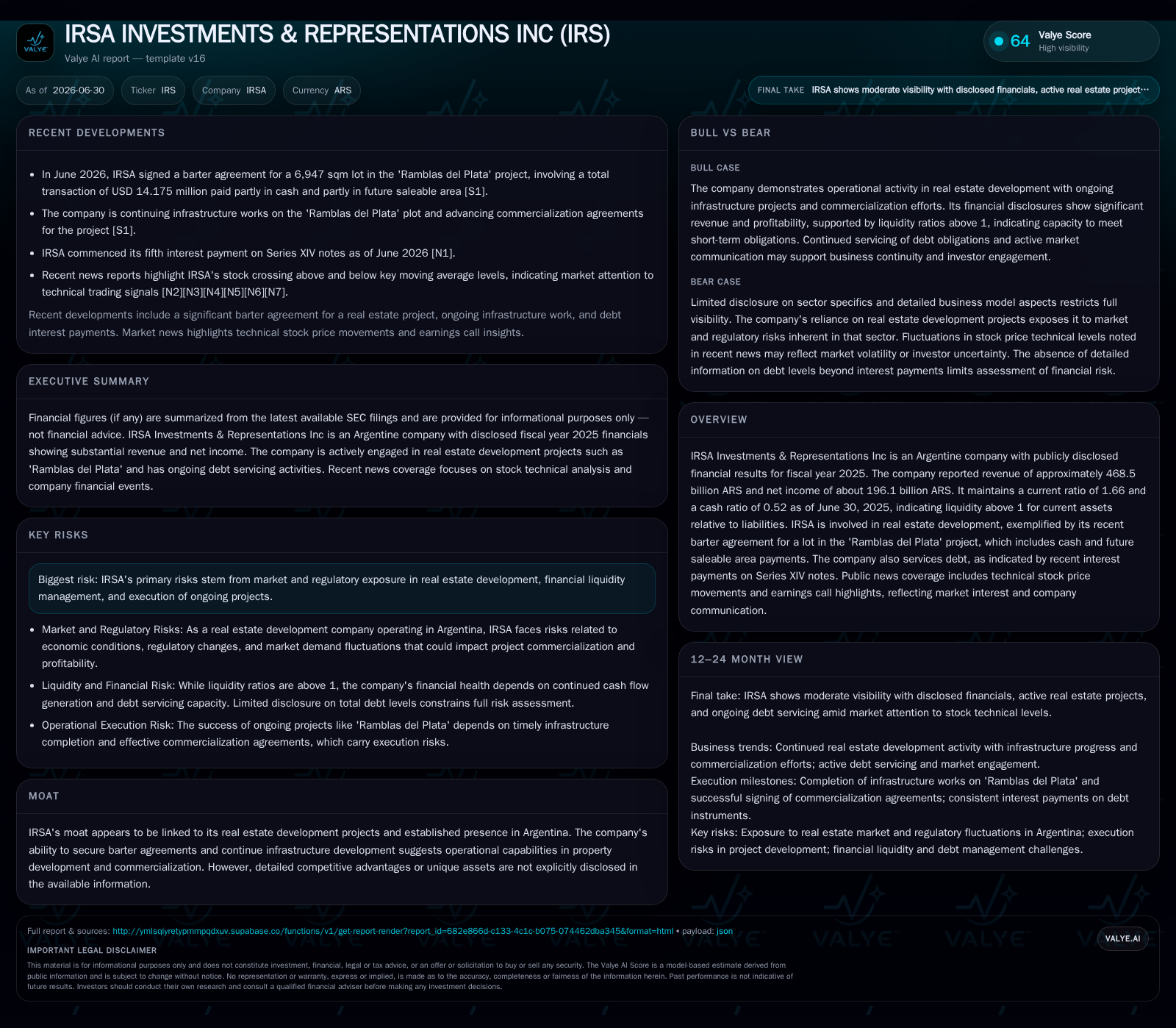
As of its June 2026 quarterly update, IRSA Investments & Representations Inc is progressing on the Ramblas del Plata project through barter agreements involving cash and future saleable area payments, reflecting an innovative financing approach. The company also remains active in debt servicing, including interest and capital installments on its Series XIV notes. With a diverse portfolio including recently acquired shopping malls, IRSA balances development with asset management amid the capital-intensive Argentine real estate market. Key challenges remain execution risks and liquidity management in a volatile macro environment.
Recent Operating Update
IRSA's latest quarterly disclosure highlights ongoing tangible progress in its hallmark "Ramblas del Plata" real estate development located in Argentina. The company recently signed a barter agreement involving a lot measuring approximately 6,947 sqm with an estimated total saleable area of 17,500 sqm valued at about USD 14.175 million. This transaction uniquely blends upfront cash payments with receivables in saleable square meters to be delivered in the future [S2]. This arrangement exemplifies IRSA's strategic use of alternative financing structures within capital-intensive development environments to sustain momentum while managing upfront capital needs.
Simultaneously, IRSA is continuing infrastructure works on the Ramblas del Plata site as it advances toward formalizing commercialization agreements for the project [S2]. This dual approach—progressing site readiness while securing sales or lease contracts—is vital for mitigating execution risk and building reliable revenue streams ahead of construction commencements anticipated next fiscal year [S14].
On the financing front, IRSA exhibits consistent discipline by servicing its debt obligations. It recently initiated payments covering both interest (8.75% annual nominal) and principal installments on its Series XIV notes originally issued in July 2022 due in 2028 [N1][S3]. Serving these obligations supports investor confidence given Argentina's often volatile credit conditions.
Further expanding its real estate footprint beyond development projects, IRSA acquired the Los Gallegos shopping mall in Mar del Plata for USD 13.5 million inclusive of purchase deposits made at closing [S22]. This addition brings the company’s controlled shopping mall portfolio to around 18 assets encompassing over 400,000 sqm of gross leasable area (GLA). The diversification between developmental projects like Ramblas del Plata and income-generating retail assets balances growth potential with regular cash flow generation.
Business Model Analysis
IRSA operates primarily as an integrated player across the Argentine real estate value chain: it undertakes land acquisition, develops residential/commercial projects, commercializes them through sales or leasing contracts, and manages operating properties post-development to realize recurring rental income. Revenue is principally driven by:
- Sale of developed properties or lots (one-time revenue influenced by pre-sales volume and price per square meter)
- Leasing income from managed shopping centers and office buildings
- Property management fees related to asset operations
Given the capital intensity of real estate development, IRSA leverages financing tools extensively including debt issuance (non-convertible notes) and barter agreements that offset cash outlays by accepting future consideration payable in property units rather than solely cash [S2][S28]. Such barter agreements serve as partial proceeds deferrals that help stretch liquidity during phases of heavy capex spend on infrastructure works.
Margins depend materially on property sale prices against development costs plus selling overheads; leasing segments contribute more stable but generally lower-margin recurring income streams [S5]. Seasonal retail sales trends affect occupancy retention/revenue growth especially around local holidays (notably July–December), influencing rental collections from tenant lessees
Industry Structure & Competitive Position
The Argentine real estate development sector remains sensitive to wide-ranging economic factors including interest rates, inflation levels, currency volatility, and regulatory frameworks governing land use/zoning permits. IRSA benefits from substantial scale within Argentina's prime urban/coastal markets with established brand recognition enabling access to significant land parcels such as Ramblas del Plata.
Comparison peers include Latin American developers balancing cyclical exposures via mixed-use developments combined with investment-grade commercial assets (shopping malls/offices). Like Brookfield or Prologis globally—but on a regional scale—IRSA manages multiple revenue streams while relying heavily on asset-backed debt markets to fund expansive project pipelines. Active debt servicing underlines its relative ability to tap capital markets despite country-level market constraints.
Growth Drivers
Key growth vectors for IRSA stem from:
- Urbanization trends supporting demand for residential/commercial real estate.
- Strategic land holdings enabling phased developments boosting saleable area supply over time.
- Infrastructure investments raising property valuations ahead of building commencements.
- Increasing retail activity lifting leasing demand across shopping mall assets.
- Adaptive financing arrangements such as barter agreements reducing upfront capital burdens while accelerating commercialization deals.
Execution progress at Ramblas del Plata—marked by signed barter deals—and new asset acquisitions affirm gradual portfolio expansion alongside steady operational cash flow generation from managed properties.
Risks And Constraints
The company faces several risks intrinsic to emerging market real estate firms:
- Execution risk including construction delays or cost overruns delaying revenue recognition from new developments.
- Economic volatility heightened by inflation impacting input costs and consumer spending patterns affecting retail tenants’ business performance.
- Currency exposure given local revenues but often USD-linked financing obligations necessitating prudent treasury management.
- Regulatory shifts potentially affecting zoning or construction timelines could alter projected development schedules.
- Lease renewal risks if tenant sales slow or vacancy increases compromise rental income stability.
- Liquidity pressures may arise if capital market access tightens amid broader macroeconomic stress.
Monitoring these risk vectors is essential to anticipate alterations in project profitability or operational margins highlighting the need for ongoing cost control measures and tenant relationship management.
What To Watch Next
Investors should track milestones including:
- Progression from infrastructure works to construction phase initiation at Ramblas del Plata next fiscal year [S14].
- Rate of commercialization contract signings for saleable space within new developments confirming pre-sale velocity metrics.
- Leasing occupancy changes within shopping mall portfolio aligned against seasonal expectations for H2 periods.
- Debt service coverage metrics relating to upcoming coupon/principal obligations that may signal refinancing needs or balance sheet stress.
- Additional strategic acquisitions or disposals that could shift portfolio composition between earning assets versus developmental inventory.
Such markers provide insights into IRSA’s operational execution capabilities amid prevailing economic conditions within Argentina’s dynamic real estate landscape.
Financial Profile Discussion
The firm services USD-denominated debt efficiently as evidenced by timely interest and principal payments on Series XIV notes due through 2028 supported by ongoing capital market issuances such as the recent USD 50 million Series XXV notes completion [N1][S3]. Maintaining access to financing amid Argentina's financial environment remains critical to funding large-scale developments without materially constraining balance-sheet flexibility.
Capital expenditures remain focused largely on advancing key projects like Ramblas del Plata where infrastructure groundwork is extensive before vertical construction can start—a typical pattern where early-phase capex precedes revenue recognition during multi-year cycles. Income contributions from mature assets like shopping malls diversify free cash flow streams helping stabilize overall financial performance across economic cycles.
Disclaimer: This analysis is based exclusively on disclosed information without investment research views or forecasts. Readers should consider inherent uncertainties related to emerging market real estate operations before forming any conclusions.
Disclaimer: This is research-only, informational analysis and not investment advice. It may include AI-generated interpretation and general industry context. Always verify important details using primary sources.

Comments