
Sanfilippo & Son 2026 Q4: Customer Concentration and Production Risks Weigh on Results
Sanfilippo & Son’s fiscal 2026 results reveal structural risks from customer concentration and single-site production dependencies impacting revenue stability and operations.
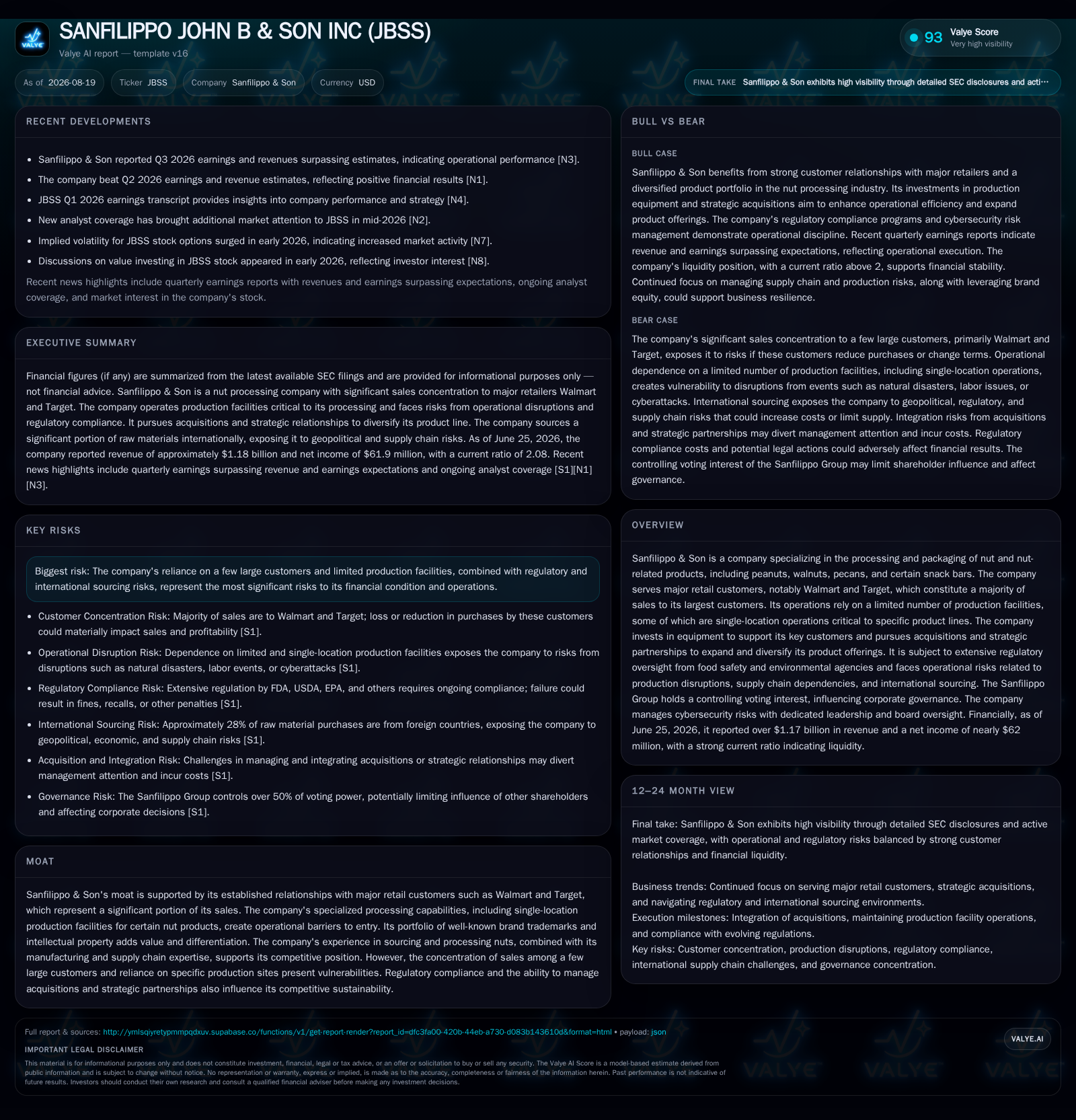
John B. Sanfilippo & Son, Inc. reported its fourth quarter and full fiscal year 2026 financial results, highlighting significant operational and revenue risks tied to its reliance on a few large retail customers and limited production facilities. Walmart and Target accounted for a majority of sales to the top five customers, creating customer concentration risk that influences pricing and volume dynamics. Additionally, certain nut processing activities occur at single-location facilities, exposing the company to potential disruptions that could materially affect product availability and financial outcomes. International sourcing of raw materials further adds geopolitical and supply chain complexity. The company’s recent equipment investments aim to support key customers but increase exposure if demand declines. As of June 25, 2026, Sanfilippo & Son maintained a current ratio of 2.08 and moderate leverage with $43.6 million in total debt. These factors collectively underscore operational and financial vulnerabilities that warrant close monitoring.
Recent Quarterly Results and Operating Update
John B. Sanfilippo & Son, Inc. released its fourth quarter and full fiscal year 2026 results on August 19, 2026, providing fresh insight into its operational and financial condition [S3]. The company’s revenue and profitability remain materially influenced by its concentration of sales to a few large retail customers and its operational reliance on a limited number of production facilities. These factors shape the company’s risk profile and capital deployment decisions.
Business Model and Customer Concentration
Sanfilippo & Son operates primarily as a processor and packager of nut and nut-related products, including peanuts, walnuts, pecans, and snack bars, selling to major retailers such as Walmart and Target [S1][S10]. This concentration means that changes in purchasing patterns, pricing demands, or contract terms from these retailers can disproportionately affect the company’s revenue and margins.
Large retail customers wield substantial negotiation power, often demanding lower prices, altered packaging, increased marketing support, or payments for retail shelf space. These pressures can compress profitability and require Sanfilippo to maintain competitive service and product offerings. The company has recently invested in new equipment aimed at better serving these key customers, which increases its fixed asset base and dependence on continued demand from Walmart and Target [S1][S10]. A loss or significant reduction in orders from these customers would not only reduce sales but also challenge the return on these capital investments.
Operational Risks from Production Facility Concentration
A notable structural risk for Sanfilippo & Son is its dependence on single-location production facilities for critical nut processing activities. Specifically, the shelling of peanuts, walnuts, and pecans, as well as the processing and packaging of certain snack bars, occur only at dedicated single sites [S1][S8][S10]. This operational concentration creates vulnerability to disruptions such as labor disputes, power failures, natural disasters, or other adverse events.
Any significant interruption at these facilities could materially reduce product availability, leading to lost sales and customer dissatisfaction. The company’s ability to quickly secure alternative production or processing capacity on acceptable terms is uncertain, which could exacerbate the financial impact of such disruptions [S1][S8]. This risk is compounded by the reliance on third-party suppliers and distributors, where disputes or interruptions may further affect the supply chain and product delivery.
Financial Position and Capital Allocation
As of June 25, 2026, Sanfilippo & Son reported current assets of $349.3 million against current liabilities of $167.9 million, yielding a current ratio of 2.08, which indicates coverage of short-term obligations by liquid assets [F1]. However, cash and cash equivalents stood at only $1.15 million, a relatively modest buffer compared to total debt of $43.6 million and net debt of approximately $42.4 million [F1]. This moderate leverage level suggests that the company’s financial flexibility depends heavily on operational cash flow generation.
The recent capital expenditures on equipment to support major customers represent a strategic allocation aimed at maintaining competitive service levels and operational capacity [S1]
Regulatory and International Sourcing Risks
Sanfilippo & Son sources about 28% of its nut, dried fruit, and oat purchases internationally, including cashews from Vietnam and West Africa, pecans from Mexico, and sunflower oil from Ukraine [S1][S4]. This international sourcing exposes the company to geopolitical, regulatory, and supply chain risks such as tariffs, trade restrictions, political instability, and compliance with foreign and U.S. regulations.
Such risks can increase raw material costs, disrupt supply continuity, and require additional compliance expenditures. Regulatory frameworks like the Food Safety Modernization Act (FSMA) impose stringent food safety and traceability requirements, potentially raising operational costs and risks of enforcement actions [S9]. Concurrently, the reliance on single-location production facilities for key processing steps elevates operational risk, with any disruption potentially causing material product shortages and sales declines.
Financially, the company’s moderate leverage and limited cash reserves constrain its ability to absorb shocks from operational disruptions or customer losses, underscoring the importance of stable cash flow generation and effective capital allocation [F1]. One plausible positive scenario is that the company’s recent equipment investments enable it to deepen relationships with Walmart and Target, stabilizing or growing sales volumes despite retailer pricing pressures [S1][S3]. This risk is heightened by the company’s moderate leverage and limited cash buffer. Confirmation would be evident through declining revenue and margins, negative cash flow trends, or adverse regulatory developments.
Watchpoints
Investors and analysts should monitor several key indicators in upcoming periods:
- Quarterly sales volumes and pricing trends with Walmart and Target to assess customer demand stability.
- Operational uptime and incident reports from single-location production facilities to gauge disruption risk.
- Capital expenditure levels and returns on recent equipment investments to evaluate capital allocation effectiveness.
- Regulatory compliance updates and developments in international sourcing that may impact costs or supply continuity.
- Liquidity and leverage trends in subsequent filings to understand financial flexibility.
These watchpoints will provide insight into the company’s ability to manage its structural risks and sustain operational and financial performance.
In summary, Sanfilippo & Son’s 2026 fiscal year results highlight the interplay of customer concentration, production facility reliance, and international sourcing in shaping its risk and opportunity profile. The company’s financial and operational resilience will depend on managing these factors effectively amid evolving market and regulatory conditions.
Disclaimer: This is research-only, informational analysis and not investment advice. It may include AI-generated interpretation and general industry context. Always verify important details using primary sources.

Comments