
Kraig Biocraft Advances Spider Silk Scale-Up Amid Continued Liquidity Pressure
Latest quarter highlights production scaling of BAM-1 Alpha spider silk with ongoing R&D and structural liquidity constraints.
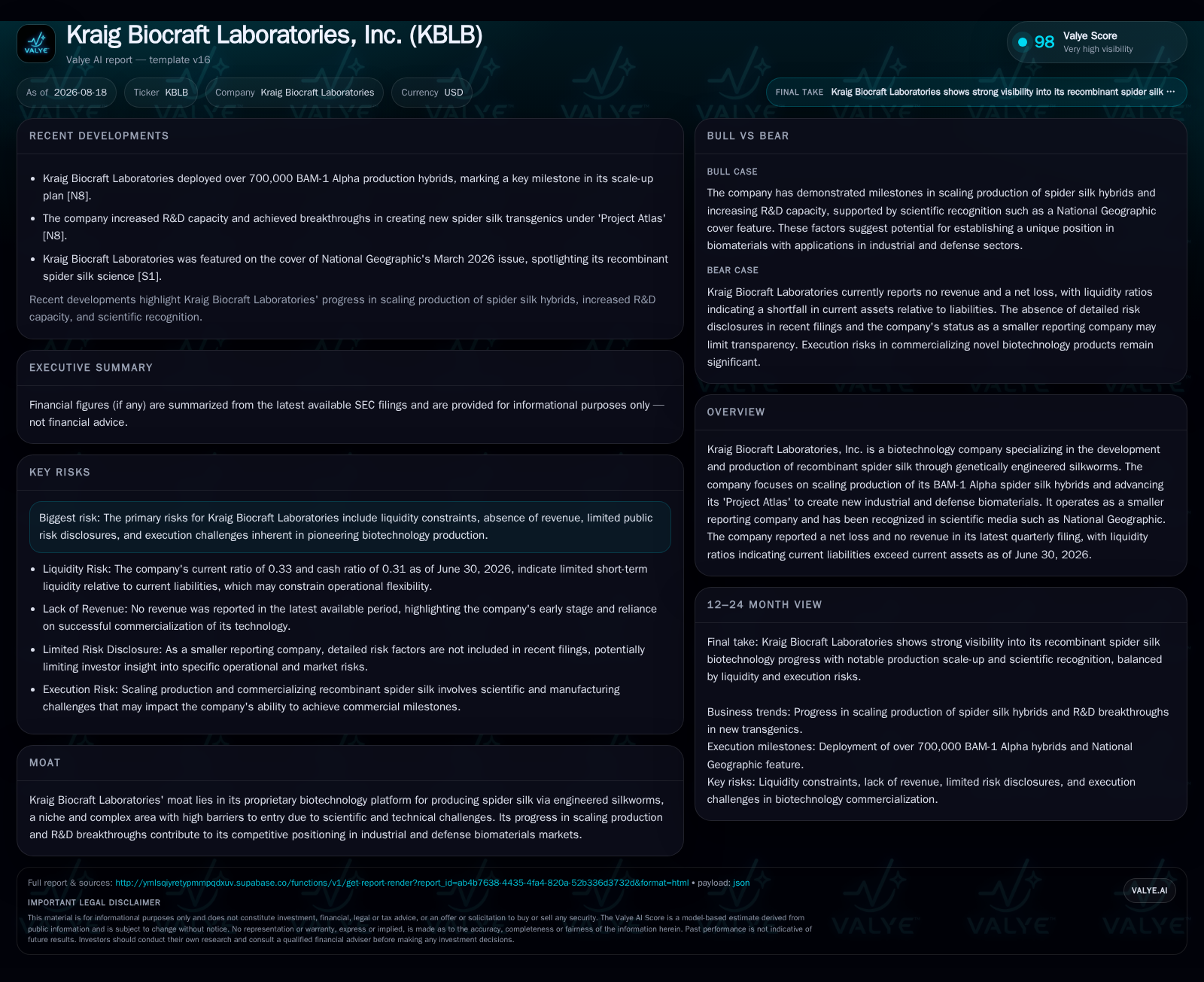
Kraig Biocraft Laboratories focuses on developing recombinant spider silk via genetically engineered silkworms, advancing its flagship BAM-1 Alpha hybrid and 'Project Atlas' initiatives. The company remains in pre-commercial stages with no revenue reported this quarter, reflecting the capital-intensive and technical challenges typical in biotech materials scale-up. Its proprietary biotechnology platform creates a niche moat, but execution risk and financing remain critical near-term concerns.
Recent Operating Update: Latest Quarter Highlights
Kraig Biocraft Laboratories released its latest quarterly report on August 13, 2026, reiterating key themes of early-stage biotech material development characterized by zero revenue recognition and ongoing operating losses [S2][F1]. No new material partnerships or contracts were disclosed in this filing, signaling that commercial traction remains nascent. The company's cash position as of June 30 stood near $3.4 million while current liabilities vastly outweighed current assets at over $10.9 million, yielding a conservative current ratio of approximately 0.33 that accentuates pressing liquidity challenges [F1]. This financial snapshot aligns with Kraig’s development-phase profile where operating cash burn outpaces inflows due to high R&D spending and pre-commercial production costs.
Business Model: Recombinant Spider Silk Production Through Engineered Silkworms
Kraig Biocraft operates within the biotechnology materials industry subsegment focused on creating high-performance biomaterials through advanced genetic engineering techniques — specifically recombinant protein production using genetically modified silkworms instead of microbial fermentation or chemical synthesis platforms [S1]. Its flagship product line revolves around the BAM-1 Alpha hybrid spider silk fiber, designed to combine superior tensile strength with enhanced durability for industrial textile applications as well as specialized defense biomaterial usage cases [S3].
Revenue generation remains contingent on achieving scalable quantities of commercially viable spider silk suitable for licensing or direct sales [S1]. Monetization pathways include selling produced fibers to industrial customers or entering co-development partnerships enabling defense applications. Value drivers include increased yield per batch (grams of fiber), improved mechanical properties validated to meet target application specifications (e.g., tear resistance), and intellectual property depth protecting proprietary gene constructs and manufacturing protocols
The 'Project Atlas' initiative further underscores Kraig's strategic push to diversify its biopolymer portfolio into new advanced materials synthesized via synthetic biology workflows leveraging their engineered silkworm lines for novel biomaterial classes beyond spider silk alone [S1]. Success here would expand addressable markets while reinforcing technological leadership.
Industry Structure and Competitive Positioning
Kraig Biocraft occupies an early-stage niche in the industrial biotechnology segment focused on sustainable biomaterials. Peer reference points include synthetic spider silk developers like Bolt Threads and Spiber Inc., both competing to overcome similar scientific hurdles around reliable large-scale biomanufacturing of spider silk proteins — a known challenge due to complexity in producing recombinant proteins with requisite molecular fidelity and post-processing characteristics.
Traditional textile fiber producers lack comparable performance properties or sustainability credentials offered by biopolymer competitors. However, biotech biomaterial companies face significant time-to-market delays due to protracted R&D cycles, scale-up manufacturing challenges, stringent quality controls, and certification requirements especially for defense-grade materials.
Kraig's competitive moat stems from its proprietary genetic engineering platform enabling biologically derived spider silk fibers directly from transgenic silkworms instead of microbial hosts or synthetic chemistry routes. This method potentially lowers cost barriers once scaled but currently weighs heavily on throughput risks tied to breeding efficiency, fiber extraction yields, and downstream processing consistency [S1].
Growth Drivers: Sustainability Demand & Defense Sector Potential
The broader industrial trend toward sustainable materials sourcing provides tailwinds as corporations seek biodegradable alternatives with advanced mechanical properties. Biotechnology materials like recombinant spider silk align well here because they combine natural origins with performance metrics surpassing traditional fibers such as nylon or polyester.
Government interests—particularly defense agencies—are increasingly investing in innovative lightweight yet resilient materials usable in personal protective equipment or specialty textiles. Kraig’s efforts under 'Project Atlas' target these defense biomaterials markets which can justify higher price points if certification milestones are achieved.
Technological advances in synthetic biology tools accelerate capability to engineer improved organism strains enhancing production yield per cycle - a crucial KPI given high sensitivity of economics to output volume [S1]. Expansion into adjacent application sectors could unlock incremental licensing opportunities.
Risks and Watchpoints: Execution Challenges and Liquidity Constraints
Primary execution risks revolve around scaling production from laboratory or pilot batches to commercial volumes maintaining consistent quality necessary for industrial buyers. Genetic stability of engineered silkworm lineages over multiple generations remains a factor that could affect yield reliability.
As Kraig reports no current revenue streams related to its core BAM-1 Alpha products or Project Atlas derivatives, reliance on timely capital raises or strategic partnerships is paramount [F1]
Additionally, without detailed disclosures regarding patent counts or licensing contracts this quarter’s filing leaves open questions about intellectual property expansion pace—a critical competitive barrier against emerging synthetic biology entrants.
Market adoption risk persists given relatively unproven commercial viability; end users must be convinced not only of product performance but also supply-chain readiness which hinges on successful scale-up milestones.
What to Watch Next
Key operating markers will include announcements related to:
- Demonstrable scale-up achievements increasing BAM-1 Alpha fiber production yields reflecting improved bioprocessing efficiencies.
- Progress reports around Project Atlas demonstrating functional prototypes or initial customer trials especially targeting defense sector applications.
- Expansion of intellectual property portfolio including patent grants protecting novel genetic constructs or manufacturing innovations.
- Strategic partnership developments either in co-development agreements or off-take contracts that begin introducing third-party validation into Kraig's commercialization pathway.
- Cash runway updates aligned with capital raising activity that mitigate current liquidity risk posed by low asset coverage against near-term liabilities.
Financial Profile Discussion
Kraig Biocraft maintains approximately $3.4 million in cash and equivalents as of mid-2026 but faces significant short-term liability obligations totaling nearly $10.9 million - resulting in a current ratio near 0.33 which is below common liquidity benchmarks signaling potential funding pressure [F1]. Total debt is negligible at under $9 thousand historically tracked but does not offset working capital deficits effectively.
Operating expenses continue driven by research and development investments critical for advancing bioprocess scale-up; correspondingly quarterly results show sustained net losses consistent with pre-revenue growth-stage companies in biotech materials space where upfront innovation intensity dominates financial performance trends [F1]
Capital allocation currently prioritizes R&D efforts potentially supported by equity financing rounds rather than debt issuance given limited tangible collateral value inherent in early-stage biomaterial IP assets[S2]. Maintaining adequate financing until reaching commercial production scalability will be crucial for avoiding dilutive funding terms or operational disruptions.
-- This analysis synthesizes the latest SEC disclosures alongside biotechnology materials industry fundamentals highlighting key operational themes intrinsic to Kraig Biocraft Laboratories’ strategic positioning. It does not constitute investment advice.
Disclaimer: This is research-only, informational analysis and not investment advice. It may include AI-generated interpretation and general industry context. Always verify important details using primary sources.

Comments