
Kinetic Seas Inc. Struggles with Customer Concentration and Financial Constraints in AI Infrastructure Market
Latest quarterly filing underscores limited customer base, cash liquidity challenges, and market competition.
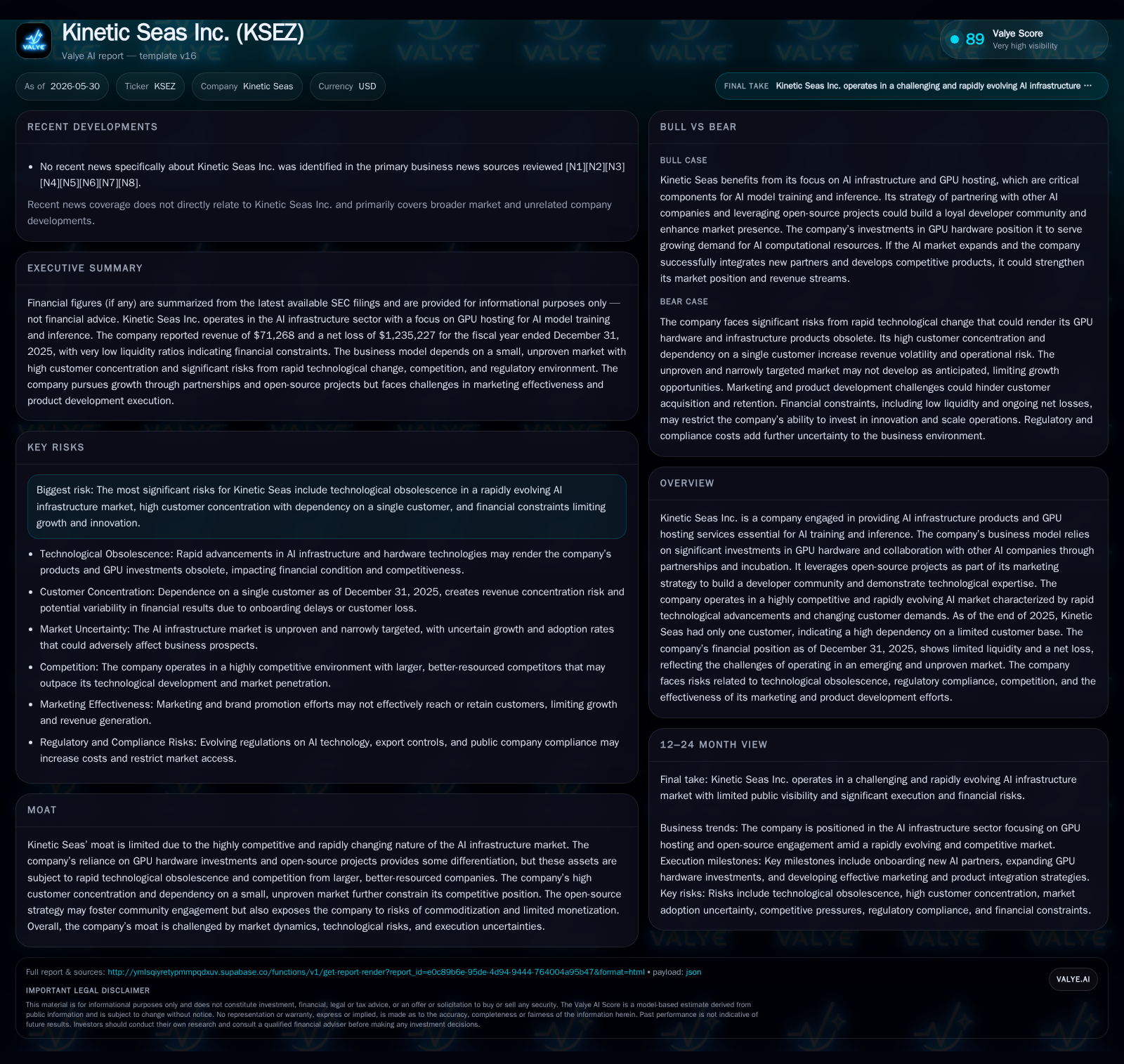
Kinetic Seas Inc., a provider of AI infrastructure and GPU hosting services, faces significant hurdles due to its high dependence on a single customer, constrained liquidity, and steep losses as per its latest 10-Q and 10-K filings. Its business model hinges on GPU hardware investments and open-source community engagement to carve out relevance in an intensely competitive and fast-evolving AI market. While the company’s strategy aims to leverage technological innovation and partnerships, financial limitations and market dynamics pose notable risks that could impede growth and operational stability.
Recent Operating Update
Kinetic Seas Inc.’s latest quarterly filing dated December 10, 2025 (10-Q) reveals acute financial strain highlighted by cash & equivalents of just $7,767 set against over $2.8 million in current liabilities, producing a razor-thin current ratio of approximately 0.02 [S2][F1]. Such figures indicate severe liquidity constraints that jeopardize operational continuity without immediate remedial actions. This update serves as a critical lens into the company's near-term survivability amid modest operational progress.
The recent annual report filed May 29, 2026 (10-K) further contextualizes these pressures by confirming diminutive fiscal year revenue of $71,268 for 2025 — a steep 66% decline from the prior year — coupled with a net loss exceeding $1.2 million [F1][S1]. The operating income trajectory shows some improvement from a sharper loss in 2024 but remains deeply negative. This signals that while losses are narrowing percentage-wise due to scale effects or cost control measures, overall profitability remains elusive.
Business Model Overview
Kinetic Seas derives revenue primarily through the provision of AI infrastructure products and GPU hosting services vital for AI training and inference workloads [S1]. Revenue mechanics revolve around leasing or managing expensive GPU compute assets that customers—typically AI software developers or research institutions—utilize for computationally intensive tasks. The company invests substantially in GPU hardware platforms requiring significant upfront capital outlay.
To augment this core offering, Kinetic Seas leverages strategic partnerships and incubation agreements designed to foster innovation pipelines and expand solution reach. Complementing this is an open-source marketing approach aimed at building an engaged developer community—a tactic intended both to showcase technological prowess and to seed potential commercial relationships.
Industry Structure and Competitive Position
Operating within the artificial intelligence infrastructure ecosystem places Kinetic Seas amidst a volatile and highly competitive arena characterized by rapid technological advances driven largely by global cloud giants like NVIDIA-accelerated data center operators as well as hyperscalers such as AWS, Google Cloud, and Microsoft Azure.
Such competitors enjoy substantial R&D budgets and broad customer bases enabling aggressive pricing strategies that can erode margins for smaller players. Additionally, frequent upgrades in GPU architectures necessitate continual reinvestment which strains smaller companies’ capital resources.
Kinetic Seas attempts differentiation through niche targeting—providing more specialized service offerings possibly not covered by larger players—and fostering additional value via open-source contributions which may drive ecosystem stickiness yet present monetization challenges if commoditized broadly [S24].
Growth Drivers
The company's growth path depends heavily on successfully expanding its customer base beyond the existing single client dependency while maintaining technological leadership through ongoing product development [S26].
Key growth facilitators include:
- Strategic acquisitions aiming to broaden technology portfolio or client access,
- Incubation partnerships to accelerate innovation cycles,
- Enhanced integration capabilities ensuring seamless workflow embedding alongside customers' existing software ecosystems.
However, these initiatives require simultaneous resolution of financial constraints; otherwise expansion efforts are likely to falter under limited operational funding.
The sustained industry trend toward increased AI adoption underpins structural demand growth but is counterbalanced by cyclical macroeconomic headwinds that could dampen IT spends [S1].
Risks / Watchpoints / Growth Constraints
Primary risks facing Kinetic Seas encompass:
- Customer Concentration: Overreliance on one pivotal customer heightens revenue volatility risk should that relationship alter or terminate unexpectedly;
- Technological Obsolescence: Rapid innovation cycles impose relentless demands on capital-intensive product refreshes;
- Financial Fragility: Minimal cash reserves relative to liabilities depict looming solvency threats without external capital infusions;
- Competitive Pressures: Larger rivals with extensive resources may outpace product development leading to market share erosion;
- Regulatory Environment: Emerging international regulations on AI technologies could curtail global sales avenues or increase compliance costs substantially.
Monitoring these vectors closely is critical as their materialization could impair both short-term viability and long-term strategic positioning.
What To Watch Next
Investors and observers should focus on several leading indicators including:
- Expansion or diversification of customer pipeline beyond the sole existing client,
- Announcements or closings of acquisitions/incubation projects along with initial performance metrics,
- Quarterly liquidity improvements or successful capital raising activities,
- Progress in integrating new product enhancements aligned with evolving AI workflows,
- Regulatory developments impacting cross-border distribution capabilities.
Each milestone will illuminate whether Kinetic Seas can transition from emerging early-stage vendor status into a sustainable competitor within the crowded AI infrastructure market space.
Financial Profile Summary
Historical performance (annual)
Capital returns and efficiency (annual)
From a financial perspective based on FY2025 data [F1]:
- Revenue totaled $71,268 reflecting substantial contraction (−66.2% YoY), underscoring challenges generating meaningful top-line growth;
- Operating losses narrowed significantly compared to prior periods but remained at $1,202,662;
- Net loss closed at $1,235,227 with operating cash flow deficits persisting at approximately $553,929;
- Cash & equivalents are critically low at $7,767 against current liabilities exceeding $2.8 million demonstrating pronounced working capital strain;
- Equity stood negative at −$350,609 indicating accumulated deficits across reporting periods.
These metrics reflect ongoing operational scaling difficulties combined with acute liquidity pressure.
This analysis synthesizes publicly filed disclosures without providing investment guidance or research views. The company's prospects depend markedly on execution against multiple interrelated strategic challenges within an evolving competitive landscape.
Disclaimer: This is research-only, informational analysis and not investment advice. It may include AI-generated interpretation and general industry context. Always verify important details using primary sources.

Comments