
Nutanix Advances AI Infrastructure Strategy on Strong Quarterly Execution
Nutanix's latest quarterly results validate its execution and highlight momentum in AI infrastructure growth fueled by its strategic partnership with AMD.
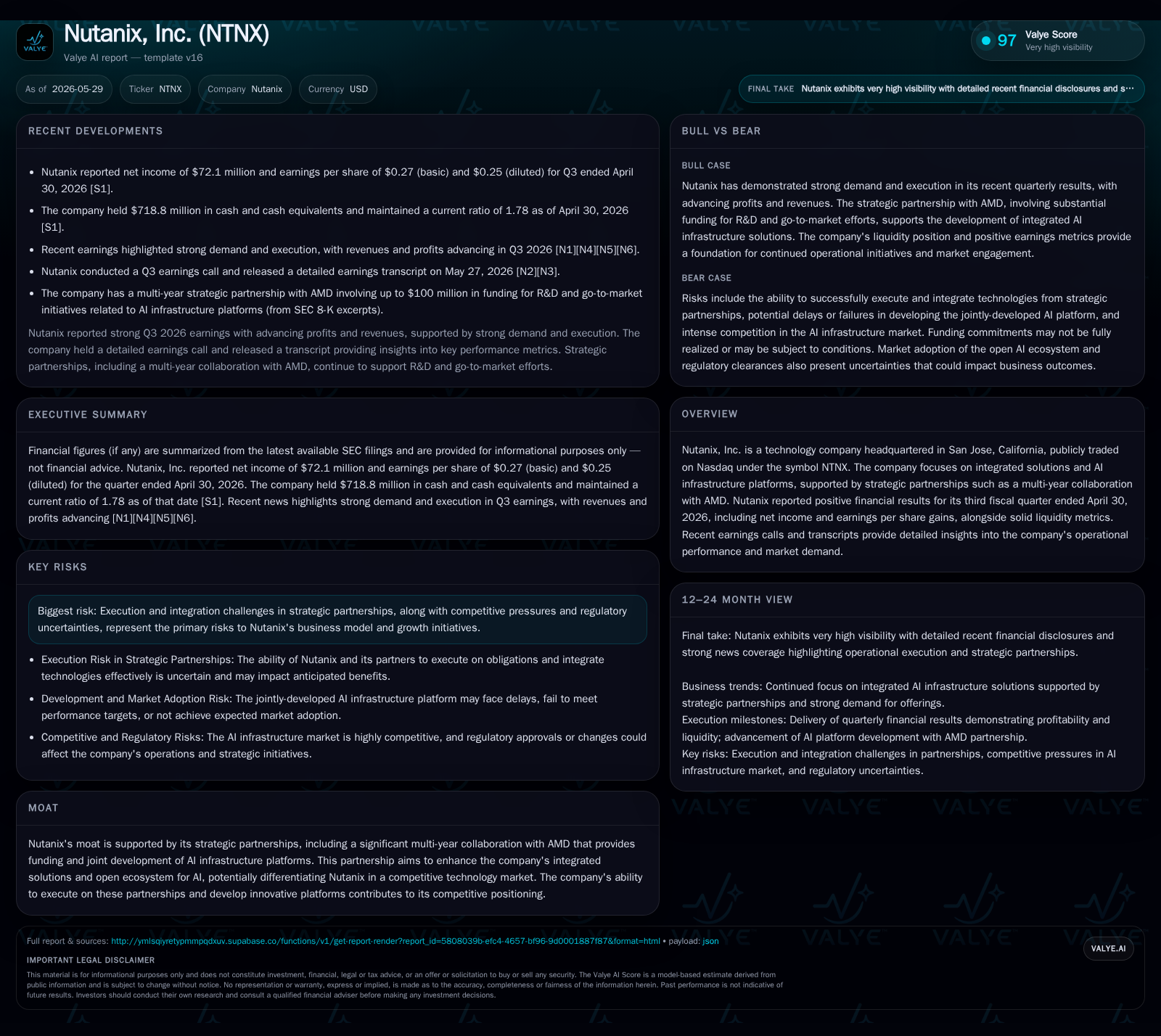
In its third fiscal quarter ended April 30, 2026, Nutanix reported net income growth and strong earnings per share improvement, underscoring operational strength. The quarter’s results reinforce the company’s strategy of leveraging integrated cloud and AI infrastructure platforms, accelerated by a multi-year collaboration with AMD. Nutanix's positioning within a competitive hybrid cloud and AI market is bolstered by this partnership, opening growth avenues through innovative solutions and ecosystem engagement. Key risks include partnership execution challenges and intensifying competition from large cloud providers.
Latest Quarterly Operating Results and Their Implications
Nutanix’s fiscal third quarter ended April 30, 2026, marked a pivotal inflection in both financial performance and strategic execution. The company announced net income growth alongside earnings per share improvements in its recent Form 10-Q filing on May 29, reinforcing that demand for its integrated cloud solutions remains strong amidst transition toward AI infrastructure platforms [S2][S3]. These results were echoed in contemporaneous earnings call commentary that elaborated on solid customer traction across its portfolio and expanding commercial pipeline [N2][N3]. The improved profitability metrics demonstrate Nutanix’s ability to leverage scale while investing in innovation enabled by the AMD collaboration.
This quarter is particularly noteworthy as it aligns with the early phases of the strategic partnership funding ramp—a partnership designed to accelerate R&D investment into AI-ready infrastructure platforms. By showing financial discipline alongside technology advancement, Nutanix signals that it can convert strategic investments into tangible market execution.
Nutanix Business Model: Integrated Solutions and AI Infrastructure Platforms
At its core, Nutanix delivers integrated cloud computing solutions built on a software-defined architecture that emphasizes hybrid and multi-cloud capabilities. Customers—often enterprise IT buyers—pay for a combination of perpetual licenses, subscription services, and bundled hardware-software solutions focused on simplifying data center operations through hyperconverged infrastructure (HCI).
The evolution toward AI infrastructure represents an expansion of this model where Nutanix leverages scalable compute fabric to support emerging AI workloads. This shift elevates the product mix from typical virtualization use cases to high-performance data pipelines critical for machine learning workloads. Recurring revenue streams from subscriptions contribute margins stability while the hardware bundles—enhanced through co-development efforts with AMD—increase switching costs by integrating performance-optimized components tightly with Nutanix’s software stack [S2]
In this context, Nutanix’s established presence in hybrid cloud management acts as a foundation upon which AI-targeted offerings can be layered. This combined solution approach supports customer lock-in due to comprehensive lifecycle services spanning provisioning, orchestration, monitoring, and optimization.
Competitive Environment and Strategic Partnerships in Context
The technology landscape Nutanix operates within is characterized by rapid evolution in cloud computing with a strong overlay of accelerating AI infrastructure demand. Competitors span large hyperscale cloud vendors moving aggressively into hybrid offerings; traditional incumbents in virtualization; and new entrants focused solely on AI hardware or software stacks.
A critical differentiator for Nutanix is its multi-year strategic partnership with AMD formalized earlier this year. This alliance secured $150 million through a private placement enabling co-funded research & development specifically targeting an integrated AI infrastructure platform [S7][S8][S29]. The partnership grants Nutanix direct access to AMD’s cutting-edge silicon architecture while providing capital to accelerate go-to-market efforts.
This collaboration aims to create an open ecosystem optimized for AI workloads—a notable advantage over competitors constrained by proprietary or narrower technology stacks. From an industry supply chain perspective, aligning with a semiconductor leader like AMD also helps mitigate risk related to component sourcing while enhancing differentiation through performance tuning tailored to Nutanix’s software layers.
Regulatory factors including antitrust clearances have been navigated successfully so far but remain a watchpoint as joint development intensifies given evolving scrutiny over tech partnerships involving foundational infrastructure technologies.
Growth Drivers: Exploiting AI Infrastructure, Customer Demand, and Ecosystem Opportunities
Nutanix’s primary growth vector is the scaling demand for enterprise-ready AI infrastructure entwined with its existing hybrid cloud management tools. Key drivers include:
- Accelerated adoption of AI platforms developed under the AMD partnership enabling customers to deploy high-performance workloads supported by native system optimizations [N2].
- Expanding Annual Recurring Revenue (ARR) potential as customers upgrade traditional virtualization deployments toward AI-augmented environments incorporating subscription models across software modules.
- Strong sales pipeline with increasing multi-year contract wins highlighted during recent earnings discussions indicating improving commercial traction beyond core HCI workloads [N2][S3].
- Open ecosystem participation fostering third-party innovations layered atop Nutanix-AI platform enhancing install base value proposition.
- Roadmap alignment toward availability milestones for jointly developed platforms expected within upcoming quarters enhancing forward visibility.
These drivers suggest a structural demand shift rather than purely cyclical spend given enterprises’ long-term capital allocation toward digital transformation initiatives encompassing hybrid cloud modernization and AI acceleration.
Risks and Constraints: Execution Challenges, Competition, and Regulatory Headwinds
While prospects appear constructive, several risk factors warrant attention:
- Execution complexity embedding next-generation hardware into existing product lines demands close coordination across engineering teams; any delays could impact time-to-market for key platform features tied to AMD collaboration [S4].
- Competitive pressures escalate as dominant cloud providers invest aggressively in proprietary AI infrastructure potentially commoditizing portions of the market or squeezing pricing power.
- Regulatory scrutiny continues around strategic alliances involving chipmakers given geopolitical concerns which could lead to delayed approvals or operational constraints impacting joint ventures.
- Integration risks remain significant when blending advanced silicon technologies into software-defined solutions requiring robust validation cycles before enterprise-wide deployments.
Together these factors create an environment where disciplined project management combined with proactive regulatory engagement will be critical for realizing intended benefits.
Monitoring Milestones: What to Watch Next on Guidance and Execution
Key near-term indicators offering insight into Nutanix’s trajectory include:
- Updates to quarterly revenue guidance reflecting actual uptake of enhanced integrated platform offerings post AMD joint R&D investments [S2][S3].
- Timing of sequential R&D funding drawdowns linked to milestone achievements within the strategic collaboration could signal progression or timing shifts of platform readiness.
- Announcements regarding availability dates or initial customer deployments of the jointly-developed AI infrastructure platform acting as tangible proof points validating market acceptance [N2].
- Trends in sales pipeline conversions from trials or proof-of-concept engagements into binding multi-year contracts would evidence commercial momentum aligning with increased recurring revenue inflows.
- Any regulatory updates issued via SEC filings or public disclosures relating to clearing hurdles or expanded permissions affecting partnership scope.
Tracking these measurable checkpoints allows assessment of whether operational execution keeps pace with strategic ambitions amid competitive intensity.
Brief Financial Overview: Liquidity, Earnings, and Capital Structure
As of quarter-end April 30, 2026, Nutanix reported $718.8 million in cash and cash equivalents supported by a healthy current ratio of approximately 1.78 indicating robust short-term liquidity positioning conducive for continued investment activity [F1]. The net income gains recorded this quarter underscore improved profitability dynamics driven by operational leverage and efficient expense management [S2]. No immediate concerns regarding leverage or refinancing emerged from recent disclosures complementing balance sheet stability.
This financial strength provides a solid foundation supporting ongoing R&D funding fulfillment under the AMD partnership while sustaining go-to-market initiatives crucial for capturing emerging demand trends in hybrid cloud plus AI infrastructure domains.
This analysis is based solely on publicly available information from SEC filings and recent company disclosures without offering investment research views.
Disclaimer: This is research-only, informational analysis and not investment advice. It may include AI-generated interpretation and general industry context. Always verify important details using primary sources.

Comments