
Stemtech Corp’s Struggle with Liquidity and Legal Hurdles Limits Growth Path
Recent filings reveal Stemtech’s severe liquidity constraints and ongoing litigation, overshadowing modest revenue growth and operational prospects.
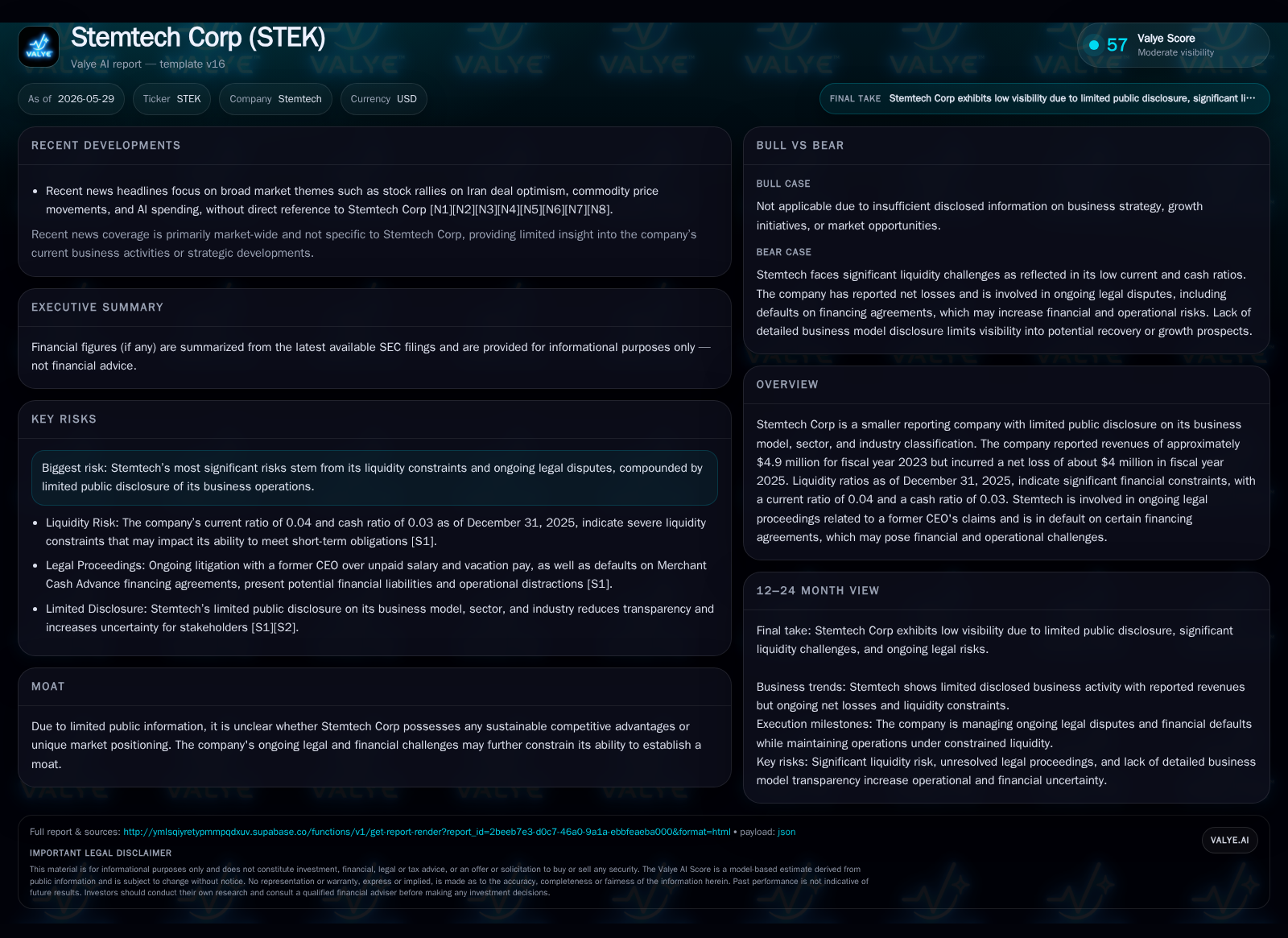
Stemtech Corp faces acute financial stress as its latest quarterly filing exposes a dangerously low current ratio and defaults on financing agreements. Despite generating nearly $4.9 million in revenue in 2023, the company continues to incur sizable net losses, underpinned by limited disclosure of its product portfolio and sector affiliation. Structural challenges common to small health-related firms, coupled with unresolved legal disputes involving former management, constrain its ability to achieve sustainable growth or build competitive advantages.
Latest Operating Developments Highlight Acute Financial Stress
Stemtech Corp’s most recent quarterly report filed November 19, 2025 [S2] dramatically illustrates the company’s acute liquidity crunch. The reported current ratio stands at an alarmingly low 0.04 as of December 31, 2025 [F1], indicating that Stemtech’s current liabilities overwhelm its short-term assets by more than twentyfold. Current assets total approximately $457,000 versus current liabilities exceeding $10.5 million [F1]. This imbalance severely limits Stemtech’s ability to meet near-term obligations without additional capital infusions or restructuring.
Further exacerbating this financial fragility is the company’s acknowledged default on certain Merchant Cash Advance (MCA) financing agreements [S1][S3]. Lenders associated with these agreements retain the right to initiate legal proceedings to recover outstanding amounts. These contingent risks amplify the operational uncertainty facing the company and suggest potential future cash demands beyond normal operations.
Collectively, these developments illustrate near-term survival challenges and underscore the restricted financial flexibility constraining Stemtech’s business activities.
Dissecting Stemtech’s Business Model: Revenue Sources and Operational Gaps
Stemtech remains opaque regarding its precise sector or product scope. Its status as a smaller reporting company exempts it from extensive disclosure obligations [S1][S2], resulting in limited publicly available information about its operational footprint. The latest annual filing for FY2025 [S1] confirms that the firm achieved revenues close to $4.9 million in calendar year 2023 [F1] yet simultaneously incurred substantial net losses—over $4 million reported for FY2025 alone [F1].
Without explicit details, one can infer that Stemtech derives revenues from product sales or services related to health and wellness niches; however, no clear product mix or customer segmentation is described. This lack of granularity inhibits direct comparison against peers or evaluation of unit economics.
Moreover, the persistent operating losses alongside minimal capital expenditures (reported as zero in recent years) indicate operational challenges possibly including inefficiencies in cost structure, marketing reach limitations, or failure to scale commercially.
Competitive Environment and Structural Challenges for Small Health-Care Related Firms
Though Stemtech's precise industry categorization is not disclosed, general observations from small health-care or wellness product providers offer relevant context. Typically such companies grapple with fragmented consumer markets lacking consolidated demand power. Price competition tends to be intense due to commoditized supplements or therapies commonly found in this segment.
Distribution often requires multi-channel engagement including direct-to-consumer platforms, retail partnerships, and network marketing approaches—each posing scalability barriers. Regulatory scrutiny over health claims can inject compliance costs and slow innovation cycles.
Without significant brand differentiation or patented formulations—which Stemtech does not explicitly claim—the company likely contends with marginal pricing power and customer switching options that are considerable.
Financially constrained smaller players are vulnerable to supply chain disruptions or abrupt cash flow issues due to working capital intensity inherent in managed inventories and promotional incentives.
Growth Drivers Appear Limited Amid Financial and Legal Constraints
In principle, growth avenues for firms like Stemtech could stem from broader adoption of health-related products amid rising consumer wellness trends globally. However, Stemtech’s stark liquidity crisis sharply reduces its capacity for channel expansion or research-driven product development.
The firm reports zero capital expenditures over recent reporting periods [F1], suggesting no reinvestment into capacity expansion or innovation pipelines. Coupled with ongoing litigation related to compensation claims from a prior CEO [S1][S3], management attention may be diverted from growth strategies toward legal defense and crisis management.
The constrained cash flow environment—evidenced by recurring negative operating cash flows—compounds difficulties in scaling operations organically or via acquisitions.
Thus, while structural market demand could exist externally, internal financial constraints block effective capture of potential growth opportunities.
Persistent Risks from Litigation and Capital Structure Shortcomings
One salient risk factor is the ongoing lawsuit initiated August 2019 by a former CEO alleging unpaid salary and vacation pay totaling approximately $267,000 [S1][S3]. Though Stemtech contests these claims with a counterclaim deeming them meritless, the litigation remains unresolved as of late-2025 [S3]. Accruals related to this matter are reflected in accounts payable [F1], adding both financial burden and uncertainty.
Additionally, default under Merchant Cash Advance agreements poses immediate risks of forced collection actions by lenders [S1][S3]. These events threaten destabilization by triggering accelerated debt repayments or liens affecting daily operations.
Stemtech’s balance sheet further reveals eroding equity levels deteriorating from approximately -$2 million at FY2023-end to nearly -$7 million by FY2025 year-end [F1], signaling accumulated losses outstripping invested capital. This negative net worth undermines borrowing capacity and investor confidence alike.
Regulatory or compliance risks tied to minimal public disclosure as a smaller reporting company also introduce opacity-related credibility concerns among stakeholders.
Key Indicators to Monitor: Cash Flow, Litigation Outcomes, and Revenue Trajectory
Close attention should focus on several near-term milestones impacting Stemtech’s trajectory:
- Litigation resolution: Outcomes of the CEO lawsuit could materially affect liabilities on the balance sheet as well as public perception.
- Revenue momentum: Clarified disclosures on sales trends post-FY2023 would help gauge commercial traction amid financial duress.
- Operational restructuring announcements: Moves toward cost rationalization or strategic pivots would reflect management response to persistent losses.
Monitoring these data points will provide signals regarding whether Stemtech can stabilize itself or continues toward deeper distress.
Compact Annual Financial Summary: Loss Trends and Balance Sheet Insights
Historical performance (annual)
Capital returns and efficiency (annual)
Over the three most recent fiscal years ending December 31 (latest data FY2025), Stemtech shows modest revenue growth (7.9% year-over-year between FY2022-23) [F1]. Yet operating income remains deeply negative throughout the period with only slight improvement (-$4.22M in FY2023 narrowing to -$2.71M by FY2025), reflecting ongoing margin pressures
Negative net income mirrors this pattern consistent with substantial operating losses despite stable revenue generation capacity around $4–5 million annually [F1]. Operating cash flows persist at negative levels culminating near half a million dollars outflow in FY2025 even before capex adjustments which were nil recently
Balance sheet deficiencies characterized by extraordinarily low current ratios (0.04) highlight severe short-term insolvency risk driven by ballooning current liabilities surpassing $10 million under relatively meager current assets just under half a million dollars [F1]. Shareholders' equity has similarly eroded into deep deficit territory (-$6.96M at FY2025), marking accumulation of losses without replenishment via fresh capital infusion evident from public disclosures.
This financial profile underscores why liquidity constraints currently dominate Stemtech’s operational landscape, limiting strategic latitude until substantial restructuring or recapitalization materializes.
Disclaimer: This analysis is based exclusively on publicly available filings through May 29, 2026 ([S1],[S2],[S3]) and SEC companyfacts data ([F1]) without speculative projections or non-disclosed information.
Disclaimer: This is research-only, informational analysis and not investment advice. It may include AI-generated interpretation and general industry context. Always verify important details using primary sources.

Comments