
Rocky Mountain Chocolate Factory Navigates Covenant Challenges Amid Franchise Expansion and Cost Pressures
The company’s latest quarterly filing reveals ongoing financial covenant breaches despite strategic capital raises and initiatives to grow its franchised retail footprint and premium product sales.
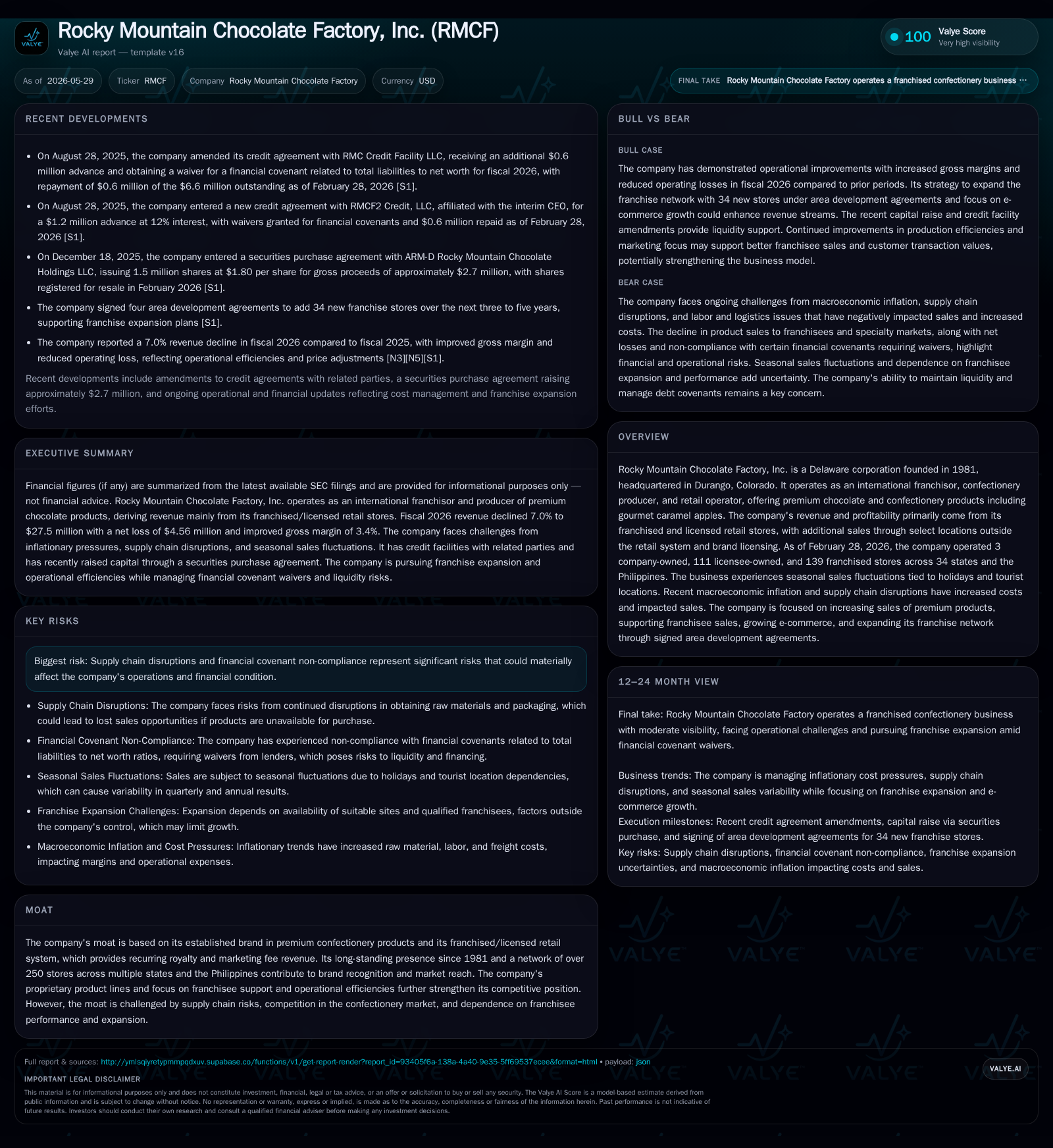
Rocky Mountain Chocolate Factory, Inc. operates a franchised/licensed retail network specializing in premium chocolates and confectionery. The company reported covenant non-compliance on its debt agreements as of November 30, 2025, but received waivers through August 31, 2026, while reducing borrowings post-quarter. It raised approximately $2.7 million via equity issuance in December 2025 to bolster liquidity. Inflationary pressures on raw materials, labor, and freight continue to weigh on margins despite adjusted gross margin improvements. Growth efforts focus on expanding and remodeling franchise stores, enhancing e-commerce and delivery channels, and driving premium product sales. Key risks include supply chain volatility, seasonal demand fluctuations, franchisee execution variability, and financial leverage constraints.
Recent Operating Update
Rocky Mountain Chocolate Factory’s latest quarterly report dated January 13, 2026 [S2] details continued non-compliance with the maximum ratio of total liabilities to total net worth covenant as of November 30, 2025. The company secured waivers for this breach covering fiscal quarters ending August and November 2025 and again through August 31, 2026 [S2][S16]. Post-quarter-end repayments reduced outstanding borrowings by $0.6 million on the $1.2 million note under the RMCF2 Credit Agreement [S2].
In December 2025, RMCF executed a securities purchase agreement issuing approximately 1.5 million shares at $1.80 per share for gross proceeds near $2.7 million [S9][S16], supporting liquidity during operating losses and cash consumption reported over recent periods [S13]. The company’s adjusted gross margin—a supplemental non-GAAP metric combining gross margin with depreciation and amortization—reflects ongoing efforts to manage inflationary pressures on raw materials alongside rising labor and freight costs [S4]. Despite these efforts, cash flow from operations remains constrained.
Business Model
Founded in 1981 and headquartered in Durango, Colorado [S1], Rocky Mountain Chocolate Factory operates as an international franchisor specializing in premium chocolate products including gourmet caramel apples manufactured at its Durango facility [S1]. The company’s revenue base primarily derives from royalty and marketing fees paid by franchisees across a network exceeding 250 stores comprising company-owned, licensee-owned, and franchised locations predominantly positioned in resort towns and tourist destinations capitalizing on seasonal consumer demand.
Franchisees benefit from brand recognition developed over four decades combined with proprietary recipes that differentiate product offerings [S1]. Direct sales outside the franchise system occur selectively along with licensing arrangements for branded consumer products.
This franchising/licensing model enables recurring royalty revenues while minimizing capital expenditure exposure inherent in directly operating retail outlets. Scalability depends heavily on franchisees’ ability to maintain brand standards and effectively engage customers.
Industry Structure and Competitive Position
Within the fragmented premium confectionery market where brand heritage and product quality are key competitive factors, RMCF occupies a niche segment. Competitors range from global chocolate brands with broad distribution to artisanal chocolatiers appealing to specialty consumers.
RMCF’s competitive advantage rests on its established brand presence since 1981 and hybrid franchising/licensing system delivering geographic reach into tourist-centric markets [S1]. However, like peers in confectionery manufacturing, it faces challenges from volatile raw material costs such as cocoa prices globally along with evolving consumer preferences toward health-conscious or ethically sourced products.
Growth Drivers
Strategic priorities emphasize increasing store count via new franchise openings plus transferring existing stores to new ownership aimed at operational improvements [S15]. Mandatory remodels for most existing stores seek to enhance customer experience thereby increasing transaction size—a strategy historically linked with post-renovation sales growth.
E-commerce platform expansion coupled with third-party delivery channel development aims to augment sales beyond physical locations aligning with broader retail digitization trends [S15]
Growth in premium product sales is critical; manufacturing centralization at Durango requires balancing capacity utilization against cost control to protect margins [S1]. The inclusion of gourmet caramel apples alongside chocolates diversifies the premium confectionery mix.
Risks / Watchpoints / Growth Constraints
Supply chain instability remains a significant risk affecting product availability and cost structure; disruptions risk inventory shortages impacting franchise operations [S21]. Inflationary pressures on raw materials inputs, labor wages, and logistics continue to compress margins despite pricing efforts.
Financial leverage constraints manifest in repeated covenant breaches related to liabilities-to-net-worth ratios under debt facilities with related parties [S2][S16]. While waivers provide temporary relief, sustained non-compliance may pressure financial flexibility.
Seasonal demand variability tied closely to holidays and tourism cycles introduces earnings unpredictability quarter-to-quarter alongside timing effects from store openings or remodel completions.
Franchisee execution variability presents operational risk; inconsistent adherence to brand standards or insufficient investment in store upgrades could dampen system-wide growth potential.
Tracking progress on new franchise openings, store remodel completions, e-commerce adoption rates, and third-party delivery uptake will provide insights into growth momentum.
Efforts toward supply chain stabilization—particularly raw material sourcing—and initiatives targeting factory efficiency gains post-capital investments will be important indicators for margin recovery prospects.
Additional shareholder support via equity financing or strategic partnerships may be necessary to extend liquidity runway supporting business plan execution.
This analysis is based exclusively on publicly available SEC filings without providing investment advice or research views regarding Rocky Mountain Chocolate Factory’s securities.
Disclaimer: This is research-only, informational analysis and not investment advice. It may include AI-generated interpretation and general industry context. Always verify important details using primary sources.

Comments