
Autodesk Grows Construction Software Revenue and Boosts AI Operations with $3.6B MaintainX Deal
Q1 2027 results highlight Autodesk’s expanding AI tools and subscription model amid challenges from competition, regulatory scrutiny, and integration risks.
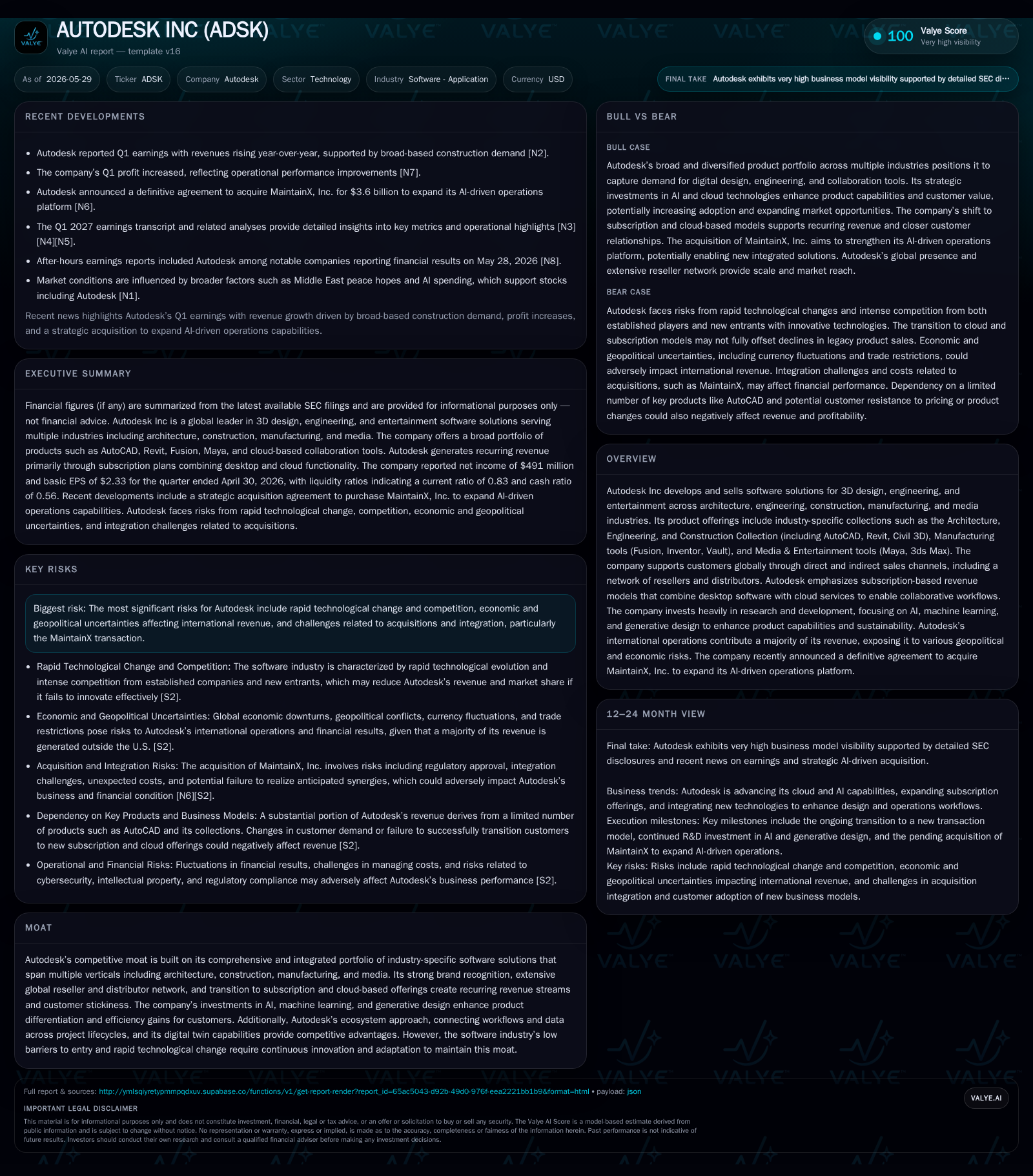
In its latest quarterly report, Autodesk reported revenue growth led by strong demand in Architecture, Engineering, and Construction (AEC) software, bolstered by a shift towards subscription and cloud services. The company announced a significant acquisition of MaintainX for $3.6 billion to enhance its AI-powered operational platform offering. Autodesk continues to deepen its integrated portfolio across construction, manufacturing, and media industries but faces risks from rapid technological change, competitive pressures, and ongoing regulatory scrutiny related to AI governance and prior accounting investigations.
Recent Operating Update
Autodesk’s first quarter of fiscal 2027 ending April 30, 2026, demonstrated solid revenue growth supported by broad-based demand in the construction sector [S2][N3]. The company’s revenue beat analyst expectations due in part to sustained strength in its Architecture, Engineering, Construction & Operations (AECO) product suite which includes flagship software like AutoCAD and Revit
A key development was the announcement of the acquisition of MaintainX for approximately $3.6 billion [S3][N2]. MaintainX is positioned as an AI-driven operations management platform targeting the industrial operations segment. This acquisition represents Autodesk's strategic push deeper into operational technology beyond design and engineering software into workflow automation powered by artificial intelligence
Autodesk’s move reflects an increasing focus on augmenting its traditional product-centric offerings with cloud-enabled collaborative platforms that enhance project delivery and operational efficiency across the industries it serves.
Business Model
Autodesk operates primarily as a subscription-based software provider offering professional design solutions for three main verticals: Architecture/Engineering/Construction (AEC), Manufacturing/product design, and Media & Entertainment (M&E). Customers pay recurring fees for access to industry-specific collections such as the Architecture, Engineering & Construction Collection (which bundles AutoCAD, Revit, Civil 3D), manufacturing tools like Fusion and Inventor, or M&E tools including Maya and 3ds Max [S1][S13][S19].
Revenue is driven by subscription contracts that are term-based allowing continuous updates and seamless cloud integration which supports collaborative workflows critical in large scale projects involving dispersed teams. Enterprise Business Agreements further facilitate volume licensing for large clients.
Apart from scaled recurring revenues through direct online sales and renewals, Autodesk leverages an extensive global network of distributors and resellers enhancing reach while managing customer support via multi-tiered models enriched with training programs [S10][S15]. The transition towards more direct transactional relationships reduces dependence on third-party channels over time but also improves data infrastructure capabilities for analytics-driven customer engagement
The recent acquisition of MaintainX will add transactional operations management capabilities supplemented by AI automation — potentially expanding Autodesk's addressable market beyond design into execution phases of projects.
Industry Structure and Competitive Position
Autodesk operates within the highly competitive application software industry focused on specialized verticals requiring integration of complex workflows. The market is fragmented with competitors ranging from established global players like Dassault Systèmes (Catia/SolidWorks), Bentley Systems (infrastructure modeling), Adobe (digital content creation), Siemens PLM (industrial software), PTC (product lifecycle management), to emerging startups innovating in AI-enabled design or construction tech [S11].
Technological evolution toward cloud computing and artificial intelligence has lowered barriers to entry while increasing the pace of disruption. Autodesk’s moat is based on its comprehensive portfolio covering multiple industry verticals with strong brand equity in AECO software—especially AutoCAD products which remain industry standards—and deep integration capabilities offered through their collections approach providing customers a one-stop ecosystem.
Investment in R&D focusing on emerging technologies like generative design frameworks powered by machine learning is critical to staying ahead given competitors’ parallel advances.
Growth Drivers
AI-Driven Innovation: Autodesk’s commitment to embedding artificial intelligence and machine learning throughout its platform drives efficiency gains for customers creating stickiness while enabling new use cases such as generative design assisting sustainable product innovation. The MaintainX deal expands this trajectory into field operations management leveraging AI.
Subscription & Cloud Transition: Recurring subscription revenues provide predictability and customer retention benefits; the cloud-first delivery model supports real-time collaboration across geographies—a growing necessity particularly for global AECO firms.
Industry Tailwinds: Increasing infrastructure spending globally along with digital transformation initiatives in manufacturing supply chains create persistent demand for advanced design-to-delivery solutions.
Ecosystem Expansion: Wrapping solutions around complete project lifecycles—from conceptual design and engineering through execution and facilities management—positions Autodesk favorably as a lifecycle solution provider with cross-product synergies.
International Growth: While majority revenue derives internationally through diversified regions including Americas, EMEA, APAC—the company continues channel expansion efforts especially in emerging markets where digital adoption accelerates [S10][S15]
Risks / Watchpoints / Growth Constraints
Autodesk faces headwinds driven by intense competition that includes larger entities with diversified resources capable of aggressive innovation or price competition. Low switching costs inherent in software markets pressure pricing power despite differentiated offerings.
Regulatory scrutiny regarding AI ethics, transparency obligations stemming from emerging laws such as the European Union’s Artificial Intelligence Act present compliance cost risks that may slow product rollout cadence or increase legal exposure [S4][S5].
The company also continues managing residual impacts from past internal investigations related to non-GAAP measure practices which have generated shareholder litigation—potentially diverting management focus and incurring legal expenditures [S6][S17].
Integration risk related to acquisitions like MaintainX includes technological harmonization challenges and realizing expected synergies against the backdrop of fast-evolving customer needs.
Macro-economic uncertainties including exposure to currency fluctuations particularly impact international revenues; regional geopolitical instabilities could disrupt customer budgets or project pipelines.
Lastly, dependency on core flagship products such as AutoCAD series means any erosion due to competitor advances or shifts in user preferences could materially affect results.
What to Watch Next
- Execution progress on integrating MaintainX technology into Autodesk’s operational workflows product suite including incremental contributions outside traditional design segments.
- Subscription renewal rates and net revenue retention metrics that serve as early signals of customer satisfaction amid product evolution in cloud/AI-enhanced environments [N4][N5].
- Updates on ongoing litigation or regulatory developments concerning prior accounting investigations or emerging AI governance frameworks influencing cost structure.
- Progress in scaling direct sales models relative to reseller channels impacting distribution dynamics.
- Performance within high-growth international markets where increased digital adoption may drive disproportionate near-term upside.
- Pipeline developments around new product launches leveraging generative design or expanded digital twin capabilities aligning with sustainability mandates.
Financial Profile Summary
As of April 30, 2026, Autodesk holds $2.67 billion in cash and equivalents against total debt of approximately $2.5 billion, resulting in a modest net cash position [F1]. The current ratio is approximately 0.83, reflecting standard operating asset-liability dynamics [F1].
Disclaimer
This analysis is based solely on publicly available information including recent SEC filings and verified news reports as of May 2026. It does not constitute investment advice or research views.
Disclaimer: This is research-only, informational analysis and not investment advice. It may include AI-generated interpretation and general industry context. Always verify important details using primary sources.

Comments