
Park Aerospace’s Growth Trajectory and Capacity Expansion Fuel Aerospace Composite Leadership
Park Aerospace’s recent quarterly update highlights a doubling backlog and ongoing capacity ramp at its Newton facility, underscoring robust demand and operational scaling in aerospace composites.
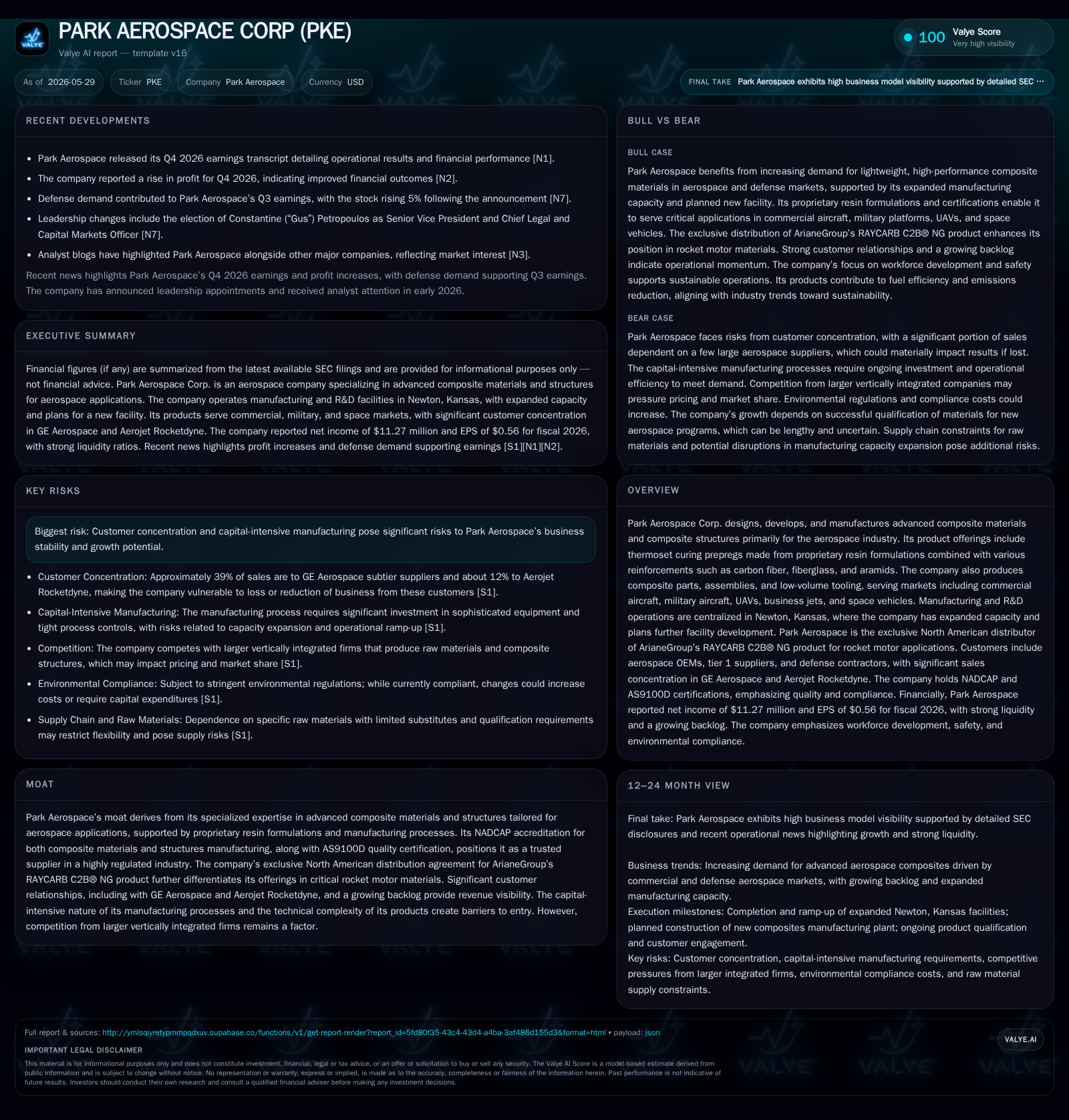
In its latest quarter ended November 30, 2025, Park Aerospace reported a material increase in firm backlog to $51.4 million from $25.8 million a year prior, driven by strong aerospace OEM and defense program demand. This growth reflects successful absorption of expanded manufacturing capacity at its Newton, Kansas campus, where the company is currently ramping production following a significant 2024 facility expansion. Park Aerospace specializes in proprietary thermoset prepregs and composite structures for aerospace applications, serving commercial, military, UAV, and space markets with notable contracts including exclusive North American distribution of ArianeGroup's rocket ablative materials. While the business benefits from high technical barriers, validated certifications, and strategic customer relationships, it faces risks from customer concentration and capital-intensive manufacturing. Looking ahead, the planned construction of a new composites plant in fiscal 2027 and sustained defense-commercial content gains represent key growth catalysts.
Latest Quarterly Update: Backlog Growth and Capacity Ramp
Park Aerospace’s fiscal third quarter ended November 30, 2025 (reported in a January 2026 filing) marked a pivotal inflection toward scale with substantial backlog expansion as a leading indicator of future revenue growth [S2]. The firm reported an unfilled purchase order backlog valued at approximately $51.4 million as of mid-May 2026, nearly doubling from $25.8 million the prior year [S10]. This is particularly notable given that roughly two-thirds of this backlog consists of composite materials products critical to aerospace manufacturers.
Management commentary in the Q4 2026 earnings transcript echoed confidence in sustained demand across both commercial aircraft OEMs and defense primes focused on rocket motor components [N1]. The Newton facility upgrade completed in fiscal 2024 effectively doubled the plant’s footprint while adding sophisticated manufacturing lines—hot-melt film and tape lines included—alongside expanded R&D labs and storage infrastructure now being fully ramped-up to satisfy this backlog surge [S1][S10]. This marks a transition from capacity build-out to effective throughput optimization.
Business Model and Product Quality: Advanced Composites for Aerospace
Park Aerospace operates at the intersection of polymer chemistry innovation and precision manufacturing with a portfolio centered on thermoset curing prepregs composed of proprietary resin formulations combined with advanced reinforcements including carbon fiber (PAN-based), fiberglass (E-glass and S2 glass), aramids such as Kevlar® and Twaron®, quartz, plus specialty chemical additives [S21]. These prepregs cater to diverse lay-up methods from hand lay-up through automated fiber placement (AFP), allowing Park to serve the full spectrum of aerospace production methodologies.
Beyond materials supply, Park converts these substrates into composite parts, assemblies, structures (including patented SigmaStrut™ and AlphaStrut™ products), and low-volume tooling primarily at its single-site Newton operation. Its end markets span jet engines, commercial/military aircraft airframes, UAVs/drones, radomes critical for sensor protection, business jets, rotary wing aircraft, and space vehicles including rocket motors [S1][S20]. The integration of both material manufacture and structural fabrication under one roof is relatively rare in the industry and facilitates tighter quality control alongside rapid iteration cycles.
Certifications amplify Park’s niche positioning: it holds NADCAP accreditation—which is an industry-standard mark—for both composite materials manufacturing/testing as well as composites fabrication itself. Additionally, Park is AS9100D certified ensuring compliance with aerospace quality management system requirements vital to maintaining FAA approvals on certified aircraft programs [S22]. These accreditations act as significant switching-cost barriers against new entrants or generalist suppliers.
Competitive Positioning Within the Aerospace Composites Industry
The aerospace composites sector features several large vertical integrators capable of producing carbon fibers/raw materials through finished aerostructures alongside numerous smaller specialized players. Park Aerospace distinguishes itself through its proprietary resin chemistries developed via deep polymer formulation capabilities coupled with a unique vertically integrated facility specializing exclusively in thermoset matrices rather than thermoplastics—a segment generally favored for cost/performance balance in many aerospace applications [S25].
A further differentiator is Park’s exclusive North American distribution agreement for ArianeGroup’s RAYCARB C2B® NG product—the leading ablative composite material used in critical rocketry systems such as heavy lift launchers and missile nozzles—extending Park's foothold firmly into space launch and defense missile segments where performance tolerances are exacting [S21][S23]. This exclusivity translates into defensible revenue streams difficult for competitors without similar partnerships or technical specialization to replicate.
Customer relationships are highly concentrated with GE Aerospace accounting for roughly 39% of worldwide sales over the last three fiscal years combined with Aerojet Rocketdyne comprising another ~12%, highlighting that losing any major customer could materially impact revenues [S19]. However, these long-standing partnerships also fortify contract stability due to embedded qualification processes facing high regulatory scrutiny.
Growth Drivers: Facility Expansion, Defense Demand, and Technological Differentiation
Park’s growth trajectory hinges largely on successfully leveraging its augmented Newton capacity while advancing plans for a second integrated composites material manufacturing facility slated for groundbreaking in fiscal year 2027 [S7][S23]. This forthcoming plant intends to address forecasted increases in both commercial aerospace production rates—driven by OEM ramp-ups—and amplified defense spending tied to strategic rocket motor programs.
Technological differentiation plays out through enhanced AFP capabilities enabled by expanded production labs which facilitate more automated tape lay-up methods preferred for complex geometries and higher repeatability versus manual lay-up approaches [S1]. Additionally, development focus remains on resin innovation tuned specifically for customer processing conditions enabling improved cure kinetics or thermal durability.
The defense segment underpins growth particularly through ablative materials for rocket motors supplied into missile programs where heat shielding demands are stringent; Park uses ArianeGroup’s RAYCARB technology therein while also producing proprietary specialty fabrics integral to nozzle components leveraged by major defense contractors allied with U.S. government spending programs [S23][S1].
Complementary content gains within commercial aerospace arise from broadening application footprints—from engine components upward to primary aircraft structures—capitalizing on ongoing shifts away from heavier metals towards lighter composite alternatives aiding fuel efficiency objectives crucial under tightening emissions regulations globally [S8][N1].
Risks and Challenges: Customer Concentration and Capital Intensity
Despite promising growth signals there remain salient risks around customer concentration where over half the Company’s sales derive from just two customers—GE Aerospace alone represents near 40%—posing significant exposure if contract loss or demand softness were to occur unexpectedly [S19]. Diversification into broader Tier 1 supplier bases is limited thus far.
Capital intensity characterizes the business model; high fixed costs tied up in specialized equipment such as hot-melt impregnation lines plus increasingly automated fiber placement machinery mean ramp timing must align tightly with secured contracts or else periods of underutilization could pressure margins or cash flow flexibility [S1][S26]. Regulatory compliance also requires rigor given hazardous material handling overseen under EPA Superfund rules though management expresses confidence that known contamination issues will not materially impair liquidity or operational continuity [S4][S26].
Further challenges could arise if raw material supply constraints emerge since some reinforcement fibers or specialty chemicals sourced have few substitutes or require extensive re-qualification impacting product delivery lead times amid potential industry-wide shortages experienced broadly elsewhere in the composites supply chain ecosystem.
Key Metrics and What to Watch Next: Milestones for Capacity Build-Out and Order Fulfillment
Leading short-term milestones center on tracking quarterly fluctuations in firm backlog which recently surged past $50 million—a crucial barometer of execution momentum—and observing how smoothly the Newton plant continues scaling throughput without bottlenecks or quality disruptions amid workforce skill development efforts detailed in recent filings [S10][N1]
The planned start of construction for the new composites facility expected during FY 2027 will be a further critical inflection point indicating management’s ability to finance modular growth while blocking out competitive entrants by increasing aggregate production capacity.
Additionally, market participants should monitor booking composition shifts between commercial aerospace versus defense-related programs as a gauge of risk diversification progress given differing project cadence profiles across those end markets.
Financial Overview: Operating Income Strength and Liquidity Position
Liquidity remains ample with cash & equivalents reported at approximately $78.5 million against comparatively minimal current liabilities producing an exceptionally healthy current ratio around 18x reflecting strong short-term solvency [F1]. Although total debt figures available date back several years (circa $72 million), estimated net debt positioning indicates negative net debt suggesting available liquidity buffers exist within appropriate capital structure boundaries given no recent contrary disclosures surfaced in filings reviewed here.
This financial resilience complements operational scalability signaling readiness to invest defensively against competitive pressures while supporting innovation programs central to retaining market-leading positions.
Disclaimer: This analysis is based solely on publicly disclosed information up to fiscal year-end March 1, 2026. It reflects an informed interpretation grounded in disclosed facts without any non-public insights or speculative projections. No investment advice or research views are intended or implied herein.
Disclaimer: This is research-only, informational analysis and not investment advice. It may include AI-generated interpretation and general industry context. Always verify important details using primary sources.

Comments